
How to Identify the 1948 Franklin Half Dollar
The 1948 Franklin half dollar is the debut issue of John Sinnock's design, featuring Benjamin Franklin's portrait and the Liberty Bell with a small eagle.
Read the full 1948 Franklin Half Dollar encyclopedia entry →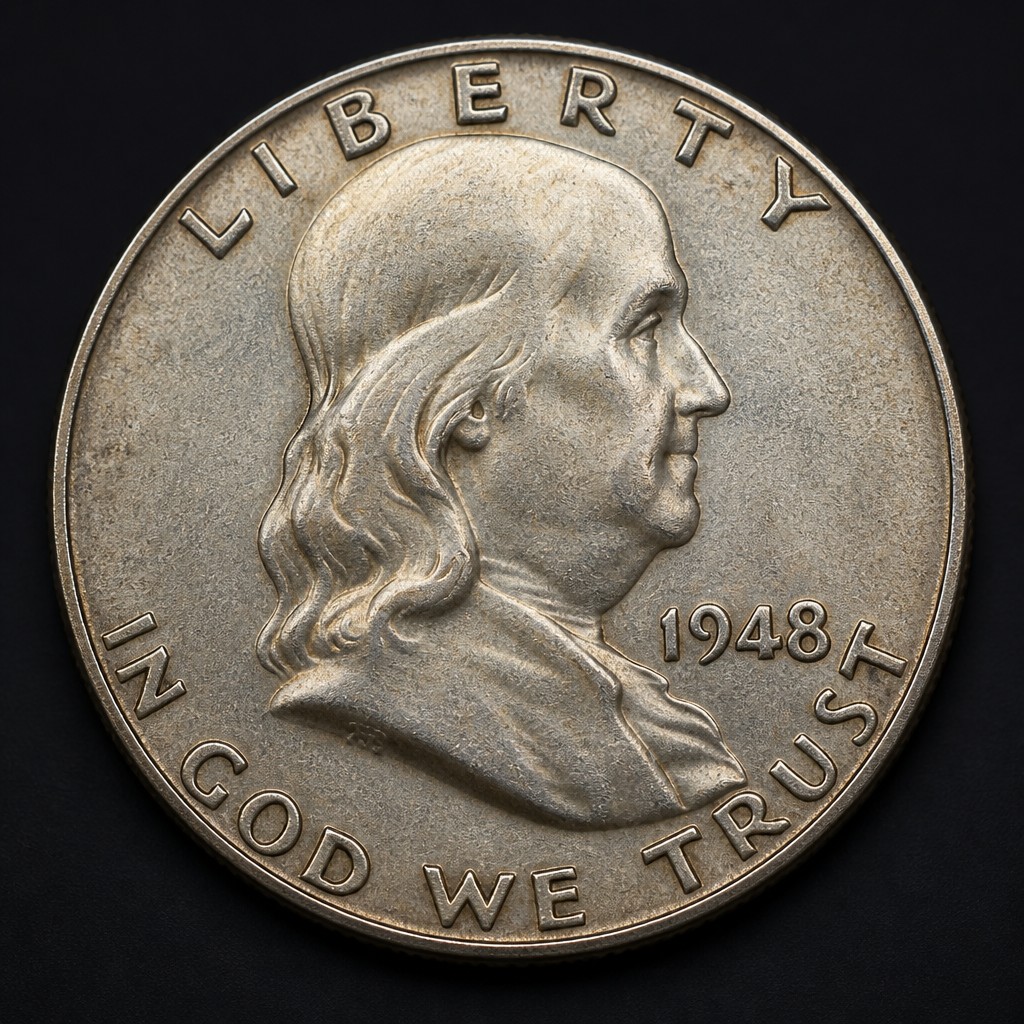
What It Is
The 1948 half dollar introduced the Franklin design by Mint engraver John R. Sinnock, replacing the Walking Liberty half dollar. It was struck at Philadelphia and Denver in the coin's first year, using the same 90% silver standard as its predecessor.
Obverse Design
A right-facing bust of Benjamin Franklin dominates the obverse. "LIBERTY" arches along the upper rim, "IN GOD WE TRUST" is lettered vertically to the left of Franklin's portrait, and the date sits below his shoulder.
Reverse Design
The Liberty Bell fills the center, complete with its famous crack, with a small eagle standing to the right, added to satisfy a legal requirement that half dollars display an eagle. "UNITED STATES OF AMERICA" arches over the top, "HALF DOLLAR" curves beneath, and "E PLURIBUS UNUM" appears in small letters near the bell.
Size, Weight, and Edge
The coin is 30.6mm in diameter, weighs 12.5 grams, contains 90% silver and 10% copper, and has a reeded edge.
Mint Marks
The mint mark appears on the reverse, above the bell's crack and to the right, roughly at the base of the bell near the small beam. No mark indicates Philadelphia; a "D" indicates Denver. There is no 1948 San Francisco issue.
Telling It Apart From Similar Coins
Because the Franklin design ran through 1963, the date and mint mark are the primary identifiers. Collectors also pay attention to "Full Bell Lines," meaning the horizontal lines at the base of the bell are complete and unbroken, which affects how a coin is graded within a date.
Judging Condition at a Glance
Check Franklin's hair curls above his ear and the bell lines for wear. Sharp, separated bell lines and crisp hair detail indicate a higher-grade coin, while worn or merged bell lines suggest more circulation. Even lightly worn Franklin halves often keep attractive luster in the fields.
Authenticity Red Flags
Watch for an altered date, a mint mark that looks added or repositioned, or bell lines that appear artificially strengthened through tooling. A coin lacking the expected silver weight, showing seams from casting, or displaying a mint mark with inconsistent font compared to genuine Denver strikes should be examined carefully before assuming it is authentic.
Frequently asked questions
What symbol appears next to the Liberty Bell on a Franklin half dollar?
A small eagle stands to the right of the bell, added to meet a legal requirement for an eagle on half dollar reverses.
Where is the mint mark on a 1948 half dollar?
On the reverse, above the bell's crack near its base; no mark means Philadelphia, and a D means Denver.
What does 'Full Bell Lines' mean?
It refers to the horizontal lines at the bottom of the Liberty Bell being complete and unbroken, a detail used when assessing higher grades.
Was a 1948 Franklin half dollar struck in San Francisco?
No, only Philadelphia (no mint mark) and Denver (D) struck half dollars in 1948.