
How to Identify the 1946-S/D Jefferson Nickel Repunched Mintmark
A postwar Jefferson Nickel showing a San Francisco S mint mark punched over a partially visible D, a repunched mint mark (RPM) variety created during hand-punching of the working die.
Read the full 1946-S/D Jefferson Nickel Repunched Mintmark encyclopedia entry →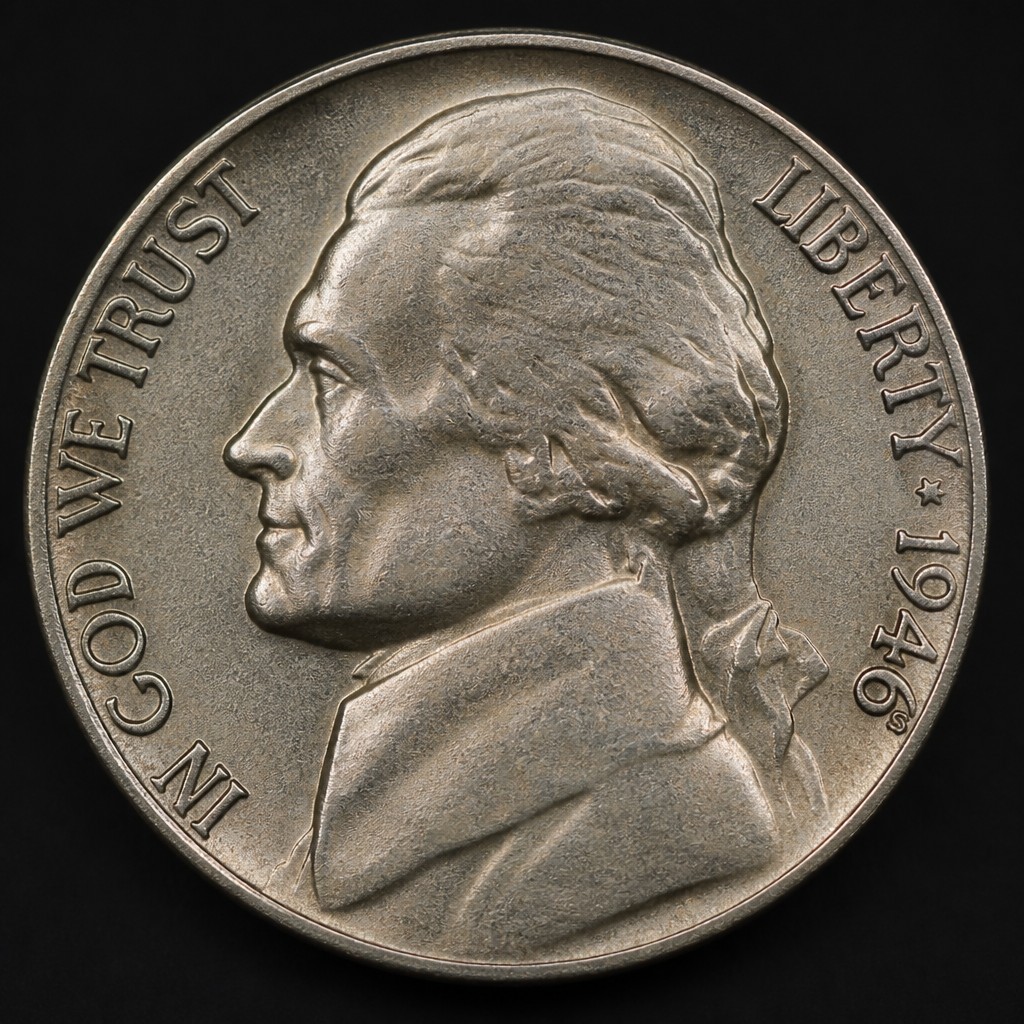
What It Is
After the wartime silver alloy nickels ended in 1945, the Jefferson Nickel returned to its standard copper-nickel composition in 1946, and mint marks continued to be applied by hand to individual dies through this period. The 1946-S/D variety shows a San Francisco "S" mint mark punched over what appears to be an earlier, misplaced "D," a classic repunched mint mark (RPM) error.
Obverse Design and Inscriptions
The obverse shows Jefferson's left-facing portrait, "LIBERTY" and a small star to the left of the bust, "IN GOD WE TRUST" along the bottom, and the date "1946" to the right. There is no doubling on the obverse for this variety.
Reverse Design and Inscriptions
The reverse depicts Monticello with "MONTICELLO" beneath it, "FIVE CENTS" below that, "UNITED STATES OF AMERICA" arcing above, and "E PLURIBUS UNUM" in small letters near the roofline. Beginning again in 1946, the mint mark returned to its standard postwar position to the right of Monticello, rather than above the dome as during the wartime years.
Size, Weight, Metal, and Edge
This nickel measures 21.2 mm in diameter and weighs 5.0 grams, made of the standard 75% copper, 25% nickel alloy, giving it a brighter, more yellowish tone than the grayer wartime silver nickels. The edge is plain.
Mint Marks and Where to Find Them
Look to the right of Monticello on the reverse for the small mint mark. On this variety, magnification should reveal a faint "D" shape underneath or beside the primary "S," indicating the die was punched more than once with different letters before being finalized for use.
Telling It Apart From Similar Coins
Compare with a standard 1946-S nickel, which shows a single, clean "S" with no secondary marks. Also distinguish a true repunched mint mark from ordinary die wear or a struck-through error, which would look like a shallow depression or blob rather than a distinguishable second letter shape. The key identifying feature is a recognizable trace of a differently shaped letter peeking from the primary mint mark.
Judging Condition at a Glance
Check Monticello's steps for sharp, unbroken horizontal lines, and inspect Jefferson's hair and cheek for wear flattening. Because the repunched mint mark is a small design element, coins with strong, well-preserved detail make the underlying "D" easier to confirm than heavily worn or low-grade examples.
Authenticity Red Flags
Be cautious of nickels where an extra letter shape near the mint mark looks freshly added, with disturbed or shiny metal that does not match the coin's overall wear and luster, since this would suggest an artificially altered mint mark rather than a genuine mint-made repunching. A legitimate RPM should show the same natural toning and wear pattern across the entire coin, including the mint mark area.
Frequently asked questions
What is a repunched mint mark (RPM)?
It occurs when a mint worker punches a mint mark into a die more than once, sometimes in a different position or even with a different letter, leaving visible remnants of the earlier punch.
Where is the mint mark on a 1946 nickel?
It is located on the reverse to the right of Monticello, which is the standard postwar mint mark position used again starting in 1946.
How do I know if the underlying letter is a genuine D and not damage?
A genuine repunched mint mark shows a recognizable letter shape consistent with the coin's natural strike and wear, while damage or tampering usually looks disturbed, shiny, or inconsistent with the surrounding surface.
Are 1946 nickels made of silver like wartime nickels?
No, the silver wartime alloy ended in 1945, and 1946 nickels returned to the standard copper-nickel composition.