
How to Identify the 1942/1 Mercury Dime Overdate
A guide to the 1942/1 Mercury Dime overdate error, explaining how a leftover 1941 die feature created the doubled date, where to look for the diagnostic, and how to avoid misidentified doubling.
Read the full 1942/1 Mercury Dime Overdate encyclopedia entry →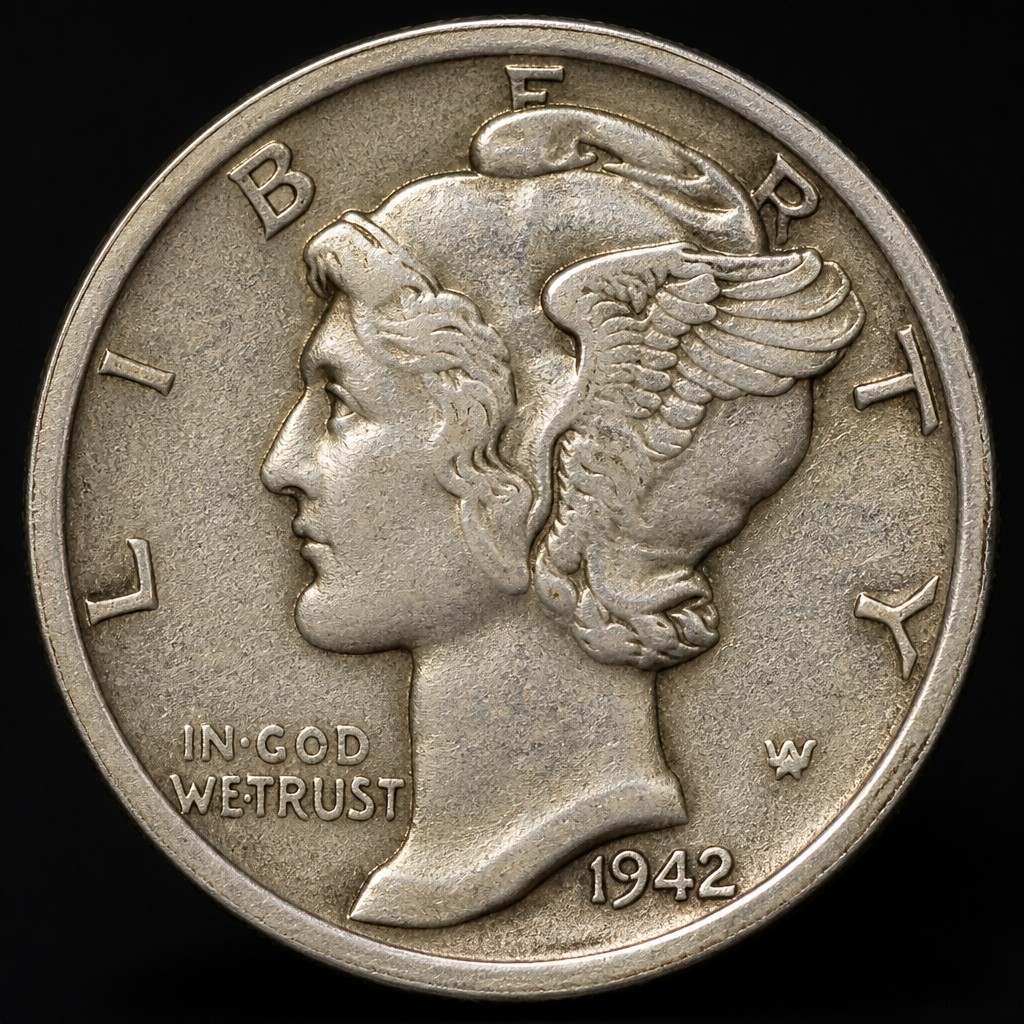
What It Is
The 1942/1 Mercury Dime overdate is a well-known die variety created at the Philadelphia Mint when a working die intended for 1942 was made using tooling that still carried traces of the 1941 date, causing the "2" to be punched over a leftover "1." The result is a date that shows evidence of both years on close inspection.
Obverse Design
Aside from the overdate feature, the coin follows the standard Mercury Dime obverse: Liberty facing left wearing a winged cap, "LIBERTY" around the upper border, and the affected date at the bottom.
Reverse Design
The reverse is unchanged from the standard design: a fasces bound with an olive branch, "UNITED STATES OF AMERICA" and "E PLURIBUS UNUM" around the border, and "ONE DIME" at the bottom.
Size, Weight, Metal, and Edge
This variety shares the standard Mercury Dime specifications: 17.9 mm diameter, 2.50 grams, 90% silver and 10% copper, with a reeded edge.
Where to Find the Overdate Diagnostic
The key diagnostic is in the last digit of the date. Under magnification, typically 5x to 10x, an extra curved or looped line belonging to the underlying "1" can be seen within or extending from the "2," most noticeably near the lower portion of the digit. This is not simply a blurry or doubled-looking date from wear; it is a distinct extra design element from a different digit entirely.
Mint Mark
This overdate variety was produced at the Philadelphia Mint, so it carries no mint mark. A separate, much rarer version of this overdate exists with a "D" mint mark from Denver.
Telling It Apart from Similar Coins and Common Misidentifications
Not every doubled-looking date on a 1942 dime is a genuine overdate. Ordinary die deterioration, minor die chips, or mechanical doubling from a shifted die can create a fuzzy or doubled appearance without representing an actual overdate. A genuine 1942/1 overdate shows a clear, separate outline of the "1" digit in a specific, consistent location recognized by specialists, rather than a generalized blur across the whole date. Comparing a suspect coin to reference images of the confirmed diagnostic, or having it examined by an expert, is the most reliable way to confirm authenticity of the variety.
Judging Condition and Authenticity Notes
Even heavily worn examples of this overdate remain collectible as long as the diagnostic doubling in the date is still visible, so condition is judged somewhat differently than for a normal dime. Because the variety carries a meaningful premium over an ordinary 1942 dime, and because false claims of overdate doubling are common among worn or low-quality photographs, third-party certification is advisable for anyone relying on this identification for value purposes.
Frequently asked questions
What causes the 1942/1 overdate on Mercury Dimes?
A working die for 1942 was created using tooling that still carried remnants of the 1941 date, so the '2' was punched directly over a leftover '1,' leaving visible traces of both digits.
Where should I look to confirm the overdate?
Examine the last digit of the date under 5x to 10x magnification for an extra curved or looped line from the underlying '1,' most visible near the lower part of the '2.'
How do I avoid mistaking normal die doubling for a genuine overdate?
Ordinary die deterioration or mechanical doubling produces a generalized blur across the date, while a genuine overdate shows a distinct, separate outline of the earlier digit in a specific, well-documented location.
Does the 1942/1 overdate have a mint mark?
The Philadelphia version has no mint mark; a separate, rarer overdate variety exists with a 'D' mint mark from the Denver Mint.