
How to Identify the 1942/1-D Mercury Dime Overdate
A guide to the rare 1942/1-D Mercury Dime overdate, covering the same date-doubling diagnostic as the Philadelphia version but confirmed by a Denver mint mark, plus authenticity considerations.
Read the full 1942/1-D Mercury Dime Overdate encyclopedia entry →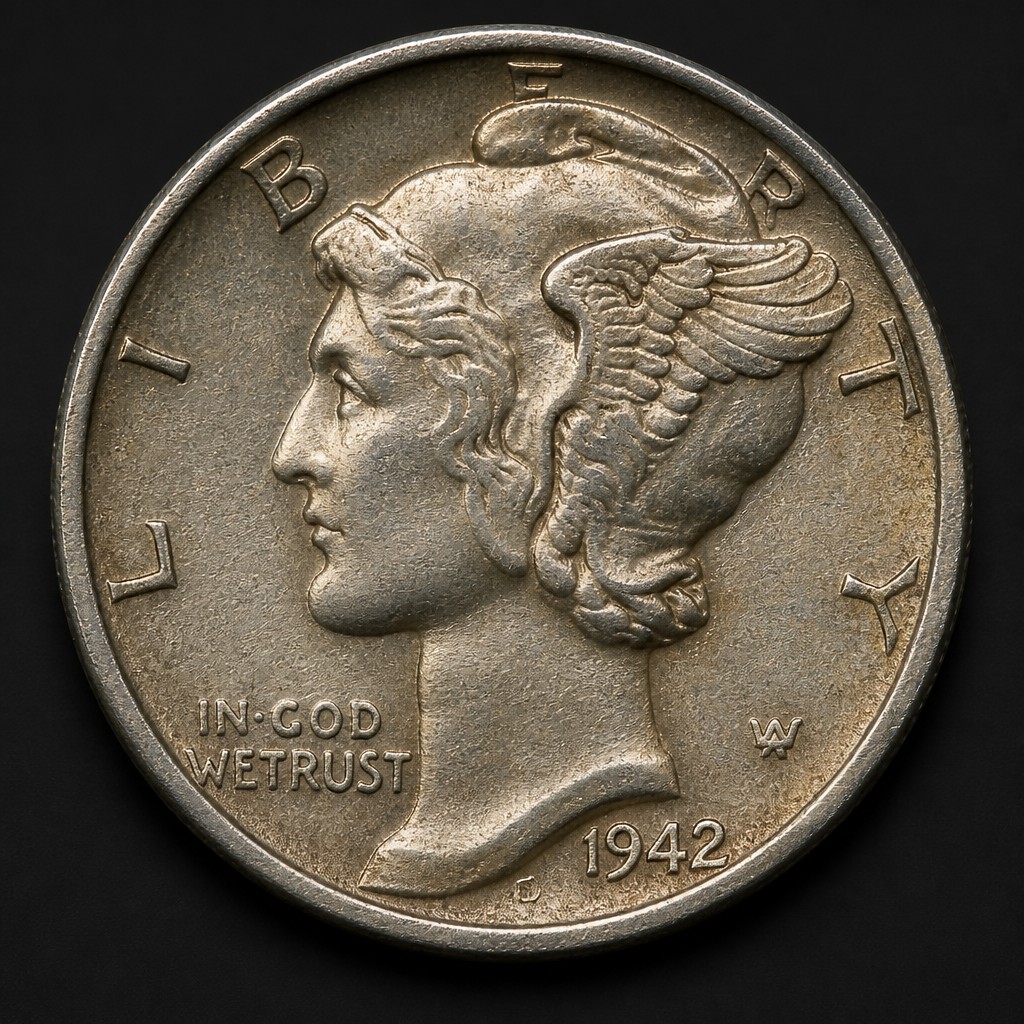
What It Is
The 1942/1-D Mercury Dime overdate is a rarer counterpart to the better-known Philadelphia 1942/1 overdate, sharing the same underlying cause: a working die created for 1942 retained traces of a 1941 date, leaving visible evidence of both years. This version was struck at the Denver Mint, identified by its mint mark.
Obverse Design
Apart from the overdate feature, the obverse follows the standard Mercury Dime design: Liberty facing left in a winged cap, "LIBERTY" around the upper border, and the affected date below.
Reverse Design
The reverse is unchanged: a fasces with an olive branch at its side, "UNITED STATES OF AMERICA" and "E PLURIBUS UNUM" around the border, and "ONE DIME" at the bottom.
Size, Weight, Metal, and Edge
This coin follows standard Mercury Dime specifications: 17.9 mm diameter, 2.50 grams, 90% silver and 10% copper, with a reeded edge.
Mint Mark and the Overdate Diagnostic
The "D" mint mark appears on the reverse near the base of the fasces, confirming Denver origin. The overdate itself is found in the last digit of the date on the obverse: under 5x to 10x magnification, a distinct extra line or loop belonging to the underlying "1" is visible within or near the "2," typically toward the lower portion of the digit, matching the same general diagnostic seen on the Philadelphia version but on a Denver-marked coin.
Telling It Apart from Similar Coins
Because this variety is significantly scarcer and more valuable than the Philadelphia 1942/1 overdate, both the overdate feature and the mint mark need to be verified independently. A coin could show a convincing overdate but have an added or altered "D" mint mark, or could have a genuine Denver mint mark on a dime with only ordinary date doubling from die wear rather than a true overdate. Each element should be checked on its own merits, ideally against verified reference images or through professional examination.
Judging Condition at a Glance
As with the Philadelphia version, this variety remains collectible across a wide range of wear as long as the overdate diagnostic and mint mark are both clearly identifiable. General wear on the obverse shows first on Liberty's hair above the ear, and on the reverse in the crossbands of the fasces.
Authenticity Notes
Given its rarity and value, this is one of the more frequently misrepresented Mercury Dime varieties, whether through misidentifying ordinary doubling as a genuine overdate, or through an added mint mark on a coin with a real Philadelphia overdate. Because both features must be genuine simultaneously, and because the financial stakes are higher than for the Philadelphia version, third-party certification from a recognized grading service is strongly recommended before treating any example as authentic.
Frequently asked questions
How does the 1942/1-D differ from the 1942/1 (no mint mark) overdate?
Both share the same date-doubling diagnostic from a leftover 1941 die feature, but the 1942/1-D was struck at the Denver Mint and carries a 'D' mint mark, making it considerably rarer and more valuable.
Where do I check for the overdate diagnostic?
Examine the last digit of the date under 5x to 10x magnification for an extra line or loop from the underlying '1' near the lower part of the '2,' the same diagnostic location used for the Philadelphia version.
Why does this variety need extra scrutiny compared to the Philadelphia overdate?
Because both the overdate feature and the mint mark must be genuine, and because the coin's higher value makes it a more attractive target for adding a fake mint mark to an ordinary 1942/1 overdate or claiming false doubling on a real Denver dime.
Should this coin be certified before it's considered genuine?
Yes, third-party certification is strongly advised given the rarity of this variety and the number of ways a coin could be misrepresented as this specific overdate.