
How to Identify the 1939-D Jefferson Nickel
How to recognize this semi-key early Jefferson Nickel from the Denver Mint, including its reverse die varieties and mint mark location.
Read the full 1939-D Jefferson Nickel encyclopedia entry →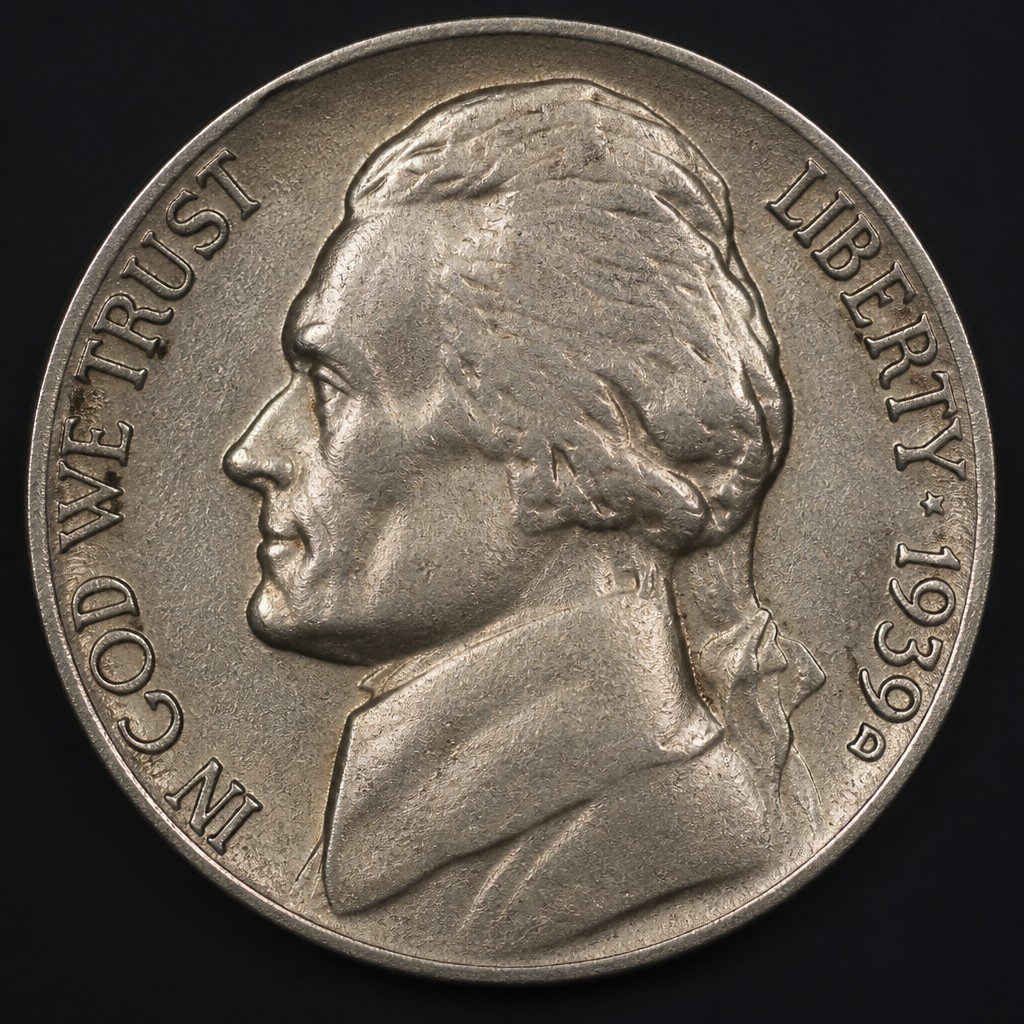
What It Is
The 1939-D Jefferson Nickel is an early date in the series and one of its scarcer issues, produced in relatively small numbers compared to other pre-war Jefferson Nickels. It carries the same basic design introduced when the series replaced the Buffalo Nickel in 1938, and it is a coin collectors specifically watch for because of its comparative scarcity next to other nickels from the same short span of years. Along with the 1939-S, it is generally regarded as one of the two toughest regular-issue dates from the first few years of the Jefferson series.
Obverse Design
Thomas Jefferson faces left in profile, a portrait based on a bust by the sculptor Jean-Antoine Houdon. LIBERTY is lettered along the left rim, IN GOD WE TRUST along the right rim, and the date appears at the lower right of the portrait, near the shoulder.
Reverse Design
Monticello is shown centered on the reverse, with MONTICELLO and FIVE CENTS below it, E PLURIBUS UNUM just above the roofline, and UNITED STATES OF AMERICA arcing around the top border.
Size, Weight, Metal, Edge
The coin measures 21.2mm across, weighs 5.00 grams, and is struck in 75% copper and 25% nickel with a plain edge.
Mint Marks
The "D" mint mark for Denver appears on the reverse to the right of Monticello, near the base of the building. A coin from this date with no mint mark was struck in Philadelphia, and one with an "S" came from San Francisco, so all three mints produced 1939 nickels in varying quantities.
Reverse Die Varieties
1939 nickels are notable for a mid-series change to the reverse hub, sometimes called the "Reverse of 1938" (used briefly into 1939, with lower, less distinct steps below Monticello) and the "Reverse of 1940" (used for the remainder of production, with taller, more clearly defined steps). Both styles can be found on 1939-D coins, and collectors sometimes seek out examples of each as a matched pair to illustrate the transition.
Grading at a Glance
Look for wear on Jefferson's cheek and hairline first, since these areas are the highest points on the obverse. On the reverse, examine the sharpness of the steps beneath Monticello; well-struck, fully separated steps indicate a stronger strike and are more desirable than mushy or blended step lines that make the base of the building look like a smooth ramp.
Authenticity Red Flags
Watch for an added or altered "D" mint mark on a common Philadelphia coin, since the mint mark is a small, isolated detail that can be tampered with relatively easily. Compare the size, font, and exact placement of the mint mark to known genuine examples, and be alert to coins that have been cleaned to hide wear, which usually shows up as unnatural brightness, a flat appearance, or fine parallel scratches visible under magnification.
Frequently asked questions
Where is the mint mark on a 1939-D nickel?
On the reverse, just to the right of Monticello near the building's base.
What makes the 1939-D scarcer than other 1939 nickels?
It had a comparatively small mintage for the era, making it a sought-after semi-key date in the Jefferson series.
What is the difference between the Reverse of 1938 and Reverse of 1940 on this date?
The Reverse of 1938 has lower, less distinct steps on Monticello, while the Reverse of 1940 shows taller, more clearly separated steps.
What metal composition does the 1939-D use?
The standard 75% copper, 25% nickel alloy used throughout the series except during 1942-1945.