
How to Identify the 1937 Doubled Die Obverse Buffalo Nickel
A Philadelphia-minted Buffalo Nickel showing noticeable doubling on the obverse lettering and date, created when the coin's die was impressed twice slightly out of alignment.
Read the full 1937 Doubled Die Obverse Buffalo Nickel encyclopedia entry →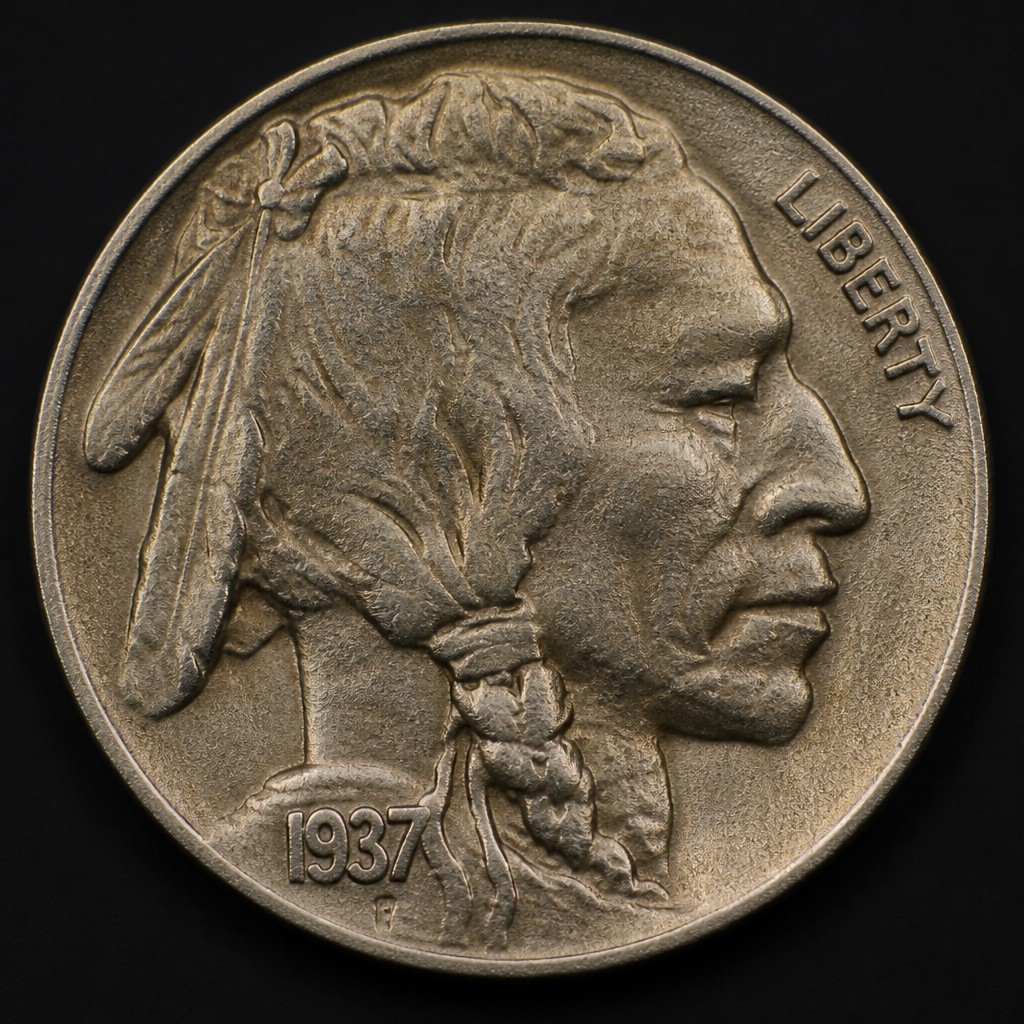
What It Is
The Buffalo Nickel (also called the Indian Head Nickel) was minted from 1913 to 1938. The 1937 doubled die obverse (DDO) is a die variety, not a separate date issue: during die preparation, the working die received two slightly misaligned impressions from the hub, leaving extra, shifted outlines on parts of the design. It was struck at the Philadelphia Mint and carries no mint mark.
Obverse Design and Inscriptions
The obverse shows a right-facing Native American portrait, with "LIBERTY" positioned to the right of the neck and the date below the truncation of the bust. On the doubled die example, look closely with magnification at the lettering of "LIBERTY" and the numerals in the date for a doubled or "shadowed" outline, as if the letters were stamped slightly twice. The doubling is a raised, secondary image rather than a scratch or smear.
Reverse Design and Inscriptions
The reverse features an American bison standing on a mound, with "UNITED STATES OF AMERICA" arcing above and "FIVE CENTS" below. "E PLURIBUS UNUM" is inscribed on the ground line beneath the bison. The reverse is normal on this variety; the doubling is confined to the obverse.
Size, Weight, Metal, and Edge
Like all Buffalo Nickels, this coin is 21.2 mm in diameter, weighs 5.0 grams, and is struck in a copper-nickel alloy (75% copper, 25% nickel). The edge is plain (smooth), as is typical for five-cent pieces.
Mint Marks and Where to Find Them
Buffalo Nickel mint marks, when present, appear on the reverse beneath "FIVE CENTS." A 1937 coin with no mint mark was struck in Philadelphia; a small "D" indicates Denver and a small "S" indicates San Francisco. The famous 1937-D "three-legged" variety is a separate, unrelated variety found on Denver coins and should not be confused with this doubled die.
Telling It Apart From Similar Coins
Because die deterioration and machine doubling can mimic a true doubled die, examine the suspected doubling under 5x-10x magnification. A genuine hub doubled die shows a distinct, rounded secondary line of consistent width running parallel to the primary design element, while mechanical or strike doubling tends to look flat, shelf-like, and shallow. Compare against a normal 1937 nickel to confirm the anomaly is not simply wear or a smudge.
Judging Condition at a Glance
On a well-struck example, the bison's fur detail and horn should be sharp, and Liberty's cheekbone and hair strands should show minimal flatness. Heavy wear first appears on the high points: the Indian's cheek and hair braid on the obverse, and the bison's shoulder and hip on the reverse. A coin with a fully readable date and crisp rim beading generally grades in the higher circulated ranges.
Authenticity Red Flags
Be cautious of nickels where the "doubling" looks like paint, glue residue, or a scratch rather than a raised design element — these are not genuine doubled dies. Also watch for added or re-engraved mint marks, since altering a common-date coin to resemble a rarer variety is a known form of tampering. When in doubt, compare the suspect coin's doubling pattern to published photographs of the known variety and consider a professional opinion for higher-value claims.
Frequently asked questions
How can I tell if my 1937 nickel has a doubled die?
Look under magnification at the word LIBERTY and the date for a raised, parallel secondary outline rather than a flat smear. True doubling has rounded, distinct edges.
Does the 1937 doubled die nickel have a mint mark?
No. This variety is known on Philadelphia-struck coins, which carry no mint mark on the reverse.
Is this the same as the 1937-D three-legged buffalo?
No, those are two separate and unrelated varieties. The three-legged variety involves a missing front leg on the bison and is found only on Denver coins.
What causes doubling on a coin's design?
It typically results from a misaligned hubbing process during die manufacture, leaving two overlapping impressions of the design on the die itself.