
How to Identify the 1937-D Three-Legged Buffalo Nickel
A guide to spotting the famous 1937-D Three-Legged Buffalo Nickel error variety, covering how the missing leg happened, where to look on the reverse, and how to avoid altered fakes.
Read the full 1937-D Three-Legged Buffalo Nickel encyclopedia entry →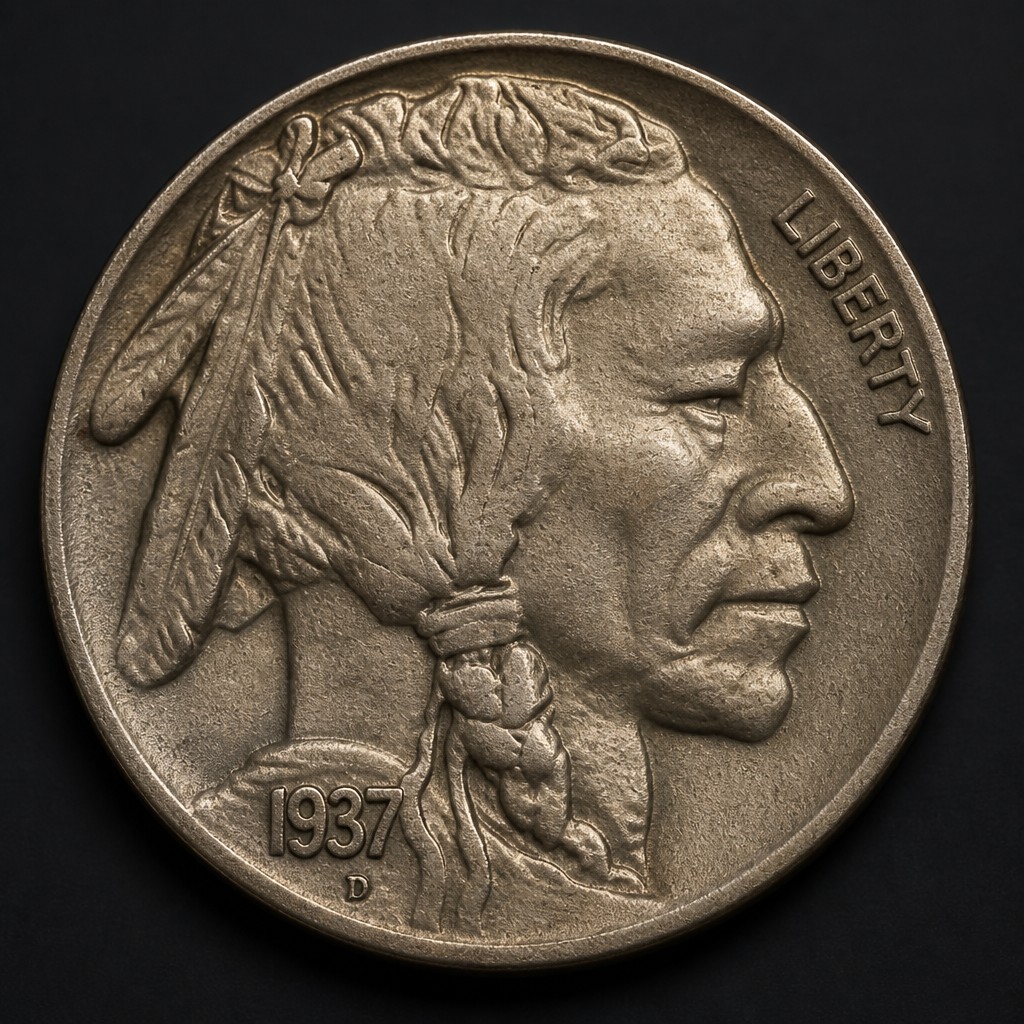
What It Is
The 1937-D Three-Legged Buffalo Nickel is a famous die variety within the regular Buffalo Nickel series (1913-1938), designed by James Earle Fraser. It resulted from excessive polishing of a reverse die at the Denver Mint, which unintentionally removed most of the bison's front right leg, leaving the animal appearing to stand on only three legs.
Obverse Design
Like all Buffalo Nickels, the obverse shows a composite portrait of a Native American man in profile facing right, based on several models used by the sculptor. "LIBERTY" appears to the right of the portrait, and the date sits below.
Reverse Design and the Missing Leg
The standard reverse shows an American bison standing on a raised mound of earth, with "UNITED STATES OF AMERICA" above, "FIVE CENTS" below, and "E PLURIBUS UNUM" along the lower border. On the Three-Legged variety, the bison's front right leg has been polished away almost entirely, leaving only a faint stub or, in stronger examples, no visible leg at all between the front shoulder and the ground line.
Size, Weight, Metal, and Edge
This coin follows the standard Buffalo Nickel specifications: 21.2 mm in diameter, 5.00 grams, struck in 75% copper and 25% nickel, with a plain edge.
Mint Marks
The mint mark "D" for Denver appears on the reverse, to the left of "FIVE CENTS," beneath the bison. This mint mark confirms the coin originated from the Denver Mint, which is essential since the Three-Legged variety is unique to 1937-D.
Telling It Apart from Similar Coins and Common Fakes
Because genuine examples carry a substantial premium, this is one of the most heavily counterfeited varieties among Buffalo Nickels, typically created by filing or tooling down the leg on an ordinary 1937-D nickel. Genuine examples show specific, well-documented characteristics beyond the missing leg, including a particular texture where the leg was polished away and consistent wear patterns matching a die that was reworked rather than damaged after striking. A coin where the leg area shows file marks, an unnaturally smooth or dished-out surface, or inconsistent metal texture compared to the rest of the coin should be treated as a likely alteration rather than the genuine die variety.
Judging Condition at a Glance
Wear on Buffalo Nickels shows first on the Native American's cheekbone and hairline on the obverse, and on the bison's hip and shoulder on the reverse. Because the Three-Legged variety already has a weak area at the leg, focus grading assessment on these other high points rather than the leg area itself.
Authenticity Notes
Given how frequently this variety is faked through simple tooling, third-party grading service certification is strongly recommended before treating any example as genuine. A legitimate 1937-D Three-Legged Nickel should show no tool marks, filing lines, or unnatural surface texture in the leg area, and its overall die characteristics should be consistent with known genuine examples.
Frequently asked questions
Why does the 1937-D Buffalo Nickel appear to have only three legs?
A reverse die at the Denver Mint was polished too aggressively, likely to remove a clash mark or defect, and this accidentally removed most of the bison's front leg from the design.
How can I tell a genuine Three-Legged Nickel from a filed fake?
Genuine examples show no tool marks or filing lines in the leg area and have surface texture consistent with the rest of the coin; a coin with visible file marks or an artificially smoothed or dished-out leg area is likely an altered fake.
Where is the mint mark on this coin?
The 'D' mint mark is on the reverse, to the left of 'FIVE CENTS,' beneath the bison, confirming Denver Mint origin.
Should I get this coin certified?
Yes, because of how commonly this variety is faked through tooling, having the coin authenticated by a professional grading service is strongly recommended before assuming it is genuine.