
How to Identify the 1935 George V Silver Jubilee Dollar (Voyageur)
Canada's first-ever circulating silver dollar, struck in 1935 to mark George V's Silver Jubilee, featuring the iconic Voyageur canoe reverse design.
Read the full 1935 George V Silver Jubilee Dollar (Voyageur) encyclopedia entry →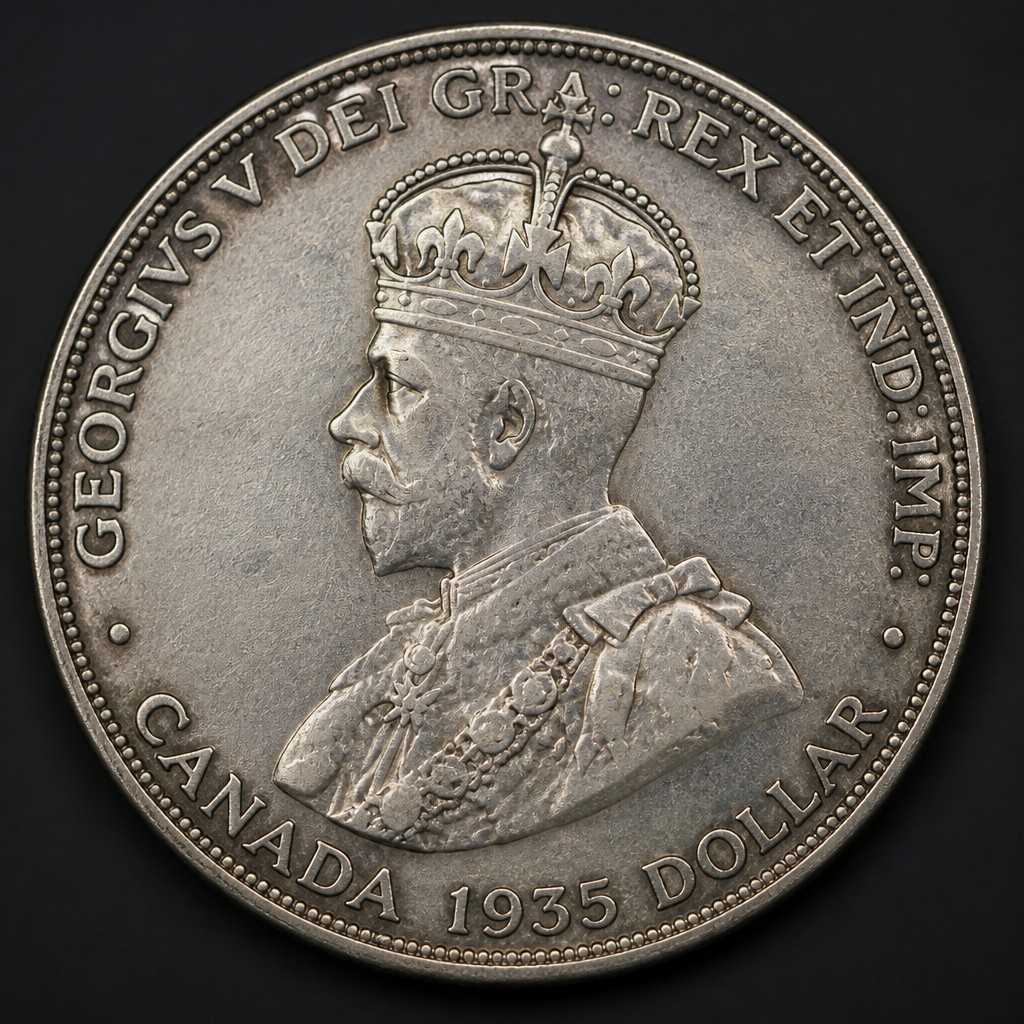
What Is This Coin?
This coin marks the introduction of Canada's silver dollar denomination, released in 1935 to commemorate 25 years since George V's accession to the throne. It introduced the Voyageur design that would define Canadian silver dollars for decades to come. Prior to 1935, Canada had never issued a circulating dollar coin, so this piece represents a genuine milestone in the country's coinage history rather than simply another commemorative alongside an existing denomination.
Obverse Design
The obverse features a mature portrait of King George V facing left, with the legend "GEORGIVS V DEI GRA REX ET IND IMP" encircling the bust — a more formal, aged rendering compared to his earlier half-dollar portraits.
Reverse Design
The reverse, designed by Emanuel Hahn, shows a Voyageur and an Indigenous guide paddling a canoe past a rocky shoreline, with the sun rising in the background. "CANADA" and the date "1935" appear around the scene. Notably, the coin does not display a numeral denomination — its size and weight identify it as a dollar rather than any printed value.
Size, Weight & Metal
It is struck in .800 fine silver, weighing approximately 23.33 grams with a diameter of 36 mm and a reeded edge, making it noticeably larger and heavier than any other circulating Canadian coin of the time.
Mint Marks & Where to Find Them
No mint mark appears; the coin was produced at the Royal Canadian Mint in Ottawa. Its identification relies entirely on the design and inscriptions rather than any mint-specific marking, since Canada did not operate multiple mints striking circulating coinage domestically at this time.
Telling It Apart From Similar Coins
The 1935 issue is easily confused with the 1936 Voyageur dollar that followed it, since the design is nearly identical. The date is the primary way to tell them apart. It should not be confused with later commemorative dollars (such as the 1939 Royal Visit or 1949 Newfoundland issues), which use entirely different reverse scenes. Because this was the very first year of the denomination, some collectors specifically seek out 1935-dated examples as a "type" coin representing the start of the series.
Judging Condition at a Glance
Wear shows first on the paddler's shoulders and the gunwale of the canoe, along with the high points of George V's hair on the obverse. A coin with sharp definition in the water ripples and full detail in the figures' clothing indicates a higher-grade example, while heavily worn coins show a flattened, indistinct canoe scene. Original mint luster in the open fields around the canoe and the king's portrait is another useful indicator, since it tends to fade quickly once a coin enters circulation.
Authenticity Red Flags
Given its status as a popular, historically significant first issue, watch for coins with soft or mushy design elements (a sign of casting), incorrect diameter or weight, or a poorly defined reeded edge. Genuine pieces have crisp, well-struck lettering and finely detailed water lines beneath the canoe. A precise scale check against the expected 23.33-gram weight is a quick, reliable first screen before examining finer design details.
Frequently asked questions
Why was the 1935 dollar issued?
It was struck to commemorate the Silver Jubilee of King George V, marking 25 years since he became king, and it was Canada's first circulating silver dollar.
Why doesn't the coin show a dollar amount?
The design relies on its distinctive large size and weight to indicate its denomination, rather than printing a numeral value on either side.
How do I tell a 1935 dollar apart from a 1936 dollar?
The designs are nearly identical, so the date struck on the reverse is the most reliable way to distinguish the two years.
What metal is the 1935 silver dollar made of?
It is struck in .800 fine silver, giving it a substantial weight and bright white-silver appearance when well preserved.