
How to Identify the 1934 Peace Dollar
A silver dollar from the Art Deco-styled Peace dollar series, identified by Liberty's radiant crown on the obverse and a resting eagle facing a rising sun on the reverse.
Read the full 1934 Peace Dollar encyclopedia entry →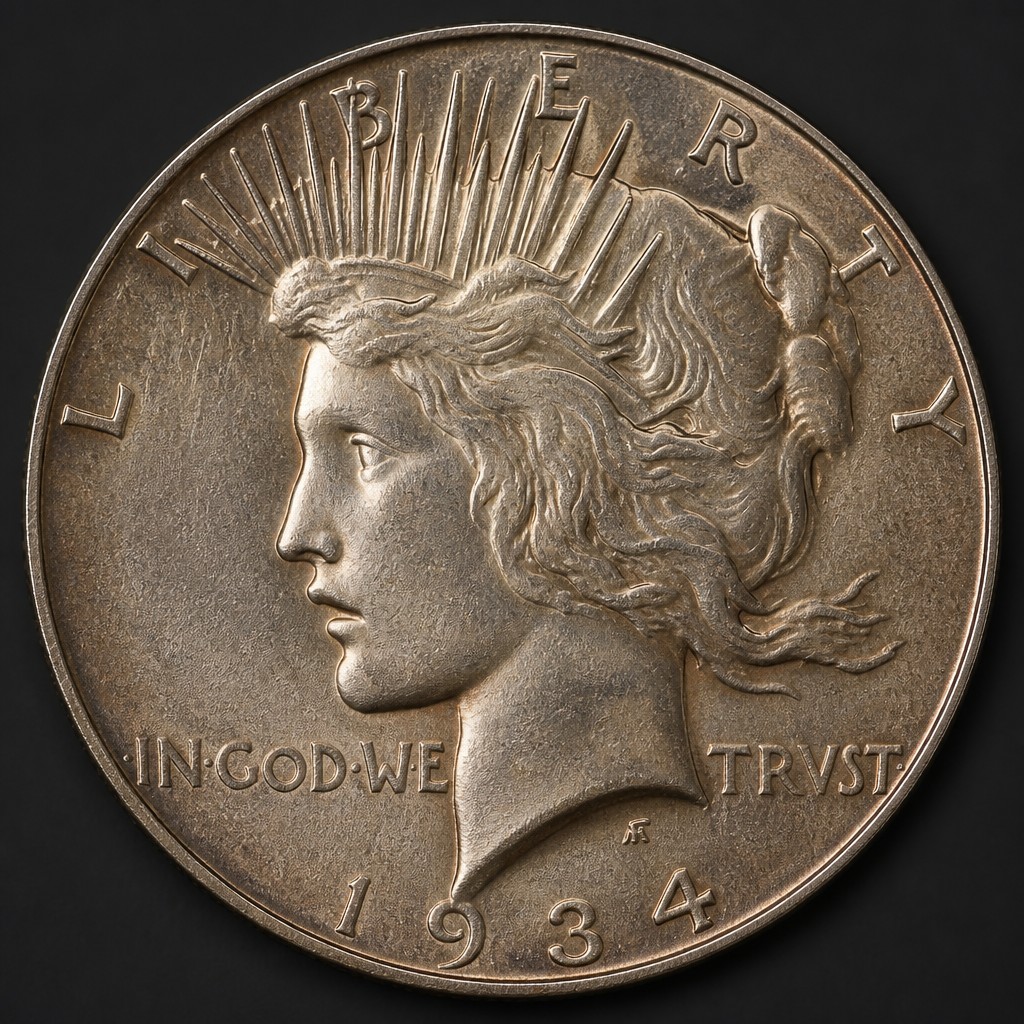
What It Is
The Peace dollar was minted from 1921 through 1935 (with a gap from 1929–1933) to commemorate the peace following World War I. The 1934 date was struck at three mints — Philadelphia, Denver, and San Francisco — with the San Francisco issue produced in noticeably smaller numbers than the other two.
Obverse Design
The obverse features a left-facing portrait of Liberty wearing a crown of rays, designed by sculptor Anthony de Francisci with a softer, more modern look than earlier Liberty designs. "LIBERTY" arches above her head, "IN GOD WE TRUST" sits to the left near her neck, and the date appears at the bottom.
Reverse Design & Inscriptions
The reverse shows a bald eagle at rest on a mountain peak, holding an olive branch, gazing toward a rising sun with rays spreading behind it. "PEACE" appears below the eagle, "UNITED STATES OF AMERICA" arches above, "E PLURIBUS UNUM" is lettered in smaller type across the middle, and "ONE DOLLAR" sits near the bottom rim.
Size, Weight, Metal, and Edge
The coin weighs 26.73 grams, is struck in .900 fine silver, measures 38.1 mm in diameter, and has a reeded edge — the same specifications used for the Morgan dollar before it.
Mint Marks and Where to Find Them
Look on the reverse near the bottom, just above "ONE DOLLAR" and below the mountain peak, close to the eagle's tail feathers. A "D" indicates Denver, an "S" indicates San Francisco, and no mint mark means the coin was struck in Philadelphia.
Telling It Apart From Similar Coins
The Peace dollar is easy to distinguish from the Morgan dollar that preceded it: Liberty's portrait has a more youthful, streamlined Art Deco look with a crown of rays rather than a wheat-and-cotton cap, and the reverse shows a resting eagle against a rising sun rather than an eagle with wings spread inside a wreath.
Judging Condition at a Glance
Check the hair above Liberty's ear and her cheek for the first signs of flattening, and examine the eagle's leg and wing on the reverse, along with the peak beneath its feet — these high points wear down before the surrounding fields.
Authenticity Red Flags
Watch for added or re-engraved mint marks near the base of the reverse, especially attempts to turn a common Philadelphia or Denver coin into the lower-mintage San Francisco issue. A genuine mint mark should match the size, font, and placement seen on verified coins from that mint and year, without file marks, doubling, or an unnatural surface texture around the letter.
Frequently asked questions
Where is the mint mark on a 1934 Peace dollar?
On the reverse, near the base above 'ONE DOLLAR' and close to the eagle's tail feathers; no mark means Philadelphia.
How do I tell a Peace dollar from a Morgan dollar?
The Peace dollar's Liberty wears a crown of rays with a more streamlined look, and its reverse shows a resting eagle facing a rising sun, rather than the wreath-and-raised-wings eagle on a Morgan dollar.
Which 1934 Peace dollar mint issue is scarcest?
The 1934-S from San Francisco had a notably smaller mintage than the Philadelphia or Denver issues that year.
What are the first spots to show wear on this coin?
Liberty's cheek and the hair above her ear on the obverse, and the eagle's wing and leg on the reverse.