
How to Identify the 1933 Double Eagle
An overview of the extremely rare 1933 Double Eagle $20 gold piece, its Saint-Gaudens design, and why almost every specimen in private hands is a fantasy strike or replica.
Read the full 1933 Double Eagle encyclopedia entry →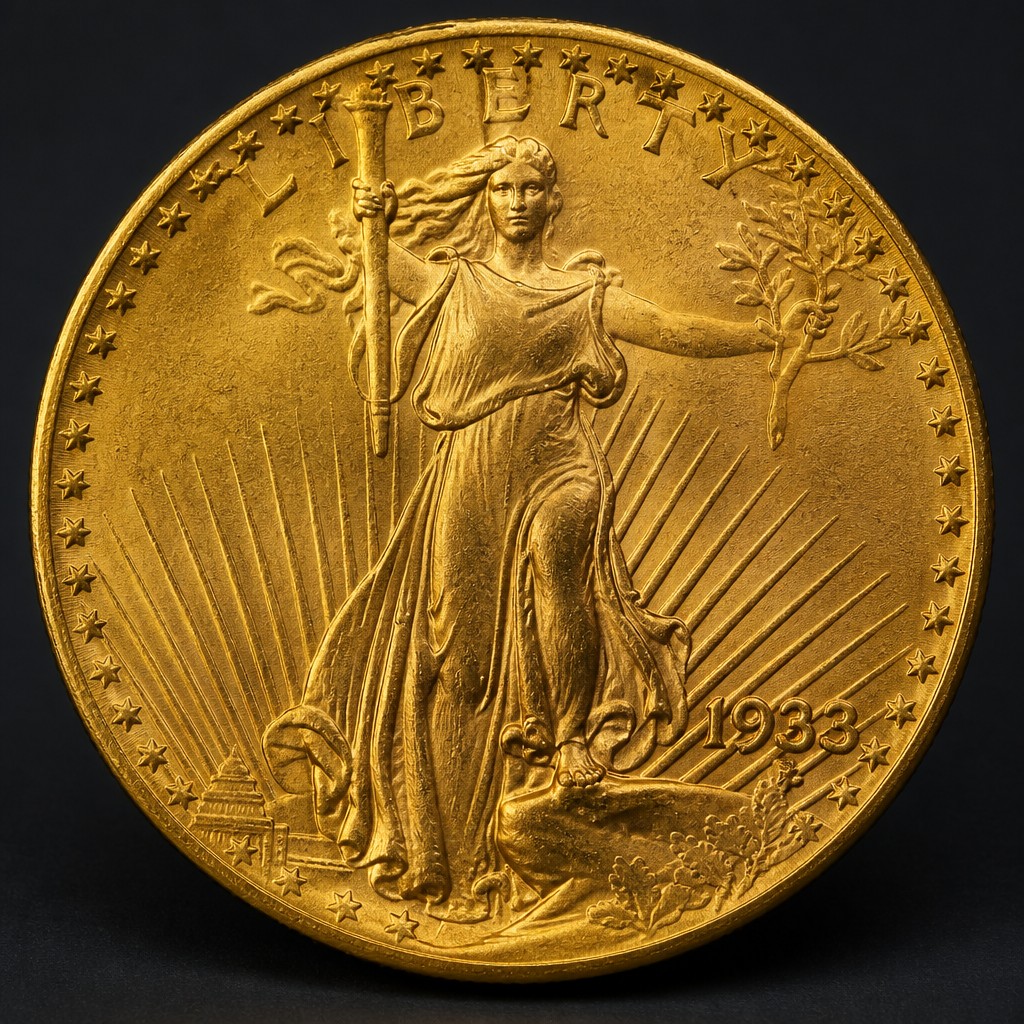
What It Is
The 1933 Double Eagle is a $20 gold coin struck at the Philadelphia Mint using the Saint-Gaudens design, but it was never officially released for circulation because the United States left the gold standard that year. Nearly all specimens were ordered melted, making genuine surviving examples extraordinarily rare and legally restricted; only one has ever been sold on the open market with clear title. A handful of others escaped the melting pot decades ago and were later recovered by federal authorities, reinforcing how tightly controlled this date remains compared to any other U.S. gold coin.
Obverse (Front)
The obverse shows a full-length, forward-striding figure of Liberty holding a torch in her right hand and an olive branch in her left, with the Capitol building and rays of sunlight in the background. The date "1933" appears at the base, and "LIBERTY" arcs above.
Reverse (Back)
The reverse depicts a bald eagle in flight over a rising sun, with "UNITED STATES OF AMERICA," "TWENTY DOLLARS," and "IN GOD WE TRUST" (added mid-1908) arranged around the design.
Size, Weight, Metal, and Edge
Like all Saint-Gaudens Double Eagles, it measures 34 mm in diameter, weighs 33.436 grams, and is struck in 90% gold and 10% copper. The edge carries a lettered motto, "E PLURIBUS UNUM," with stars between the words.
Mint Marks
Genuine 1933-dated Double Eagles were struck only at Philadelphia and therefore carry no mint mark.
Telling It Apart From Similar Coins
This date shares its design with other Saint-Gaudens Double Eagles (1907-1932), so the date alone is the key identifying feature. Because genuine 1933 pieces are essentially unobtainable, any coin offered as one should be treated with extreme skepticism; most "1933" coins encountered are altered-date common-year Double Eagles or modern replica/fantasy pieces, not the real thing.
Grading at a Glance
On any Saint-Gaudens Double Eagle, check the roundness of Liberty's gown folds and the sharpness of the sun's rays on the reverse; heavy circulation wear flattens the high points of Liberty's leg and breast and dulls the eagle's feather tips.
Authenticity Red Flags
Because of its fame, the 1933 date is a frequent target for date alterations, where a common year such as 1928 is modified to read "1933." Look for tooling marks, an unnatural texture, or a mismatched font around the last digit of the date. A coin's legal status should also raise questions: the U.S. government has treated unauthorized 1933 Double Eagles as government property, and only one example has been legally monetized. Modern struck or cast replicas, often sold openly as novelty items, may also carry the date and should be checked for correct weight, diameter, and edge lettering before assuming any deeper significance.
Frequently asked questions
Is it legal to own a 1933 Double Eagle?
The U.S. government has historically claimed ownership of unauthorized 1933 Double Eagles as unreleased Mint property; only a single example has clear legal title, so any other specimen should be treated with caution.
How is the 1933 Double Eagle different from other Saint-Gaudens Double Eagles?
The design is identical to other years; only the date sets it apart, which is also why the date is a common target for alteration on more common-year coins.
Does a genuine 1933 Double Eagle have a mint mark?
No, all 1933 Double Eagles were struck at the Philadelphia Mint, which did not use a mint mark at the time.
What should make me suspicious of a coin sold as a 1933 Double Eagle?
Given how rare genuine examples are, an altered date, unusual surface texture around the numerals, or an unclear ownership history are all significant warning signs.