
How to Identify the 1922 No D Lincoln Cent
A guide to the 1922 No D Lincoln cent, a Denver-only issue where some dies produced coins with no visible mint mark, and how to tell genuine examples from altered coins.
Read the full 1922 No D Lincoln Cent encyclopedia entry →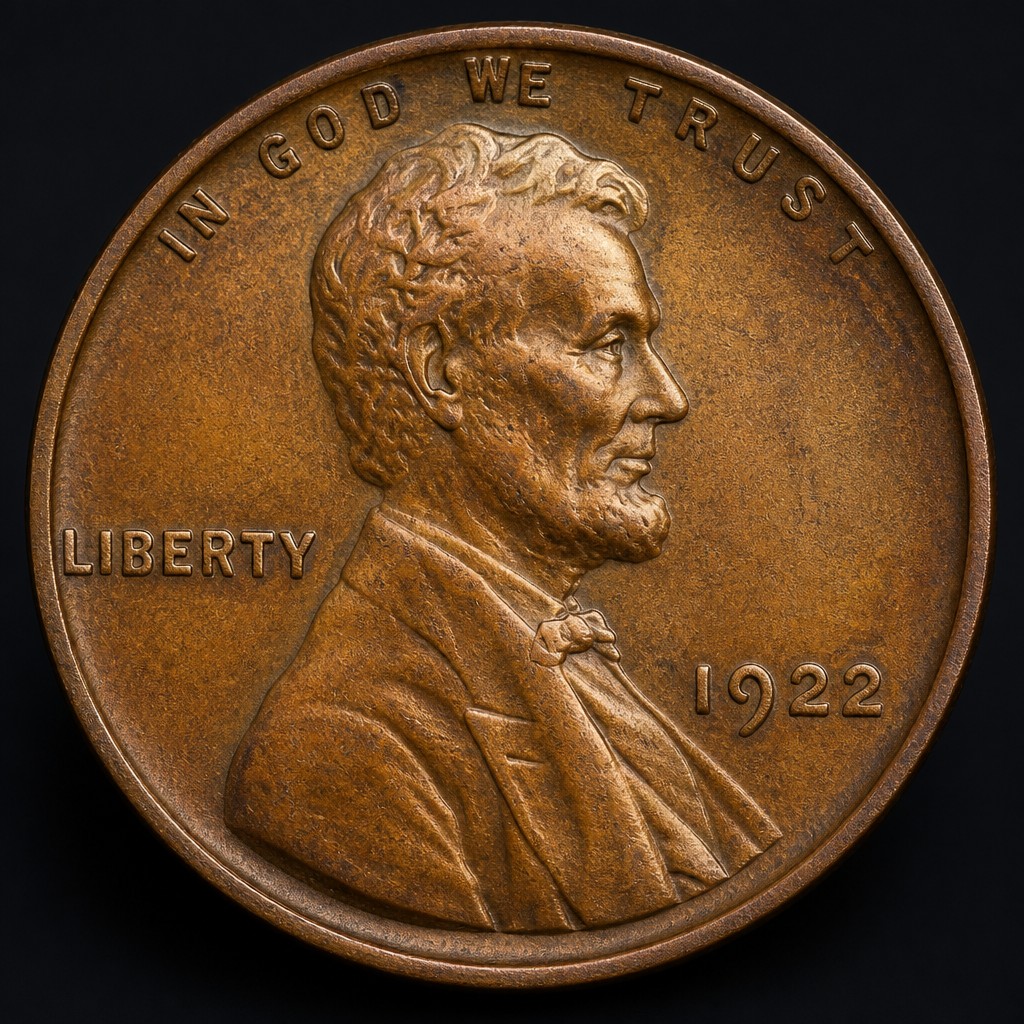
What It Is
In 1922, Denver was the only mint that struck Lincoln cents; none were made in Philadelphia or San Francisco that year because of a shortage of new dies early in the year. Because several working dies became worn down or clogged with grease in the mint-mark area, a number of 1922 cents were struck without a visible "D," creating the famous "1922 No D" variety, which is a die variety rather than an intentional mint issue.
Obverse Design
Standard Wheat cent obverse: Lincoln facing right, "IN GOD WE TRUST" above his head, "LIBERTY" to the left, and the date "1922" to the right.
Reverse Design
Standard Wheat cent reverse with two curved wheat stalks framing "ONE CENT," "UNITED STATES OF AMERICA," and "E PLURIBUS UNUM" in small letters above center.
Size, Weight, and Metal
Struck in 95% copper bronze alloy, with the remainder tin and zinc, weighing 3.11 grams, measuring 19 mm across, with a plain edge.
Mint Marks
Because every 1922 cent came from Denver, the mint-mark area below the date is the key feature to examine. A "Strong D" shows a clear, well-formed mint mark; a "Weak D" shows a faint, partially filled-in mark; and the true "No D" variety shows no trace of a mint mark at all, tied to a specific recognized die pairing that specialists identify by particular characteristics of the reverse die.
Telling It Apart From Similar Coins
A 1922 cent with no visible mint mark could be either a genuine No D variety or a coin that has had its mint mark removed or filed off after striking. Examine the mint-mark area under magnification for tool marks, unnatural smoothness, or disturbed metal flow, and compare the reverse die characteristics — particularly the strength and shape of "ONE CENT" and the wheat stalks — to reference images of the recognized No D die pairing before drawing conclusions.
Judging Condition
Look at Lincoln's cheek and hairline and the sharpness of the wheat stalks to judge overall wear, keeping in mind that the weak strikes common to 1922 Denver cents in general can make a coin look softer in detail than its actual wear would otherwise suggest.
Authenticity Red Flags
Because a genuine No D variety carries real value, watch for mint-mark areas that appear artificially smoothed, polished, or refinished in an attempt to hide a removed "D." Any sign of surface disturbance, an unusually shiny or slightly pitted patch exactly where a mint mark should be, or die characteristics that don't match the documented genuine No D pairing are all warning signs worth investigating further.
Frequently asked questions
Why don't all 1922 cents have a mint mark?
Worn or clogged dies at the Denver Mint sometimes failed to strike a visible 'D.'
Were any 1922 cents made in Philadelphia?
No, Denver was the only mint striking cents that year.
How can I tell if a mint mark was removed?
Look under magnification for tool marks, unnatural smoothness, or a shiny patch exactly where the 'D' should be.
What separates 'Weak D' from true 'No D'?
A Weak D shows a faint partial mark, while the true No D variety shows no trace of a mint mark and matches a specific reverse die.