
How to Identify the 1921 Walking Liberty Half Dollar
The 1921 Walking Liberty half dollar is a widely recognized key date thanks to unusually low mintages at all three producing mints that year.
Read the full 1921 Walking Liberty Half Dollar encyclopedia entry →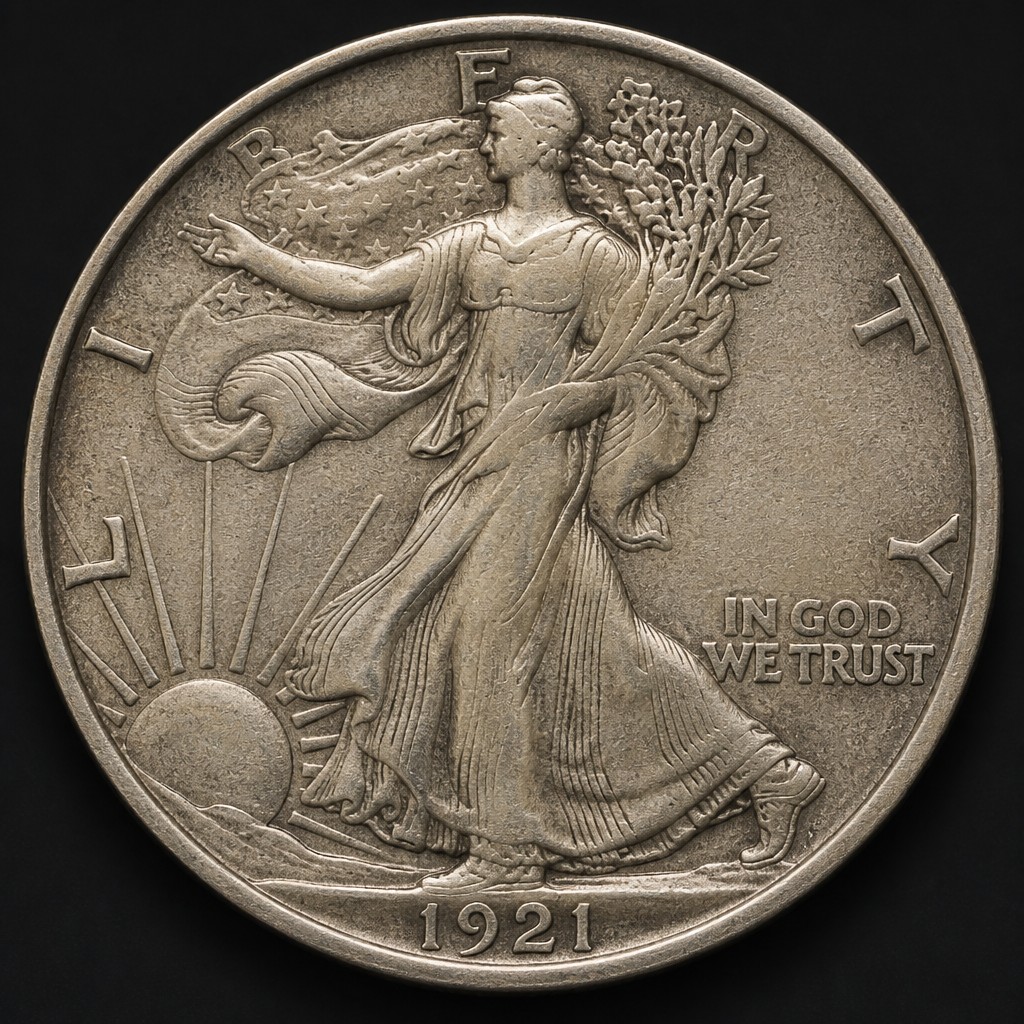
What It Is
The 1921 Walking Liberty half dollar belongs to the series designed by Adolph A. Weinman and struck from 1916 to 1947. The 1921 issues from Philadelphia, Denver, and San Francisco all had low production runs, making this one of the most sought-after dates in the series.
Obverse Design
Liberty walks toward a rising sun draped in the American flag, olive branch in her left arm and right hand outstretched. "LIBERTY" arches over the top, "IN GOD WE TRUST" appears to the right of her legs, and the date sits along the bottom rim.
Reverse Design
A perched eagle with wings raised stands on a rocky ledge next to a small pine sapling. "UNITED STATES OF AMERICA" curves along the top, "HALF DOLLAR" along the bottom, and "E PLURIBUS UNUM" runs vertically beside the eagle's wing.
Size, Weight, and Edge
The coin measures 30.6mm across, weighs 12.5 grams, is composed of 90% silver and 10% copper, and has a reeded edge.
Mint Marks
By 1921 the mint mark had moved permanently to the reverse, appearing to the left of "HALF DOLLAR," just above the branch tip. Philadelphia coins show no mint mark, Denver coins show a small "D," and San Francisco coins show a small "S." All three 1921 mint mark combinations are scarce compared to surrounding years.
Telling It Apart From Similar Coins
Because the 1921 date is a genuine key date, confirm the digits are crisp and unaltered, particularly the last "1," which is sometimes tooled from a "4" or other digit on doctored coins. Compare the mint mark's size, font, and placement to authentic references, since added mint marks are a known problem on this date.
Judging Condition at a Glance
Check Liberty's left leg and the bodice folds along her torso, along with the eagle's breast and leg feathers on the reverse; these high points flatten first with wear. A coin with strong central details and bold rims usually sits in a higher circulated grade.
Authenticity Red Flags
Given the premium 1921 dates command, watch for re-punched or added mint marks, unnatural surface texture from casting, incorrect edge reeding count, or a diameter and weight that fall outside the normal silver half dollar specifications. A magnet test can help rule out base-metal fakes, since genuine silver coins are not magnetic.
Frequently asked questions
Why is the 1921 half dollar valuable?
All three 1921 mint mark varieties (Philadelphia, Denver, San Francisco) had low mintages, making them scarce compared to other Walking Liberty dates.
Where do I find the mint mark on a 1921 half dollar?
On the reverse, just to the left of HALF DOLLAR and above the branch tip.
How do I know if the mint mark was added later?
Look under magnification for solder marks, tool lines, or a mint mark whose font or size doesn't match genuine period examples.
What should I check first when identifying a 1921 half dollar?
Confirm the date is unaltered, then verify the mint mark location and style match known genuine 1921 coins.