
How to Identify the 1921 Peace Dollar (High Relief)
The 1921 Peace Dollar debuted the series in unusually high relief, with a radiate Liberty head obverse and a resting eagle reverse, before relief was lowered in 1922.
Read the full 1921 Peace Dollar (High Relief) encyclopedia entry →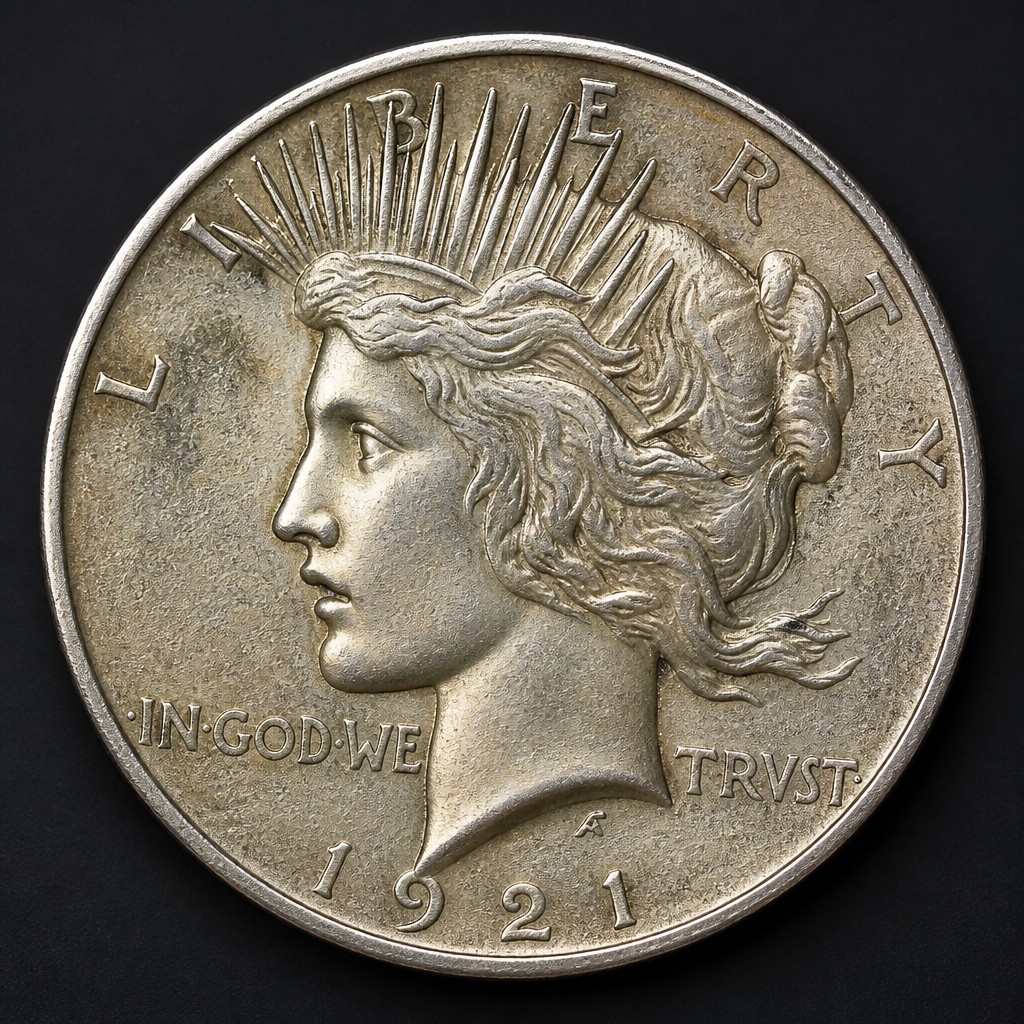
What It Is
The 1921 Peace Dollar was the first year of the Peace dollar series, created to commemorate the peace following World War I. Designed by Anthony de Francisci, it was struck in an unusually high relief that made the coin difficult to produce in large quantities, leading the Mint to lower the relief starting in 1922.
Obverse Design
Liberty's head faces left, wearing a radiate crown or tiara suggesting rays of light. "LIBERTY" arcs above, "IN GOD WE TRUST" sits in the left field, and the date is below.
Reverse Design
An eagle rests on a rocky outcrop, clutching an olive branch, with sunrise rays radiating behind it. "UNITED STATES OF AMERICA" and "E PLURIBUS UNUM" arc around, "ONE DOLLAR" appears at the bottom, and the word "PEACE" is inscribed below the eagle.
Size, Weight & Metal
Struck in 90% silver, 10% copper, the coin weighs 26.73 grams, measures 38.1 mm across, and has a reeded edge, matching the specifications of the Morgan dollar it replaced.
Mint Marks
The 1921 Peace dollar was struck only at the Philadelphia Mint and carries no mint mark; mint-marked Peace dollars did not appear until 1922 and later.
Telling It Apart from Similar Coins
The high relief of the 1921 issue gives the design a noticeably rounder, more three-dimensional appearance compared to the flatter, lower-relief Peace dollars struck from 1922 onward — this is the single best way to spot a 1921 at a glance, alongside the date itself. Compared to the Morgan dollar struck in the same year, the Peace dollar's bare-headed Liberty with a radiate tiara and its resting-eagle reverse are completely different from the Morgan's capped portrait and wreathed eagle.
Grading at a Glance
Because the high relief made full striking difficult, look for weakness at the center of Liberty's hair and on the eagle's breast even on otherwise well-preserved coins — this can reflect striking limitations rather than actual wear. Genuine wear shows first on Liberty's hair above her ear and cheek, and on the eagle's leg and wing.
Authenticity Red Flags
Because the 1921 high relief is more valuable than later, common-date Peace dollars, some unscrupulous sellers may misrepresent a lower-relief later date as 1921, or alter a date digit. Compare the coin's profile against known high-relief examples — the rounder, more sculpted look is difficult to fake convincingly — and check that the date reads clearly as 1921 without signs of re-engraving or tooling around the numerals.
Frequently asked questions
What makes the 1921 Peace Dollar different from later Peace dollars?
It was struck in high relief, giving it a rounder, more three-dimensional look compared to the flatter design used from 1922 onward.
Does the 1921 Peace Dollar have a mint mark?
No, it was struck only at the Philadelphia Mint; mint-marked Peace dollars began in 1922.
Why does the center of the design sometimes look weak?
The high relief made full striking difficult, so softness in Liberty's hair or the eagle's breast can reflect striking limits rather than wear.
How do I tell it apart from a 1921 Morgan Dollar?
The Peace dollar shows a bare-headed Liberty with a radiate tiara and a resting eagle, while the Morgan shows Liberty in a cap with a wreathed, spread-wing eagle.