
How to Identify the 1921 Morgan Dollar
The 1921 Morgan Dollar was struck in the series' final year after a 17-year gap, with unusually high mintage and a slightly softer strike than earlier Morgans.
Read the full 1921 Morgan Dollar encyclopedia entry →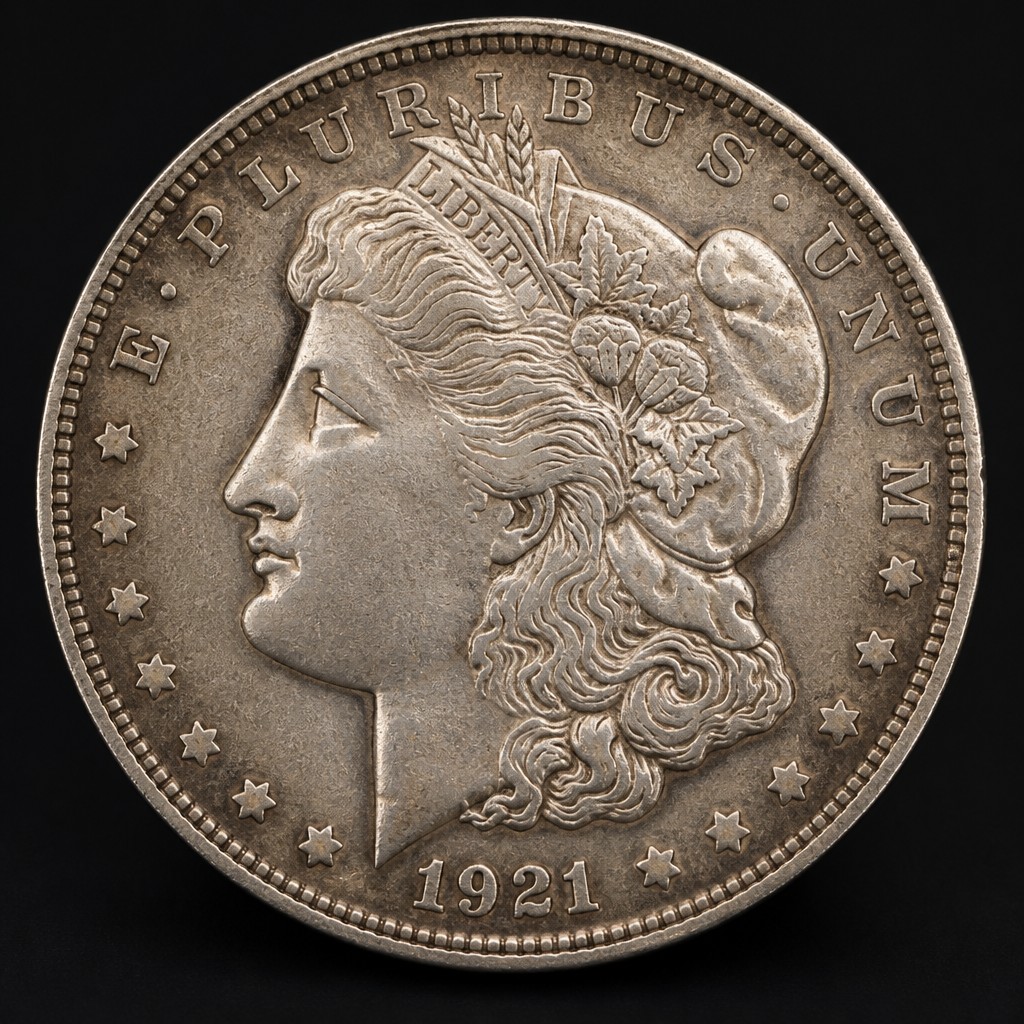
What It Is
The 1921 Morgan Dollar marks the last year of the original Morgan dollar series, which had run from 1878 to 1904 before pausing. Silver dollar production resumed in 1921 to meet requirements of the Pittman Act, which mandated replacing millions of silver dollars that had been melted years earlier. Later in 1921, the Mint switched to the new Peace dollar design, making 1921 the only year both types were struck.
Obverse Design
Liberty faces left wearing a cap, with wheat and cotton forming a wreath behind her head. "E PLURIBUS UNUM" arcs above, stars surround the portrait, and the date is below, designed by George T. Morgan.
Reverse Design
An eagle with wings spread holds an olive branch and arrows, encircled by a wreath. "UNITED STATES OF AMERICA" arcs above, "ONE DOLLAR" below, and "IN GOD WE TRUST" appears just above the eagle's head.
Size, Weight & Metal
Struck in 90% silver, 10% copper, the coin weighs 26.73 grams, measures 38.1 mm across, and has a reeded edge.
Mint Marks
The mint mark sits on the reverse, below the wreath bow near the bottom rim. 1921 Morgans were struck at Philadelphia (no mark), Denver ("D"), and San Francisco ("S") — notably the only year Denver ever struck a Morgan dollar.
Telling It Apart from Similar Coins
Because 1921 is the only year both a Morgan and a Peace dollar were minted, check the obverse portrait: the Morgan shows Liberty in profile wearing a cap with a wreath behind her, while the Peace dollar shows a bare-headed Liberty with a radiate tiara and a completely different reverse design featuring an eagle at rest. Compared to Morgans from 1878-1904, 1921 strikes often appear slightly softer or less sharply detailed due to worn dies pressed back into service after the long gap.
Grading at a Glance
Wear appears first on Liberty's hair above her ear and on the eagle's breast feathers. Because 1921 had an exceptionally high mintage across all three mints, well-preserved uncirculated examples are relatively common compared to many earlier Morgan dates, though sharply struck coins with full hair and feather detail still stand out.
Authenticity Red Flags
As one of the most common Morgan dollar dates, 1921 coins are less frequently targeted for date alteration than genuine rarities, but counterfeit strikes (particularly from overseas) do circulate. Compare weight, diameter, and the ring/sound when gently tapped against a known genuine silver dollar, and look for a properly formed mint mark under magnification rather than one that looks added or oddly shaped.
Frequently asked questions
Why was the Morgan Dollar struck again in 1921 after a long gap?
The Pittman Act of 1918 required the Mint to replace millions of silver dollars that had been melted, so Morgan dollar production resumed for one final year.
How do I tell a 1921 Morgan from a 1921 Peace dollar?
The Morgan shows Liberty wearing a cap with a wreath behind her head; the Peace dollar shows a bare-headed Liberty with a radiate tiara and a resting eagle on the reverse.
Where is the mint mark on a 1921 Morgan Dollar?
On the reverse, below the wreath bow near the bottom rim; look for 'D,' 'S,' or no mark for Philadelphia.
Why do 1921 Morgans sometimes look softly struck?
The Mint used older or reworked dies after the 17-year production gap, which can result in slightly less crisp detail than earlier Morgan dollars.