
How to Identify the 1921 Mercury Dime
A guide to the 1921 Mercury dime's Winged Liberty design, fasces reverse, low post-WWI mintage, and how to tell a genuine key date from an altered common-date coin.
Read the full 1921 Mercury Dime encyclopedia entry →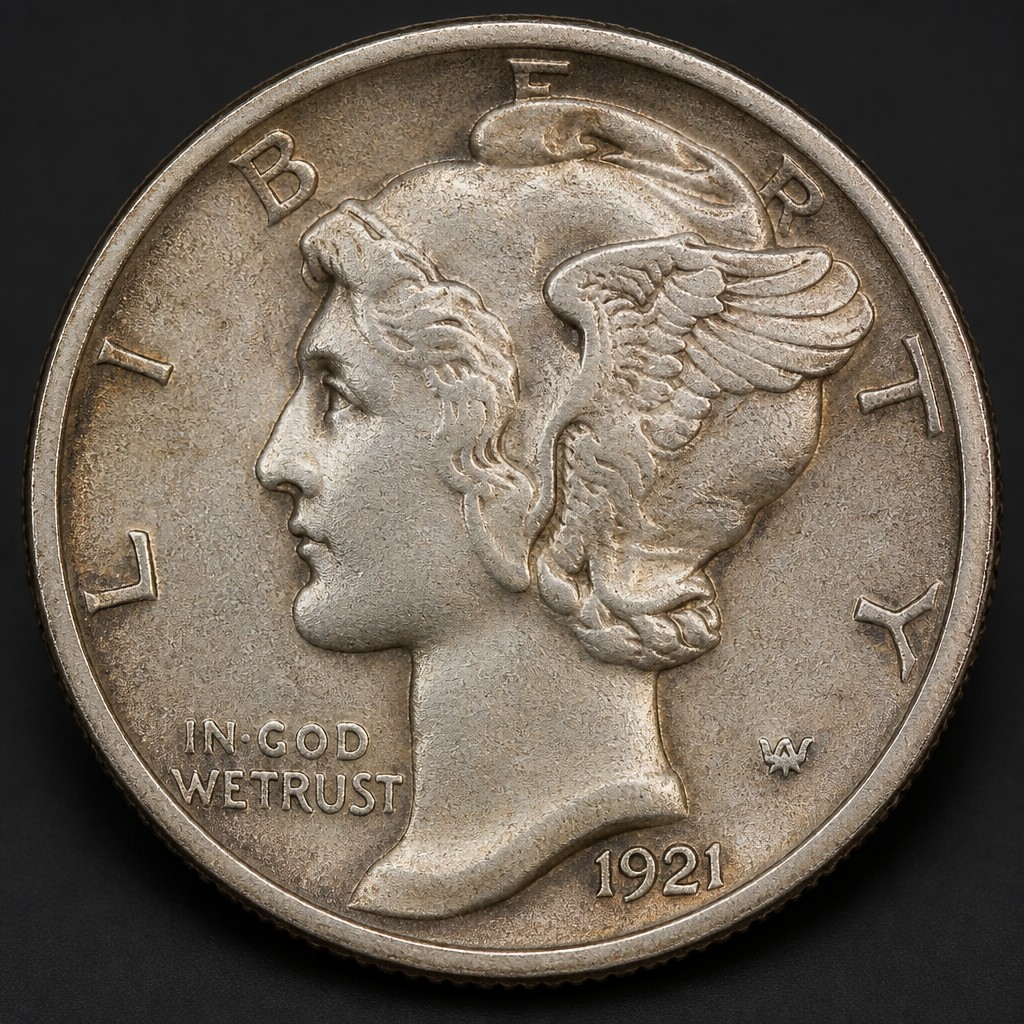
What It Is
The Mercury dime, officially the Winged Liberty Head dime, was designed by Adolph A. Weinman and struck from 1916 to 1945. The 1921 Philadelphia issue, along with its 1921-D counterpart, had a notably low mintage caused by reduced coinage demand following World War I, making it one of the key dates of the series and a coin that many collectors specifically target when assembling a complete date-and-mintmark set.
Obverse Design
Liberty is shown facing left wearing a winged cap, a design meant to symbolize liberty of thought rather than the Roman god Mercury, despite the coin's popular nickname. LIBERTY arches around the border, the date sits below, and the designer's small "AW" monogram appears at the truncation of the neck.
Reverse Design
The reverse depicts a fasces, a bundle of rods bound around an axe symbolizing authority and unity, with an olive branch beside it. UNITED STATES OF AMERICA arches above, "ONE DIME" appears below, and E PLURIBUS UNUM is lettered in small type to the side.
Size, Weight, Metal, and Edge
The coin measures about 17.9mm in diameter and weighs approximately 2.5 grams in a 90% silver alloy, with a reeded edge.
Mint Marks
A small mint mark letter, "D" for Denver or "S" for San Francisco, appears on the reverse to the left of the fasces near the base; no letter indicates a Philadelphia strike, which is the case for this particular date.
Telling It Apart From Similar Coins
The 1921 dime looks identical in design to every other Mercury dime; what makes it a key date is simply its low mintage that year. Confirming the date and absence of a mint mark (for the Philadelphia issue) or the presence of a "D" (for the equally scarce Denver issue) is the entire identification process, since no design differences exist between dates.
Judging Condition at a Glance
Check Liberty's cheek and hair strands and the bands wrapped around the fasces for the first signs of wear. Collectors also look for "Full Bands," meaning the horizontal bands on the fasces are fully separated and sharply struck, a mark of an exceptionally well-made mint-state example, though basic grading for circulated coins focuses on overall wear to the portrait and fasces.
Authenticity Red Flags
Because the 1921 and 1921-D issues carry a significant premium over most other Mercury dime dates, they are sometimes recreated by altering the date or mint mark on a more common year. Examine the date digits closely for uneven spacing, tool marks, or a surface texture that does not match the rest of the coin, and compare the mint mark's style and position to genuine references. Given the value involved, certification from a major grading service is a reliable way to confirm a genuine example.
Frequently asked questions
Why is the 1921 Mercury dime a key date?
Coinage demand dropped sharply after World War I, resulting in a low mintage for both the 1921 Philadelphia and 1921-D issues.
Does the design differ from other Mercury dimes?
No, the design is identical across all dates; scarcity comes from the low mintage of this particular year, not any visual difference.
What does 'Full Bands' mean?
It refers to the horizontal bands on the reverse fasces being fully separated and sharply struck, a detail collectors look for in high-grade mint-state examples.
Where is the mint mark located?
On the reverse, to the left of the fasces near its base; no mint mark indicates a Philadelphia strike.