
How to Identify the 1921-D Mercury Dime
A visual guide to the 1921-D Mercury (Winged Liberty Head) dime, the low-mintage key date of the series, covering its design, mint mark placement, and how to spot altered or added mint marks.
Read the full 1921-D Mercury Dime encyclopedia entry →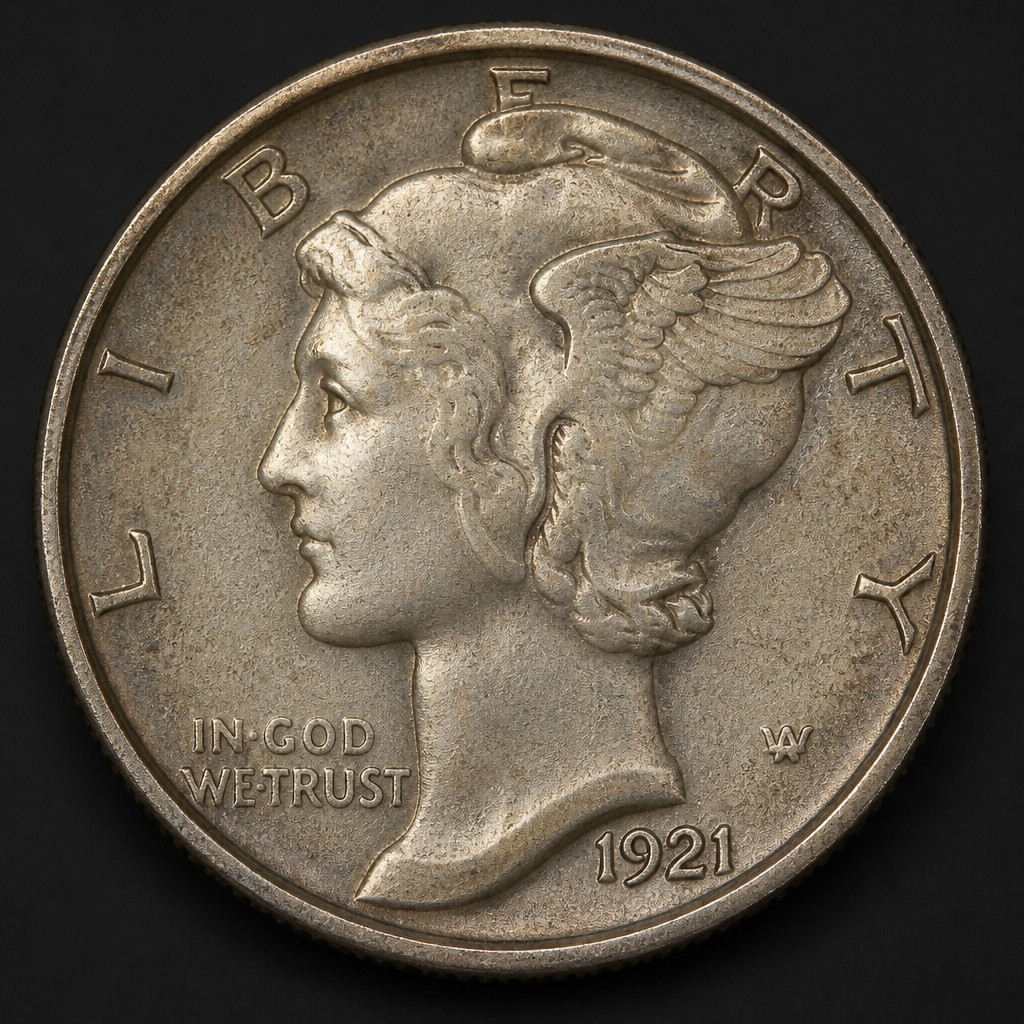
What It Is
The Mercury dime, officially the Winged Liberty Head dime, was struck from 1916 to 1945 and designed by Adolph Weinman. The 1921 and 1921-D issues are the key dates of the entire series because both the Philadelphia and Denver mints struck unusually small numbers of dimes that year, a low point in production caused by reduced demand for small change in the early 1920s.
Obverse Design
The obverse shows Liberty's head facing left wearing a winged Phrygian cap, a design many people mistake for the Roman god Mercury, which is how the coin got its popular nickname. The wings on the cap represent freedom of thought. "LIBERTY" arcs around the top rim, "IN GOD WE TRUST" appears in the field to the left of the neck, and the date sits at the bottom, just above the rim denticles.
Reverse Design
The reverse features a fasces, a bundle of rods bound around an axe, tied with a ribbon, with an olive branch running diagonally across it to symbolize both strength through unity and a preference for peace. "UNITED STATES OF AMERICA" arcs around the top, "ONE DIME" is at the bottom, and "E PLURIBUS UNUM" runs vertically in small letters to the right of the fasces.
Size, Weight, Metal & Edge
The coin measures 17.9mm in diameter, weighs 2.5 grams, and is struck in 90% silver and 10% copper. The edge is reeded, with fine parallel grooves running around the circumference.
Mint Mark Location
For the 1921-D, the small "D" mint mark sits on the reverse to the left of the fasces, just above the "ONE DIME" lettering and close to the rim. A genuine 1921 Philadelphia strike has no mint mark in that spot at all, since Philadelphia coins of this era were not marked.
Telling It Apart from Similar Coins
Because both 1921 (no mint mark) and 1921-D are scarce, confirming the presence and style of the "D" is the main identification task. Compare the mint mark's size, font, and exact placement against verified images of genuine 1921-D dimes; a mint mark that looks slightly too large, oddly positioned, or has rough, uneven edges around it may have been added after striking rather than being part of the original die.
Judging Condition at a Glance
Check the high points first: the hair just above Liberty's ear on the obverse, and the horizontal bands crossing the fasces on the reverse. A coin with the crossbands fully separated and sharply defined is considered to have a stronger strike and typically grades higher; wear rounds off these details first, followed by softening in the wing feathers and the fasces' vertical lines.
Authenticity Red Flags
Because this is a key date commanding a substantial premium over common-date Mercury dimes, watch for coins where the mint mark shows tooling marks, file lines, or a slightly different metal texture around it, all signs of an added mint mark. Also inspect the date digits under magnification for re-engraving or an unnatural gap between numerals, since altering a common-date dime into a "1921" is another known method used to create a fake key date. When in doubt, comparison with published reference photos of authenticated examples is a useful first check.
Frequently asked questions
Where exactly is the mint mark on a 1921-D Mercury dime?
On the reverse, to the left of the fasces near the rim, just above the words ONE DIME.
How can I tell if the D mint mark was added later?
Look closely under magnification for tooling marks, file lines, or a slightly different surface texture around the mint mark, and compare its font and size to verified genuine examples.
What metal is the 1921-D dime made of?
It is 90% silver and 10% copper, weighing 2.5 grams with a reeded edge.
Why is the 1921-D considered a key date?
Both the Denver and Philadelphia mints struck unusually low numbers of dimes in 1921, making surviving examples scarcer than most other dates in the series.
What is the fasces symbol on the reverse?
It is a bundle of rods bound around an axe with an olive branch across it, a classical symbol of unity and strength paired with a wish for peace.