
How to Identify the 1918/7-S Standing Liberty Quarter Overdate
A visual guide to spotting the famous 1918/7-S overdate variety, showing where the underlying 7 peeks through the 8 in the date and how to avoid look-alike doubling.
Read the full 1918/7-S Standing Liberty Quarter Overdate encyclopedia entry →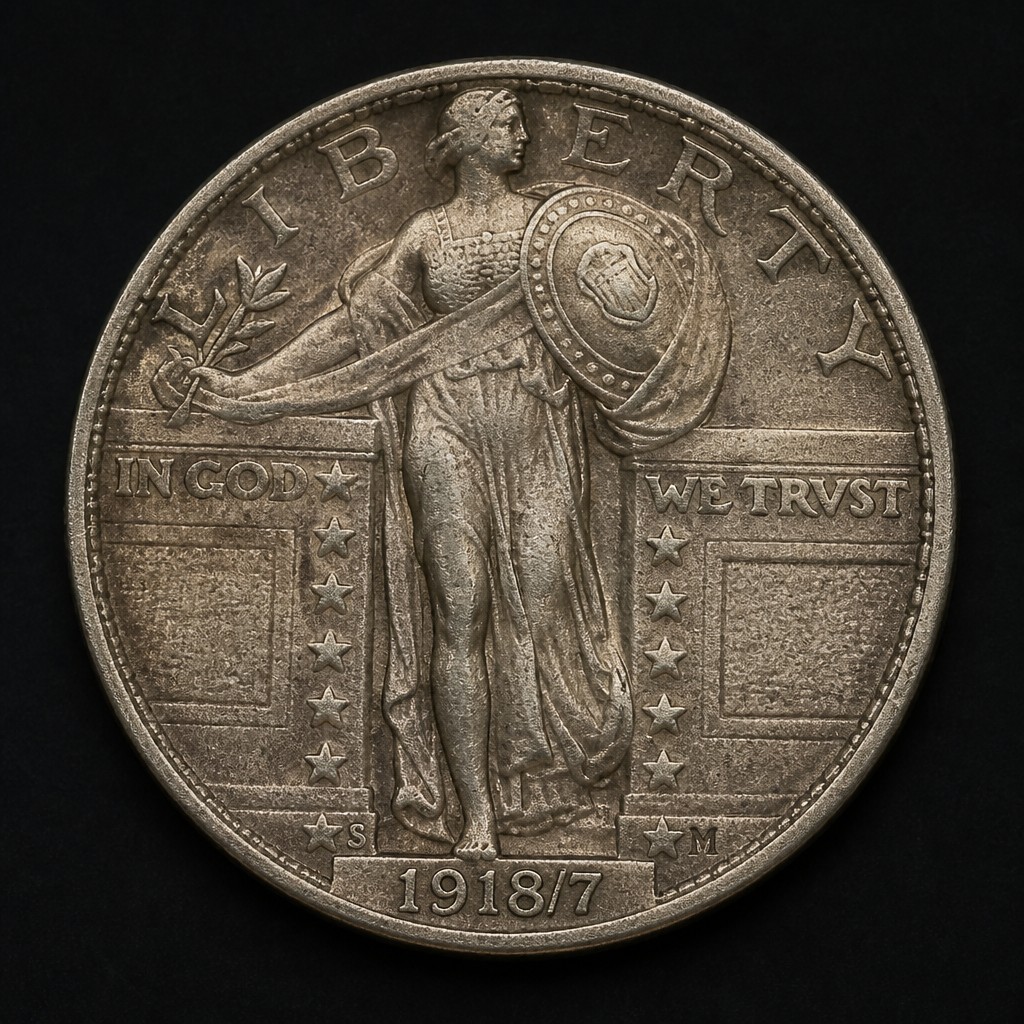
What This Coin Is
The 1918/7-S is one of the most celebrated die varieties of the 20th century. It occurred when a San Francisco Mint worker prepared a working die by punching a new date over one left from the prior year, leaving traces of the old "7" visible beneath the final "8" in "1918."
Obverse Design
Hermon A. MacNeil's Liberty stands within a gateway formed by two pillars, holding an olive branch in her right hand and a shield in her left, symbolizing readiness for peace but preparedness for defense. On this early "Type 1" version, her right breast is bare. "LIBERTY" arches across the top, "IN GOD WE TRUST" sits to the right of the gateway, and the date is at the bottom rim, unprotected by any raised border.
The Overdate Detail
Under magnification, the lower portion of the last digit in the date shows a distinct extra line or curve belonging to the old "7," positioned inside or overlapping the "8." This differs from ordinary die doubling because it reflects two different digits punched at different depths, not a doubled impression of the same numeral.
Reverse Design
An eagle in flight fills the center, wings spread wide, with "UNITED STATES OF AMERICA" arched above and "QUARTER DOLLAR" below. On the Type 1 reverse the stars are arranged with several grouped to the right of the eagle rather than beneath it.
Size, Weight, Metal, and Edge
Standing Liberty quarters are struck in 90% silver, 10% copper, weigh 6.25 grams, measure 24.3 mm across, and have a reeded edge, matching the specifications of the Barber and early Washington quarters that bracket the series.
Mint Mark Location
Unusually for a coin of this era, the mint mark sits on the obverse rather than the reverse: look just to the left of the date, near Liberty's leading foot. No mark means Philadelphia; a "D" indicates Denver and an "S" indicates San Francisco. On this variety, confirming an "S" mint mark to the left of the date is essential, since the overdate is unique to the San Francisco issue of that year.
Telling It Apart from Similar Coins
Ordinary 1918-S quarters without the overdate are common and share the same design otherwise; only close inspection of the last date digit under a loupe reveals the doubled numeral. Some worn or damaged coins show scratches or die chips near the date that can mimic the effect, so the extra line should clearly form the curve of a "7" rather than a random mark.
Judging Condition at a Glance
Wear appears first on Liberty's head and the rounded shield rim on the obverse, and on the eagle's breast and the leading wing edge on the reverse. On Type 1 coins, the date sits unprotected at the rim, so it wears down or disappears entirely on well-circulated pieces; the head, shield, and date's legibility together give a quick read on grade.
Authenticity Red Flags
Because several dates in this series carry low mintages, watch for added or re-engraved mint marks on the obverse, and for full dates that look freshly re-cut on coins that should otherwise show wear consistent with the rest of the design. A mint mark or date that appears sharper or more raised than the surrounding worn surface is a sign to look closer. Because this variety commands a strong premium, added or artificially enhanced "overdate" marks on ordinary 1918-S quarters are a known concern; the shape and position of the underlying digit should match published examples of the genuine variety precisely.
Frequently asked questions
What exactly is overdated on this coin?
A leftover 7 from a die intended for 1917 remains partially visible beneath the final 8 in the 1918 date.
Where is the mint mark?
On the obverse, just to the left of the date, near Liberty's foot; it reads 'S' for San Francisco on this variety.
Do I need magnification to see the overdate?
Yes, a loupe or macro photo is typically needed to clearly see the extra line from the underlying 7.
Is every 1918-S quarter an overdate?
No, only a small portion of 1918-S quarters show the overdate; most are ordinary examples without the doubled digit.