
How to Identify the 1918/7-D Buffalo Nickel Overdate
A guide to spotting this famous overdate error on a Denver Buffalo Nickel, where a leftover 1917 die digit shows through beneath the 1918 date.
Read the full 1918/7-D Buffalo Nickel Overdate encyclopedia entry →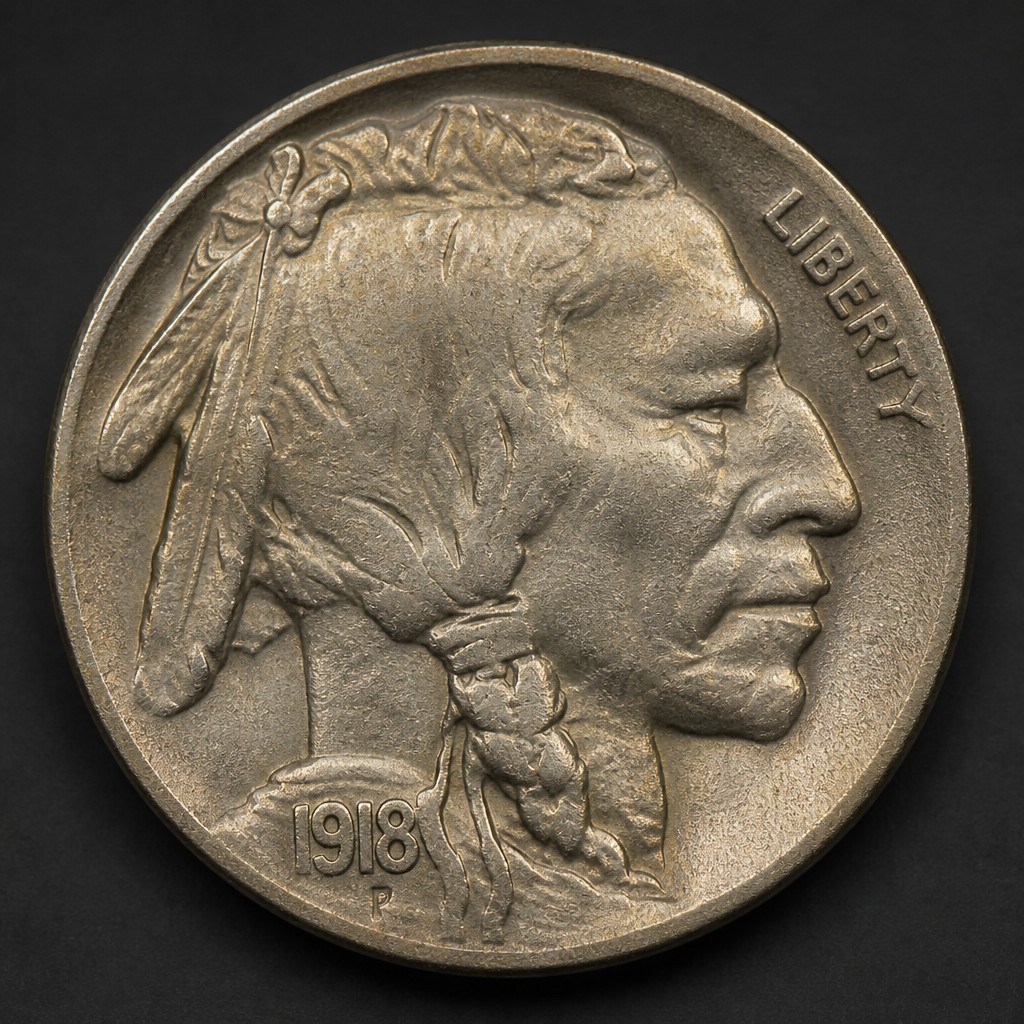
What It Is
The 1918/7-D Buffalo Nickel is one of the most celebrated die errors in United States coinage. During a busy production year, a Denver Mint worker reused a partially-effaced 1917-dated working die and re-punched it with an 1918 date rather than preparing a fresh die, leaving traces of the old "7" visible beneath the new "8." It is not a separate design or denomination change, just a regular 1918-D Buffalo Nickel carrying this distinctive overdate error, and it has long been treated as one of the key varieties in the entire Buffalo Nickel series.
Obverse Design
The obverse shows a composite Native American portrait facing right, combining features said to be drawn from several real individuals, with braided hair, a headband, and feathers falling behind the neck. LIBERTY appears in raised letters at the upper right rim, following the curve of the coin. The date sits at the bottom edge just below the bust truncation, and this is exactly where the overdate doubling appears.
Reverse Design
The reverse depicts an American bison standing on a small mound of earth, based on a design inspired by an American bison at a zoological garden. UNITED STATES OF AMERICA arcs across the top, E PLURIBUS UNUM runs along the ground line beneath the animal, and FIVE CENTS is lettered in the exergue below the mound.
Size, Weight, Metal, Edge
Like every Buffalo Nickel, it measures 21.2mm in diameter, weighs 5.00 grams, and is struck in a 75% copper, 25% nickel alloy. The edge is plain, with no reeding or lettering.
Mint Marks
This overdate exists only from the Denver Mint. The small "D" mint mark sits below FIVE CENTS in the exergue on the reverse, consistent with Buffalo Nickel mint mark placement used from 1913 onward. No overdate variety of this type is known from Philadelphia or San Francisco strikes of 1918.
Spotting the Overdate
Under magnification, look at the last digit of the date. A curved remnant of the old "7" appears trapped inside or peeking from the loops of the "8," and collectors often describe it as a faint hook, extra line, or shadow within the digit. Comparing the suspect coin to enlarged reference photos of the diagnostic under a loupe or digital microscope is the most reliable way to confirm it, since ordinary die wear, grease-filled dies, or a poorly struck date can create a misleading illusion of doubling that is not a true overdate.
Grading at a Glance
Check the high points first: the cheek and hair above the ear on the obverse, and the hip and shoulder of the bison on the reverse, since these areas flatten quickly with circulation. Because the mint mark and date sit in a shallow, low-relief area that wears down or fills with grime easily, look for a full, unbroken date with all digits legible before assuming a coin is problem-free or correctly identified.
Authenticity Red Flags
Because the overdate is valuable relative to an ordinary 1918-D, some regular coins have had the date altered or tooled to fake the extra digit. Warning signs include scratches, tool marks, or unnatural metal flow lines around the date, a "7" that looks crudely added rather than emerging naturally from beneath the "8," or a mint mark that looks re-cut, oddly shaped, or repositioned relative to genuine examples. Comparing die markers, meaning the exact shape, size, and position of the doubling, against published diagnostics is the standard way collectors and dealers separate genuine overdates from altered coins.
Frequently asked questions
Where on the coin does the overdate actually appear?
In the last digit of the date at the bottom of the obverse, where a trace of the underlying 7 shows through the 8.
Does the 1918/7-D overdate exist in other mints?
No, it is known only from the Denver Mint; look for the small D below FIVE CENTS on the reverse.
How can I tell a real overdate from an altered date?
Genuine overdates show natural die doubling with no tool marks; altered coins often have scratches, odd metal texture, or an unnaturally sharp extra digit.
What size and metal is this coin?
It is 21.2mm wide, weighs 5 grams, and is made of 75% copper and 25% nickel with a plain edge, same as any Buffalo Nickel.