
How to Identify the 1916 Walking Liberty Half Dollar
The 1916 Walking Liberty half dollar launched Adolph Weinman's iconic design and is the only date with the mint mark on the obverse near the rim.
Read the full 1916 Walking Liberty Half Dollar encyclopedia entry →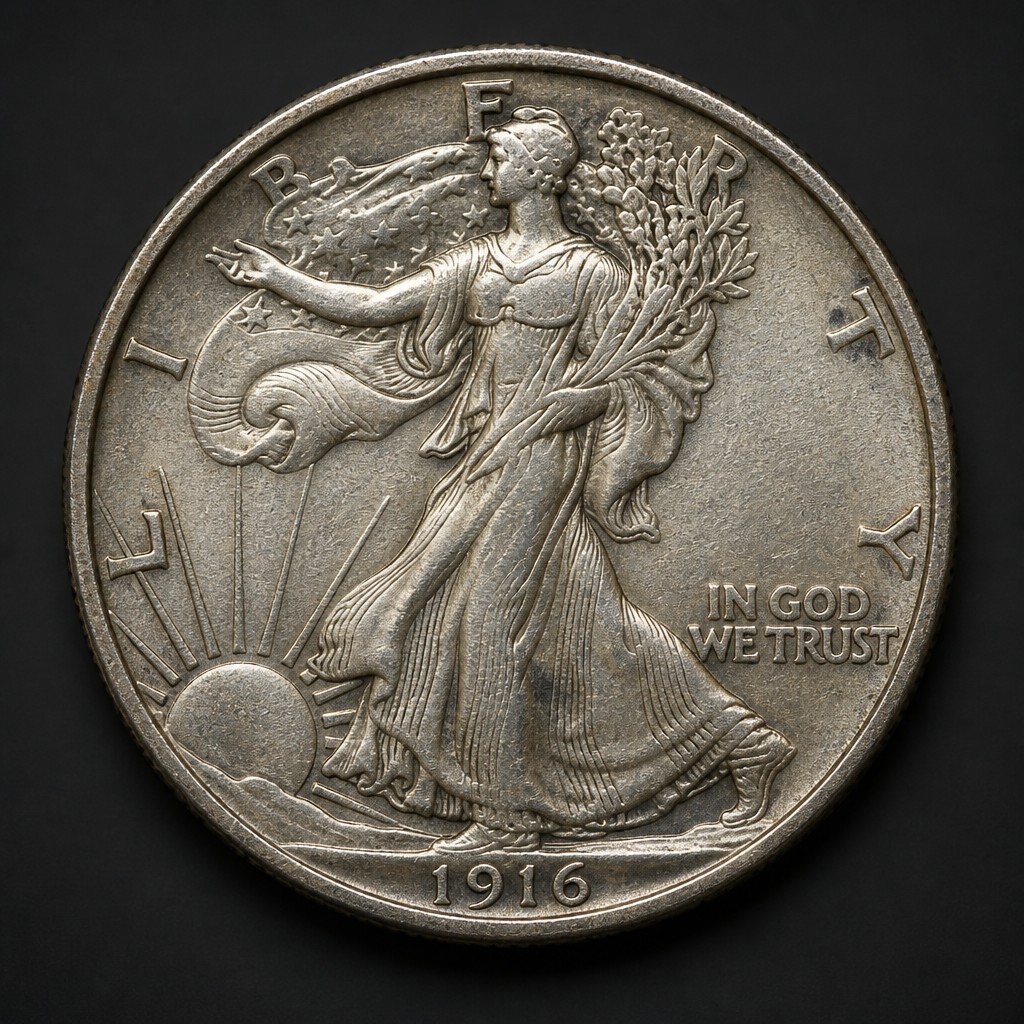
What It Is
The 1916 Walking Liberty half dollar is the first-year issue of one of America's most admired coin designs, created by sculptor Adolph A. Weinman. It replaced the Barber half dollar and was struck in 90% silver at Philadelphia, Denver, and San Francisco.
Obverse Design
Liberty strides toward a rising sun, wrapped in the American flag with her right hand extended and an olive branch in her left arm, symbolizing peace and prosperity. "LIBERTY" arches along the top rim, "IN GOD WE TRUST" sits to the right of her legs, and the date appears at the bottom.
Reverse Design
An eagle stands on a rocky crag with wings partly spread, a small mountain pine sapling growing beside it. "UNITED STATES OF AMERICA" arches around the top, "HALF DOLLAR" curves along the bottom, and "E PLURIBUS UNUM" runs vertically to the right of the eagle.
Size, Weight, and Edge
The coin is 30.6mm in diameter, weighs 12.5 grams, contains 90% silver and 10% copper, and has a reeded edge, matching other silver half dollars of the era.
Mint Marks
1916 is unusual: the mint mark, when present, sits on the obverse near the lower left rim, just below the phrase "IN GOD WE TRUST" and above the date area. Philadelphia coins carry no mint mark, while Denver and San Francisco pieces show a small "D" or "S" there. Starting the following year the mint mark moved to the reverse, making 1916 (and part of 1917) visually distinct.
Telling It Apart From Similar Dates
Because the obverse mint mark placement is unique to 1916 and early 1917, checking that spot is the fastest way to separate a 1916 from later dates that carry the mint mark on the reverse near the lower left of "HALF DOLLAR." The overall design otherwise looks similar through 1947, so the date digits and mint mark position together confirm the year.
Judging Condition at a Glance
Look at Liberty's exposed leg and the eagle's breast feathers, which wear first. Sharp, rounded, full details in these areas suggest higher grades, while flattened, smooth surfaces indicate heavy circulation. Original coins usually show soft, even luster in the fields even when worn.
Authenticity Red Flags
Because early Walking Liberty halves carry a premium, check for added or altered mint marks near the obverse rim, mismatched font style compared to genuine examples, or file marks and solder traces suggesting a mint mark was transplanted from another coin. A coin that feels unusually light, has a dull gray or mustard-colored surface inconsistent with silver, or shows a seam around the edge may be a cast counterfeit.
Frequently asked questions
Where is the mint mark on a 1916 half dollar?
On the obverse, near the lower left rim below IN GOD WE TRUST, unlike later dates where it moved to the reverse.
What metal is the 1916 Walking Liberty half dollar made of?
It is struck in 90% silver and 10% copper, weighing 12.5 grams.
How can I tell a 1916 from a later Walking Liberty half dollar?
Check the date first, then confirm the mint mark position matches the obverse-only placement used in 1916 and part of 1917.
Why does the 1916 half dollar have no mint mark sometimes?
Coins struck at the Philadelphia Mint never carried a mint mark during this era, so a blank spot below the date area is normal for Philadelphia strikes.