
How to Identify the 1916 Standing Liberty Quarter
An identification guide to the 1916 Standing Liberty quarter, the rare first-year Type 1 issue, covering its bare-breast design, size and metal, and how to detect an altered date from 1917.
Read the full 1916 Standing Liberty Quarter encyclopedia entry →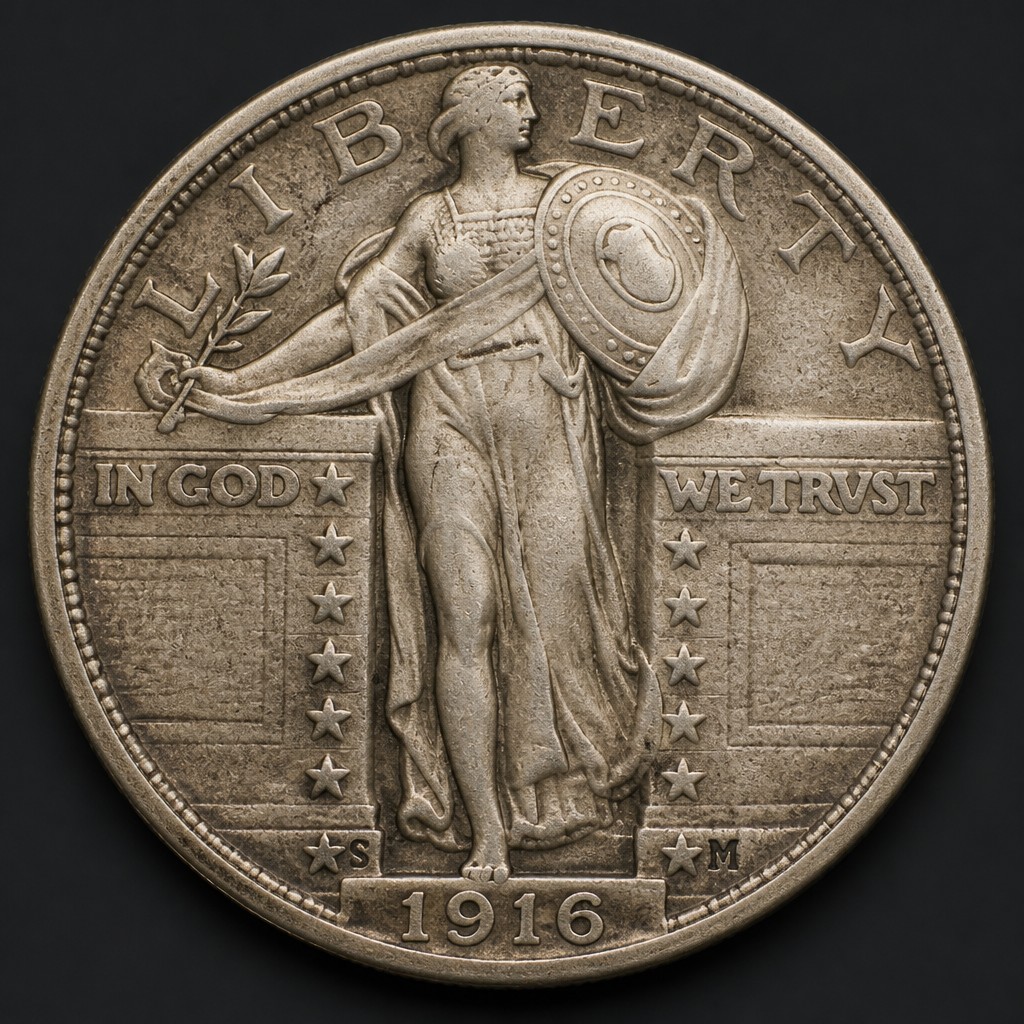
What It Is
The Standing Liberty quarter, designed by sculptor Hermon MacNeil, debuted in late 1916 with an extremely small mintage, making it the key date and one of the most valuable and sought-after 20th-century United States quarters despite being part of a design used for over two decades.
Obverse Design
Liberty stands full-length within a gateway formed by two low walls, holding a shield in her left hand and an olive branch in her right, gesturing toward peace while remaining ready for defense. On this first-year "Type 1" design, her right breast is bare; this changed in mid-1917 when a chain mail covering was added to the design. "LIBERTY" arcs above, stars flank the gateway, and the date sits at the bottom on a small pedestal beneath Liberty's feet.
Reverse Design
An eagle in flight facing left dominates the reverse, surrounded by stars along the border, with "UNITED STATES OF AMERICA" arcing above and "QUARTER DOLLAR" below. The 1916 issue does not carry "E PLURIBUS UNUM," a motto added later during the Type 2 redesign in 1917.
Size, Weight, Metal & Edge
The coin measures 24.3mm in diameter, weighs 6.25 grams, is struck in 90% silver and 10% copper, and has a reeded edge.
Mint Marks
The 1916 issue was struck only at Philadelphia, so it carries no mint mark. Later Standing Liberty quarters place their mint mark on the obverse, to the left of the date, a detail worth knowing when comparing this issue to later years of the series.
Telling It Apart from Similar Coins
The most important comparison is against the far more common 1917 Type 1 quarter, which shares the identical bare-breast design and general appearance. Because a genuine 1916 is worth dramatically more than a 1917, examine the date digits closely for signs of re-engraving or an added serif that would turn a "7" into a "6." Also confirm whether the design is Type 1, with the bare breast, or Type 2, with the chain mail covering adopted mid-1917 onward, since a Type 2 coin cannot possibly be dated 1916.
Judging Condition at a Glance
Because the design was struck in high relief, it wears quickly compared to flatter coin designs. Check Liberty's head and the shield's rivets on the obverse for flatness, and look at whether the head area is sharply defined, sometimes described as a "Full Head" strike when the hair and facial details remain fully distinct rather than worn smooth.
Authenticity Red Flags
Given the coin's rarity and value, this date is a frequent target for alteration from a genuine 1917 coin. Look for tooling or engraving marks around the date, inconsistent spacing or alignment between digits, and compare the overall diameter, weight, and denticle detail to known genuine examples. Given the stakes involved with a coin of this significance, verification by a professional grading service is advisable for any candidate example before drawing firm conclusions.
Frequently asked questions
How do I know if my Standing Liberty quarter is a genuine 1916?
Check the date digits carefully for signs of alteration from 1917, and confirm the design is Type 1 with a bare-breasted Liberty and no E Pluribus Unum on the reverse.
Does the 1916 quarter have a mint mark?
No, it was struck only at Philadelphia, so it has no mint mark.
What is the difference between Type 1 and Type 2 Standing Liberty quarters?
Type 1, used in 1916 and part of 1917, shows Liberty's breast bare; Type 2, adopted later in 1917, covers it with chain mail armor.
Why does this date wear down so quickly?
The high-relief design put Liberty's head and shield details in prominent, exposed positions that flatten faster than typical coin designs.
What does a Full Head strike mean?
It refers to Liberty's head showing complete, well-defined hair and facial detail rather than the softened look caused by wear or a weak strike.