
How to Identify the 1913 Liberty Head Nickel
An overview of the extremely rare 1913 Liberty Head nickel's design and why only a handful of genuine examples exist, plus how ordinary Buffalo nickels are sometimes mistaken for it.
Read the full 1913 Liberty Head Nickel encyclopedia entry →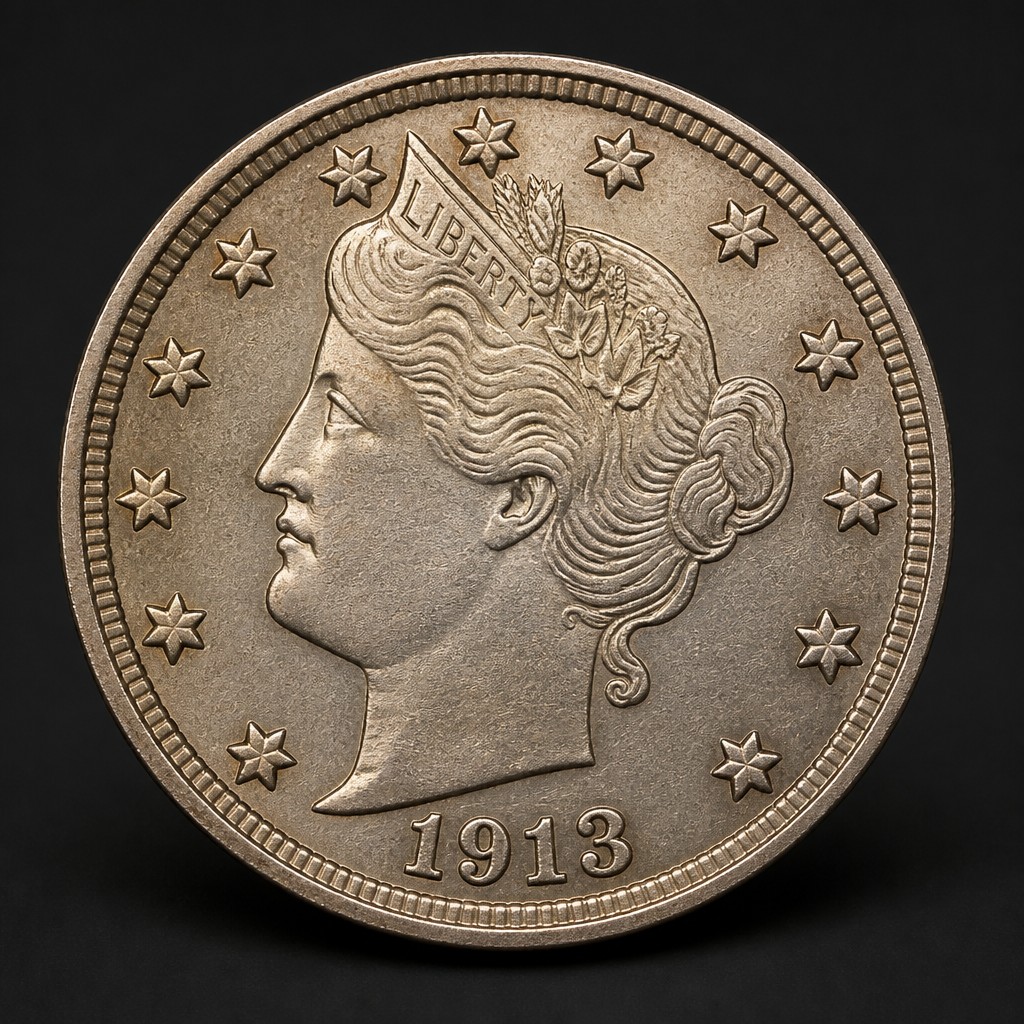
What It Is
The Liberty Head (or "V") nickel was the regular design used from 1883 to 1912. Officially, the Mint switched to the Buffalo nickel design for 1913. However, five examples dated 1913 with the old Liberty Head design are known to exist, apparently struck unofficially at the Philadelphia Mint without official sanction, making them among the most famous rarities in American coinage.
Obverse (Front)
A left-facing head of Liberty wears a coronet inscribed "LIBERTY," with stars around the border and the date at the bottom.
Reverse (Back)
A large Roman numeral "V" (for five, denoting five cents) sits at the center, encircled by a wreath, with "UNITED STATES OF AMERICA" above and "CENTS" below the wreath — the word "CENTS" was added starting in 1883 after early nickels without it were fraudulently gold-plated and passed off as five-dollar gold pieces.
Size, Weight, Metal, and Edge
The coin is a copper-nickel alloy (75% copper, 25% nickel), 21.2 mm in diameter, weighs about 5 grams, and has a plain edge.
Mint Marks
Regular Liberty Head nickels show no mint mark for Philadelphia issues; some later dates were struck at Denver and San Francisco with mint marks near the rim. All five known genuine 1913 examples were struck at Philadelphia and carry no mint mark.
Telling It Apart from Similar Coins
Because only five genuine 1913 Liberty Head nickels are known, any coin claiming to be one should be compared very closely with published photographs and, in practice, would need expert examination to confirm. Far more common is confusion with the 1913 Buffalo nickel, the coin actually issued that year in large numbers, which shows a Native American profile on the obverse and a bison standing on a mound on the reverse — an entirely different design that is not rare.
Judging Condition at a Glance
Since genuine examples are exceptionally well documented and tracked individually, condition assessment for this date is a matter for expert numismatists rather than casual visual grading; ordinary wear points (Liberty's hair and cheek, the wreath details) apply in principle but are secondary to authentication.
Authenticity Red Flags
The overwhelming likelihood for any newly found "1913 Liberty Head nickel" is that it is either a legitimate 1913 Buffalo nickel misidentified by the finder, or an altered/fabricated date on a common Liberty Head nickel from a nearby year (such as recutting a "3" from an "8" or similar digit). Because so few genuine examples exist and their ownership history is well documented, any claimed discovery warrants careful comparison to the design details described above and expert review rather than assuming rarity from the date alone.
Frequently asked questions
Why is the 1913 Liberty Head nickel so rare?
The Mint had officially switched to the Buffalo nickel design for 1913, so the five known Liberty Head examples dated 1913 appear to have been struck without official authorization.
How many genuine examples are known to exist?
Only five genuine specimens are documented, and their history has been closely tracked by collectors and researchers.
How do I avoid confusing this with the coin actually issued in 1913?
The coin officially struck in 1913 was the Buffalo nickel, showing a Native American profile and a bison, a completely different design from the Liberty Head coronet-and-wreath design.
What should I do if I think I've found one?
Compare it carefully to reference photos of the design and date, and seek expert examination, since altered dates on common Liberty Head nickels are far more likely than a genuine discovery.