
How to Identify the 1909-S VDB Lincoln Cent
A visual guide to spotting the key-date 1909-S VDB cent, including its designer initials, mint mark placement, and the details that separate it from common look-alikes.
Read the full 1909-S VDB Lincoln Cent encyclopedia entry →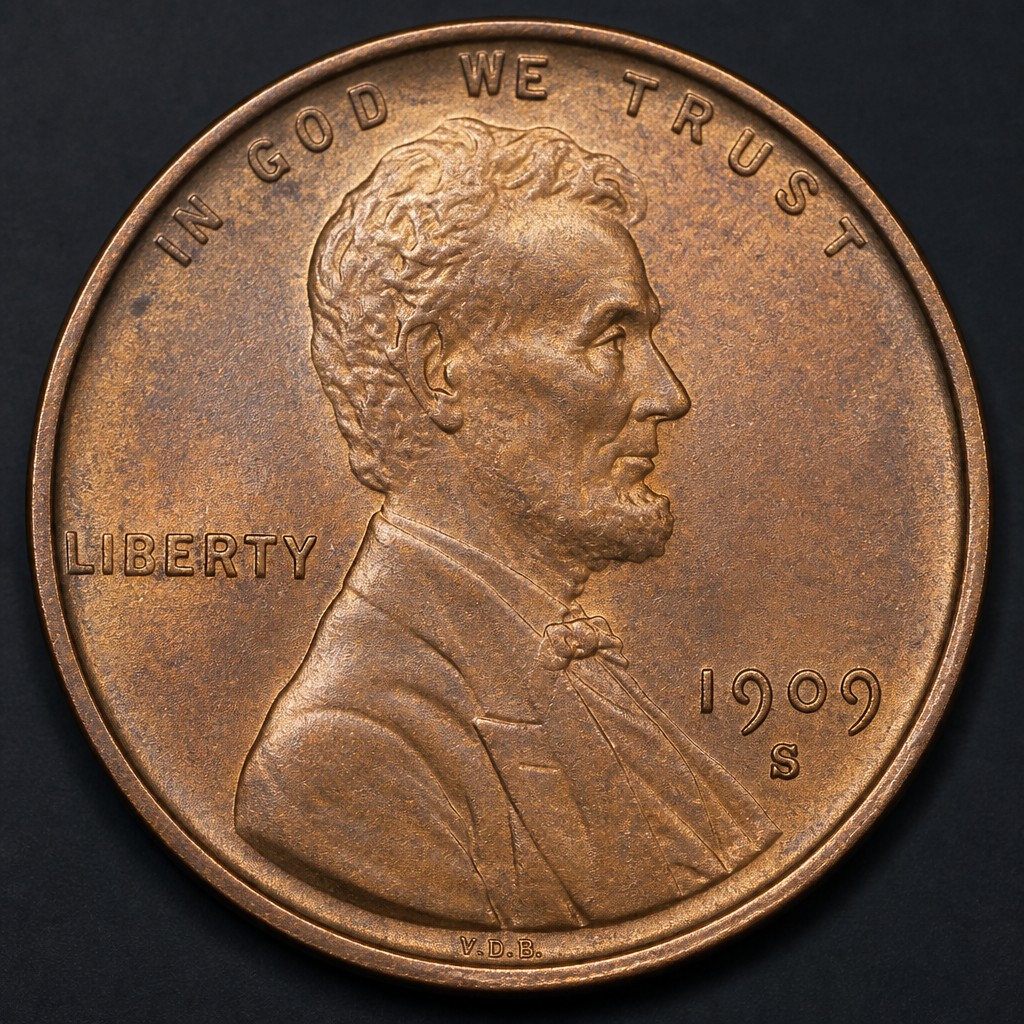
What It Is
The 1909-S VDB is the first-year Lincoln cent struck at the San Francisco Mint, notable for the tiny designer initials "V.D.B." (Victor David Brenner) on the reverse. Public objection to the initials led the Mint to remove them later in 1909, making this the lowest-mintage regular-issue cent of the design's first year.
Obverse (Front)
The obverse shows Abraham Lincoln's right-facing portrait, with "IN GOD WE TRUST" arcing above his head, "LIBERTY" to the left of the portrait, and the date "1909" to the right. The mint mark "S" sits just below the date, on the same line, slightly to the right of center.
Reverse (Back)
The reverse displays two wheat stalks flanking "ONE CENT" and "UNITED STATES OF AMERICA," the design used from 1909 to 1958. Along the bottom rim, between the wheat stalks, tiny raised letters "V.D.B." appear centered at the base — this is the feature that defines the variety.
Size, Weight, Metal, and Edge
The coin is bronze (95% copper, 5% tin and zinc), measures 19 mm in diameter, weighs about 3.11 grams, and has a plain edge.
Mint Mark Location
Look directly below the date on the obverse for a small "S." No mint mark means Philadelphia; a "D" would indicate Denver, but no 1909 Denver VDB cents were struck with the initials.
Telling It Apart from Similar Coins
The most common point of confusion is the 1909 VDB cent without an "S" (a Philadelphia coin, far more common) and the 1909-S cent without VDB (no initials on the reverse rim, also less scarce than the VDB version). Check both the mint mark under the date and the tiny letters on the reverse rim before assuming a coin is the key variety.
Judging Condition at a Glance
On worn examples, check Lincoln's cheek and jaw for smoothing and the wheat stalks for flattened detail. On uncirculated coins, original mint luster and sharp definition in the hair and beard lines indicate higher grade. Cleaning or heavy handling reduces value regardless of the date.
Authenticity Red Flags
Because of its desirability, this date is frequently altered by adding a fake "S" to a common 1909 VDB cent or by adding fake "V.D.B." letters to a 1909-S cent. Look for tool marks, an oddly shaped or poorly centered mint mark, uneven letter spacing in "VDB," or a mint mark that sits at a different height or angle than genuine examples. A coin with a suspiciously sharp date on an otherwise worn coin is also a warning sign.
Frequently asked questions
Where exactly is the mint mark on a 1909-S VDB cent?
Directly below the date on the obverse, a small letter 'S' appears roughly centered beneath the '1909.'
How can I tell VDB from non-VDB 1909-S cents?
Check the bottom rim of the reverse between the wheat stalks; VDB examples have tiny raised initials 'V.D.B.' there, while non-VDB coins have plain space.
What metal is this coin made of?
It is 95% copper bronze, the standard cent alloy used from 1909 until the switch to zinc-coated steel in 1943.
Why do fake 'S' mint marks appear on this date?
Because the 1909-S VDB has a much lower mintage than the plain 1909 VDB, some sellers add a false mint mark to a common coin to mimic the scarcer variety.