
How to Identify the 1908-S Indian Head Cent
A visual guide to the 1908-S Indian Head Cent, the first branch-mint issue of the series, covering the S mint mark location, headdress and wreath design, and how to check for altered mint marks.
Read the full 1908-S Indian Head Cent encyclopedia entry →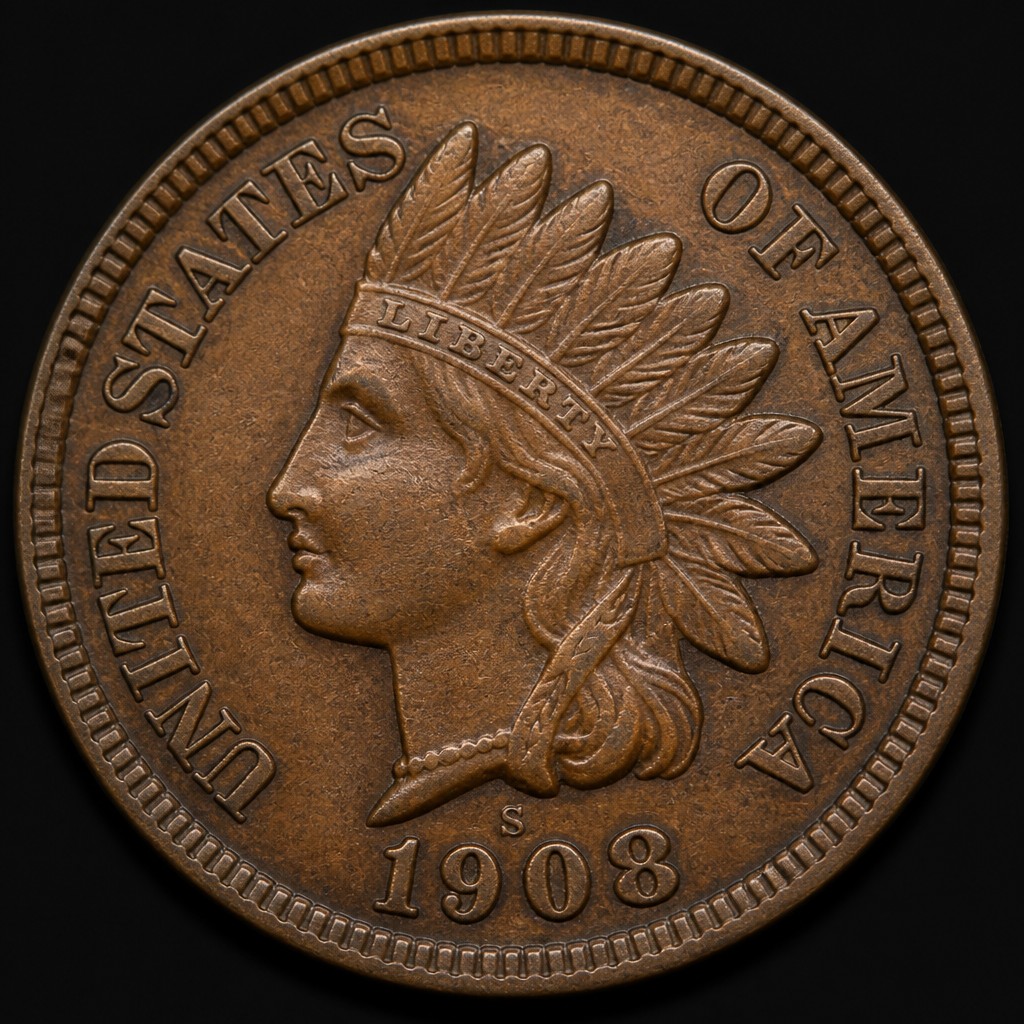
What It Is
The 1908-S Indian Head Cent holds a special place in the series as the first year a branch mint, San Francisco, struck this design. Its relatively low mintage compared to Philadelphia output of the same year makes it a scarcer, sought-after date.
Obverse Design
Liberty is portrayed wearing a Native American-style feathered headdress, facing left, with UNITED STATES OF AMERICA around the border and the date, 1908, below.
Reverse Design
An oak wreath, tied with a ribbon and topped by a shield, encloses the words ONE CENT.
Size, Weight, Metal, and Edge
The coin is bronze, roughly 95% copper with the balance tin and zinc, weighing about 3.11 grams and measuring 19mm across, with a plain edge.
Mint Marks
The "S" mint mark appears on the reverse, below the wreath near the point where the ribbon knot meets the base of the design, just above the rim. This location is the only place to check for a mint mark on this coin, and this issue represents the earliest use of an S mint mark on an Indian Head cent.
Telling It Apart From Similar Coins
Since the 1908 Philadelphia cent shares the identical design apart from the missing mint mark, always check the reverse mint mark area before assuming a coin is the more common Philadelphia issue. The following year's 1909-S is a different, even scarcer date, so the final digit of the date should also be confirmed alongside the mint mark.
Judging Condition
Look at the sharpness of the headdress feathers, the "LIBERTY" lettering on the headband, and the wreath and ribbon detail on the reverse. As with other Indian Head cents, wear first appears on the highest points of the portrait and the ribbon knot, while the recessed background fields hold their detail longer.
Authenticity Notes
Because the 1908-S carries a meaningful premium over the common Philadelphia date, added or altered mint marks are a known risk. Look closely at the "S" for a color, texture, or finish that does not match the surrounding metal, an oddly precise or crisp appearance compared to the rest of a worn coin, or any signs of tooling or re-cutting around its edges under magnification.
Frequently asked questions
Where is the mint mark on a 1908-S Indian Head Cent?
It is a small "S" on the reverse, located below the wreath near the ribbon knot, just above the rim.
Why is 1908-S significant in the Indian Head series?
It was the first year San Francisco struck Indian Head cents, and its mintage was much lower than Philadelphia's for that year.
How do I avoid confusing 1908-S with 1909-S?
Check both the final digit of the date and the mint mark, since these are two different dates with different mintages and values.
What should I look for to check if the S mint mark is real?
Compare its size, shape, and surface texture to genuine reference examples, and examine it under magnification for tooling marks or an inconsistent finish.