
How to Identify the 1907 High Relief Double Eagle
Augustus Saint-Gaudens's sculptural $20 gold masterpiece, struck only briefly in 1907 with a Roman numeral MCMVII date and dramatically deep relief.
Read the full 1907 High Relief Double Eagle encyclopedia entry →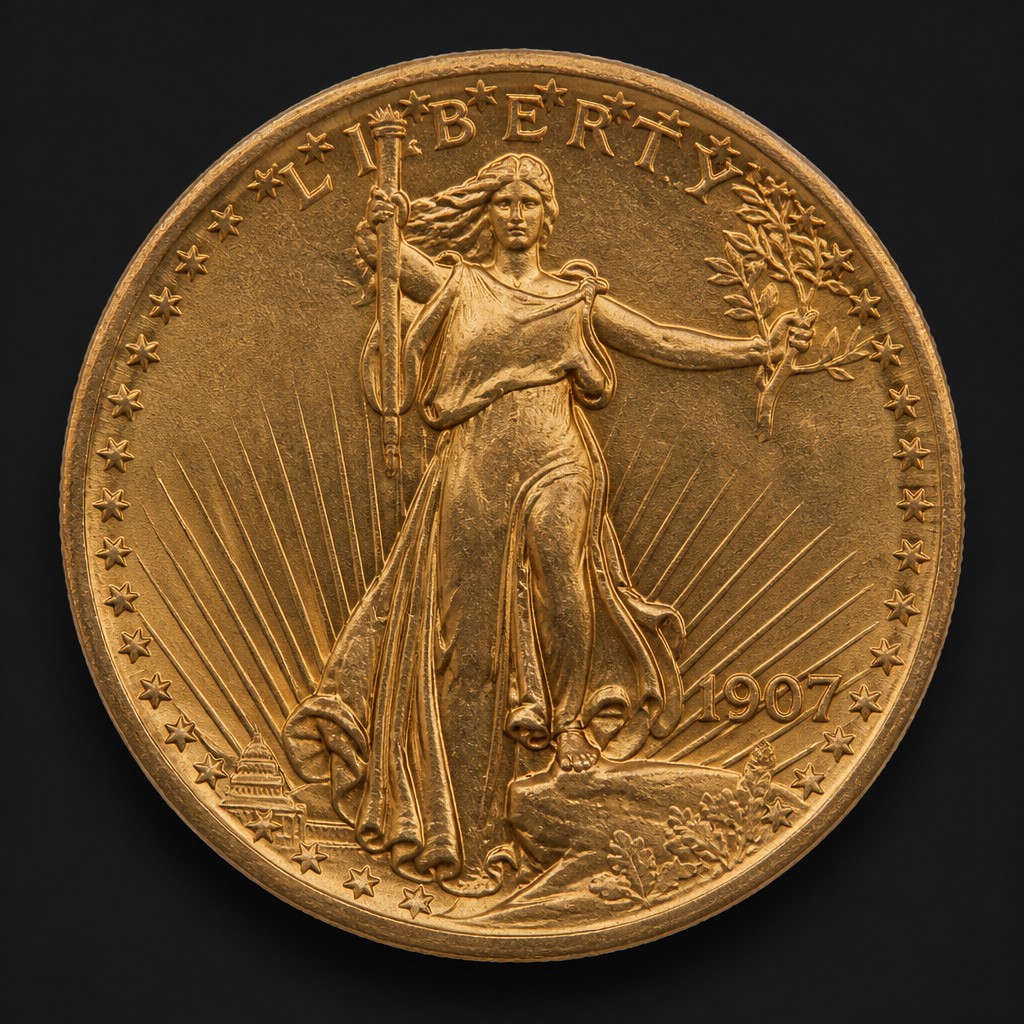
What It Is
The 1907 High Relief Double Eagle is a $20 gold coin designed by sculptor Augustus Saint-Gaudens at the request of President Theodore Roosevelt, who wanted more artistically ambitious American coinage. The design was struck in dramatically high, sculptural relief for only a short period in 1907 before the Mint switched to a flatter, mass-producible version. It is widely regarded as one of the most beautiful U.S. coins ever issued.
Obverse Design
A full-length figure of Liberty strides forward, holding a torch aloft in one hand and an olive branch in the other, with the U.S. Capitol building and rays of sunlight in the background. Forty-six stars, representing the states then in the Union, surround the border. The date appears in Roman numerals as MCMVII rather than Arabic numerals.
Reverse Design
An eagle flies above a stylized sunburst, with UNITED STATES OF AMERICA and TWENTY DOLLARS around the border. Neither IN GOD WE TRUST nor E PLURIBUS UNUM appears — Saint-Gaudens and Roosevelt deliberately omitted the religious motto, a choice Congress later reversed for subsequent double eagles.
Size, Weight, Metal & Edge
34mm diameter, about 33.44 grams, .900 fine gold. Unlike the plain reeded edge of the earlier Liberty Head double eagle, this coin's edge carries a ring of raised stars rather than reeding. Collectors also recognize two rim varieties from 1907 known as "wire rim" and "flat rim."
Mint Marks
None. All High Relief double eagles were struck at the Philadelphia Mint only.
Telling It Apart From Similar Coins
Compare it to the later "Arabic numerals, low relief" Saint-Gaudens double eagles struck from late 1907 through 1933, which use a standard Arabic date (such as 1908, 1909, and so on) and show a noticeably flatter strike. Compare it to the earlier Liberty Head double eagle (1849-1907), an entirely different coronet-portrait design with a plain reeded edge. The Roman numeral MCMVII date combined with a strikingly three-dimensional, rounded strike identifies this specific 1907 issue.
Judging Condition at a Glance
Because of the coin's unusually deep relief, wear shows first on Liberty's breast, knee, and the tip of her torch, and on the eagle's breast on the reverse. Well-struck genuine examples show remarkable depth and roundness to the design compared with the flatter later Saint-Gaudens double eagles.
Authenticity Red Flags
Given its high value, this is a frequently counterfeited coin. Check for crisply formed Roman numerals, a star-decorated edge rather than plain reeding, and deep but well-defined relief. Modern counterfeits often show soft, rounded details lacking the crisp sculptural quality of a genuine Saint-Gaudens strike, or an incorrect plain edge.
Frequently asked questions
What makes the edge of this coin unusual?
Instead of the plain reeded edge used on most U.S. gold coins, the Saint-Gaudens double eagle, including the 1907 High Relief, has a ring of raised stars on its edge.
Why is the date written as MCMVII instead of 1907?
Saint-Gaudens used Roman numerals for an artistic, classical effect. Later Saint-Gaudens double eagles switched to standard Arabic numerals.
Why doesn't this coin have IN GOD WE TRUST?
Saint-Gaudens and President Roosevelt intentionally left the motto off the original design. Congress required its restoration on double eagles struck from mid-1908 onward.
What are 'wire rim' and 'flat rim' varieties?
They are two minor rim styles found on 1907 High Relief double eagles, both struck the same year, distinguished by a thin raised wire-like edge versus a flatter rim border.
Does this coin have a mintmark?
No. All 1907 High Relief double eagles were struck exclusively at the Philadelphia Mint.