
How to Identify the 1892 Barber Half Dollar
The 1892 Barber half dollar is the first-year issue of Charles Barber's Liberty Head design, marking the start of a series struck through 1915.
Read the full 1892 Barber Half Dollar encyclopedia entry →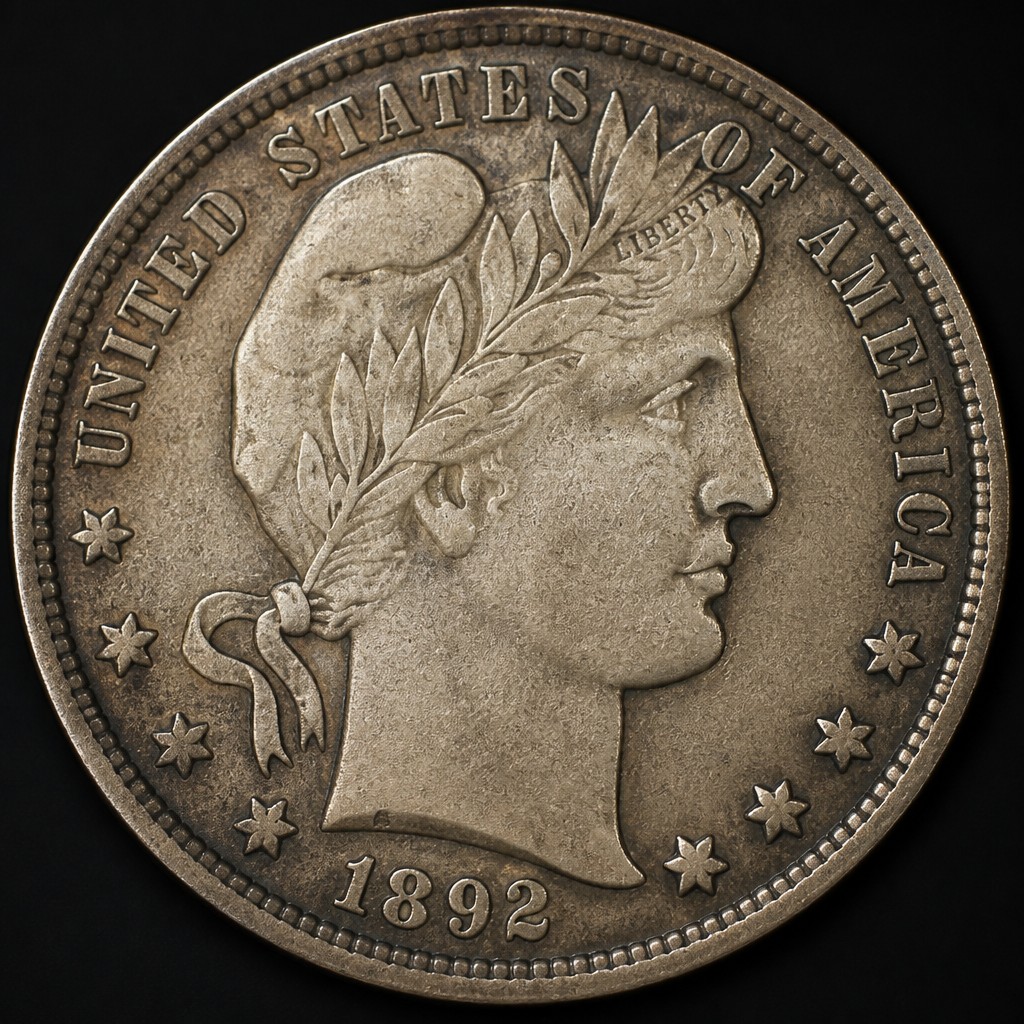
What It Is
The 1892 half dollar introduced the Barber design, created by Chief Engraver Charles E. Barber, replacing the earlier Seated Liberty half dollar. It was struck at Philadelphia, New Orleans, and San Francisco, all in 90% silver.
Obverse Design
A right-facing Liberty head wears a laurel wreath cap with "LIBERTY" lettered on the headband. Thirteen stars surround the portrait, and the date sits below.
Reverse Design
A heraldic eagle holds an olive branch and arrows, with a shield across its breast. "UNITED STATES OF AMERICA" arches along the top, "HALF DOLLAR" curves along the bottom, and a ribbon above the eagle carries "E PLURIBUS UNUM."
Size, Weight, and Edge
The coin is 30.6mm across, weighs 12.5 grams, contains 90% silver and 10% copper, and has a reeded edge.
Mint Marks
The mint mark is located on the reverse, below the eagle and just above the point where "HALF DOLLAR" begins, near the bow of the ribbon. Philadelphia coins carry no mark, New Orleans coins show an "O," and San Francisco coins show an "S." Some 1892-O coins are known with an unusually small "micro O" mint mark, a notable variety.
Telling It Apart From Similar Coins
Because the Barber design remained unchanged from 1892 to 1915, the date and mint mark are essential for identification. First-year 1892 coins should be checked closely against 1893 and later dates, since the digits "2" and "3" can be confused on worn coins.
Judging Condition at a Glance
Wear shows first on Liberty's cheek and the hair above her forehead, and on the eagle's breast feathers and top of its wings. Sharp definition in these areas signals a higher grade, while smooth, rounded contours indicate a well-worn coin.
Authenticity Red Flags
Examine any "O" or "S" mint mark for correct size, shape, and placement, since the rare micro O variety is sometimes mimicked by altering a regular O mint mark. Check for tooling around the date or mint mark, an incorrect coin weight, or a dull, grainy surface that could indicate a cast counterfeit rather than a genuine struck coin.
Frequently asked questions
Where is the mint mark on an 1892 Barber half dollar?
On the reverse, below the eagle near the ribbon bow above HALF DOLLAR.
What is the 'micro O' variety?
It refers to an unusually small O mint mark found on some 1892-O half dollars, considered a notable variety among collectors.
How do I tell an 1892 from other Barber half dollar dates?
The design is identical across the series, so you must read the date and mint mark carefully, watching for worn digits that can be misread.
What parts of the coin wear first?
Liberty's cheek and hair on the obverse, and the eagle's breast feathers and wing tops on the reverse.