
How to Identify the 1891 Seated Liberty Quarter
The final year of the Seated Liberty quarter design before it was replaced by the Barber quarter, struck in significant numbers and widely available to collectors today.
Read the full 1891 Seated Liberty Quarter encyclopedia entry →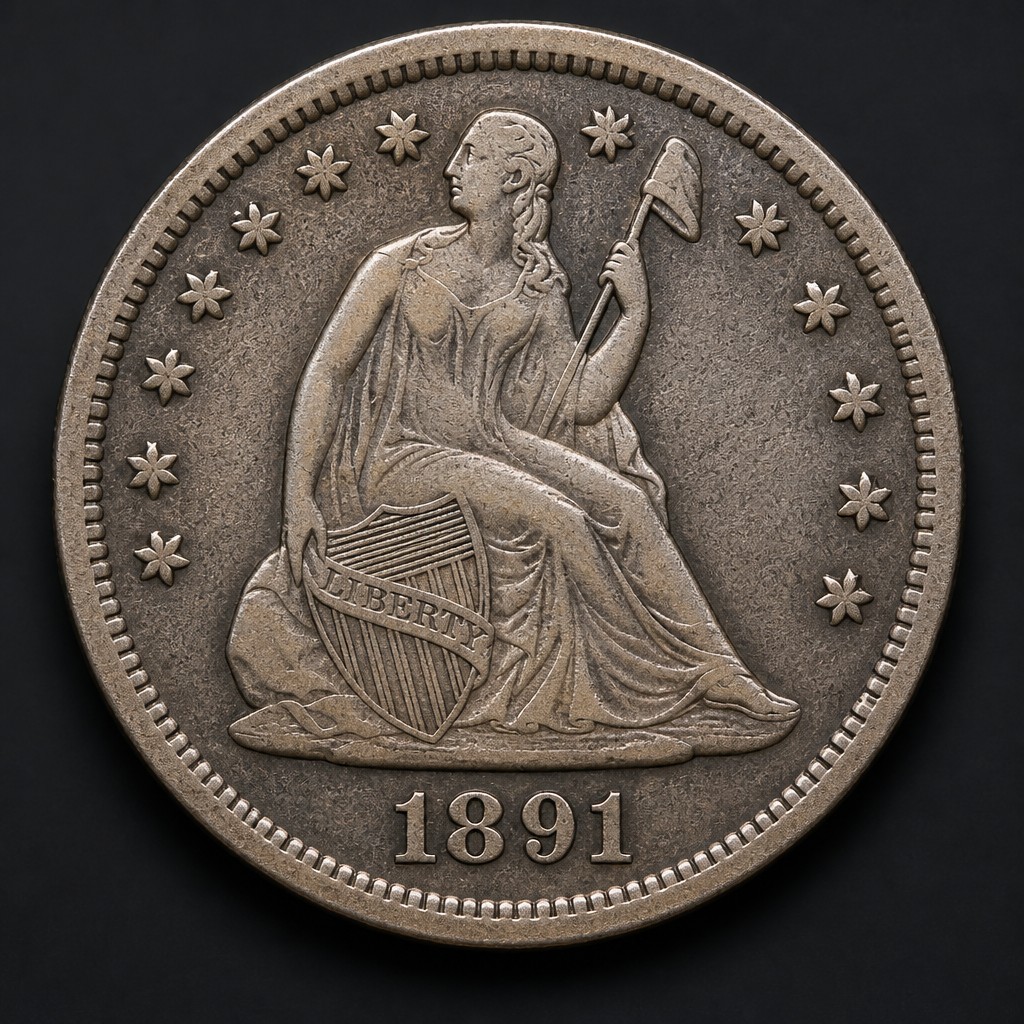
What the Coin Is
The 1891 quarter represents the last year of the long-running Seated Liberty design before the Barber quarter took its place beginning in 1892. By this point the design had been in continuous use, with minor modifications, for over five decades, making it a fitting closing chapter for one of the longest-running coin designs in U.S. history.
Obverse Design & Inscriptions
Liberty sits on a rock, holding a liberty pole topped with a cap in one hand and a shield inscribed "LIBERTY" in the other, with drapery at her elbow. Stars surround the figure and the date "1891" appears below, in the same familiar arrangement used throughout the motto-era Seated Liberty quarters.
Reverse Design & Inscriptions
The reverse shows an eagle with a shield on its breast, an olive branch and arrows in its talons, and the motto "IN GOD WE TRUST" on a ribbon above its head. "UNITED STATES OF AMERICA" and "QUARTER DOL." surround the design as on other motto-era Seated Liberty quarters, unchanged from the design used since 1866.
Size, Weight, Metal, Edge
The coin is struck in 90% silver and 10% copper, weighs 6.25 grams, measures 24.3 mm in diameter, and has a reeded edge, matching the standard used throughout the later Seated Liberty quarter years.
Mint Marks
Look below the eagle on the reverse for a mintmark. Coins without a mintmark were struck at Philadelphia; an "O" indicates New Orleans; and an "S" indicates San Francisco, all of which produced 1891-dated quarters in differing quantities.
Telling It Apart From Similar Coins
Because this is the final Seated Liberty date, compare it against the 1892 Barber quarter, which replaced the seated figure with a right-facing head of Liberty wearing a cap and laurel wreath — an entirely different obverse design. Within the 1891 issue itself, the mintmark determines which facility struck the coin, and each mint's output should be considered separately when assessing scarcity.
Judging Condition at a Glance
Examine Liberty's knee, breast, and head, along with the eagle's wing feathers and shield lines, as the primary wear points. As one of the more available Seated Liberty dates, well-preserved examples with strong design details are not unusually difficult to find compared to earlier key dates in the series, making this an approachable coin for building a type collection.
Authenticity Red Flags
As with any silver coin, inspect the surfaces for consistent, natural toning and struck (not tooled) design elements. Watch for an added or altered mintmark meant to simulate a scarcer mint of issue, and compare suspect coins against genuine examples for correct mintmark shape, size, and placement, since subtle differences can reveal an altered coin.
Frequently asked questions
Why is 1891 significant for this coin type?
It was the final year of the Seated Liberty quarter design before the Barber quarter replaced it starting in 1892.
Which mints struck 1891 quarters?
Philadelphia (no mintmark), New Orleans ('O'), and San Francisco ('S') all struck quarters dated 1891.
How do I tell it apart from a Barber quarter?
The Barber quarter shows a right-facing head portrait of Liberty rather than the full seated figure found on the 1891 design.
Is the 1891 quarter considered rare?
It is generally one of the more available dates in the Seated Liberty series compared to earlier key dates.