
How to Identify the 1888/7 Indian Head Cent Overdate
A well-known Indian Head Cent overdate variety where a 1887 working die was re-punched with an 8, leaving a visible remnant of the earlier 7 beneath the final digit.
Read the full 1888/7 Indian Head Cent Overdate encyclopedia entry →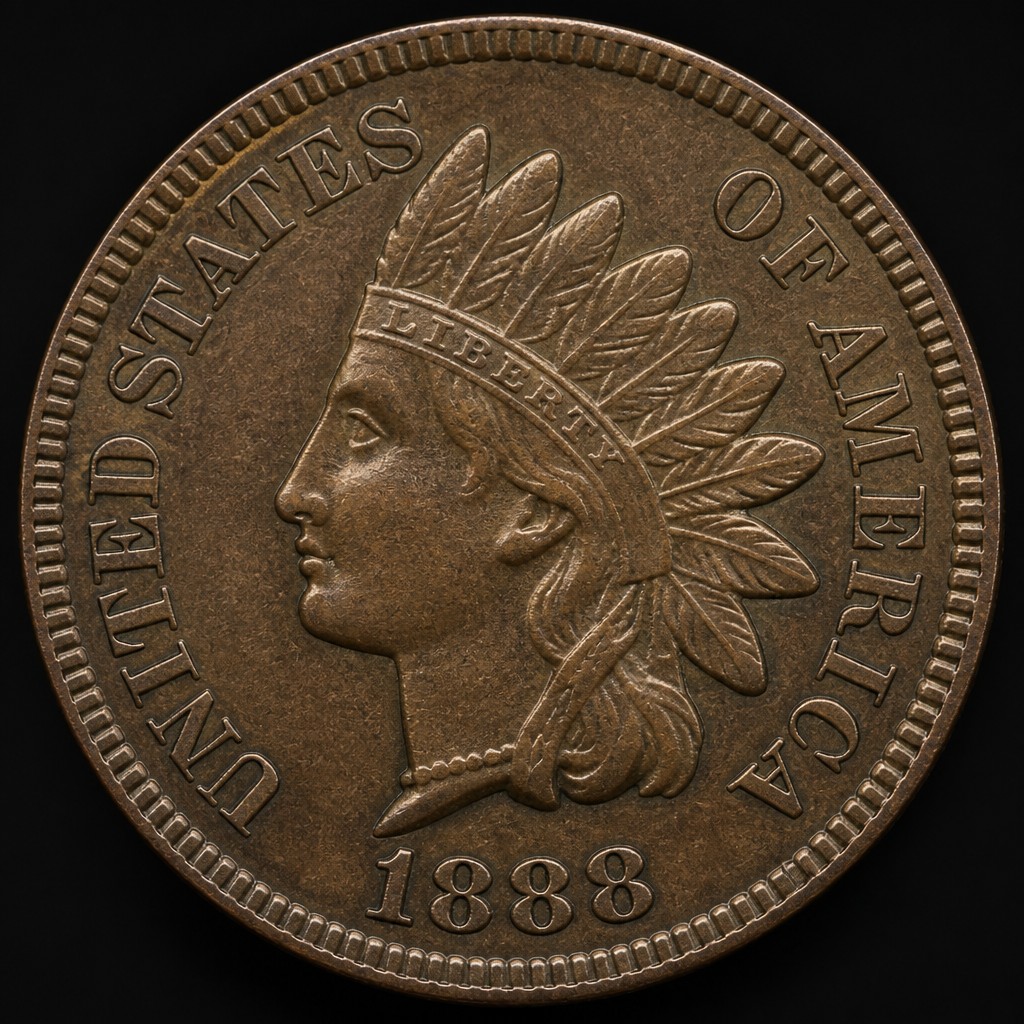
What It Is
The 1888/7 overdate is a die variety of the Indian Head Cent in which a die originally dated 1887 was repurposed the following year and re-punched with "1888," leaving traces of the old "7" visible underneath the new final "8." It is one of the more famous overdates in the series and requires careful magnification to confirm.
Obverse Design and Inscriptions
The obverse depicts Liberty as a Native American woman wearing a feathered headdress, with "UNITED STATES OF AMERICA" above and the date below. On this variety, look closely at the last digit of the date: a curved line or loop resembling the top of a "7" should be visible peeking out from within or beside the "8."
Reverse Design and Inscriptions
The reverse shows "ONE CENT" enclosed within a wreath tied with a ribbon bow at the base. This side of the coin is unaffected by the overdate and appears identical to any normal 1888 Indian Head Cent.
Size, Weight, Metal, and Edge
Like other Indian Head Cents of this era, it measures 19 mm in diameter, weighs 3.11 grams, and is struck in a bronze alloy of 95% copper with 5% tin and zinc. The edge is plain.
Mint Marks and Where to Find Them
All Indian Head Cents from 1888 were produced at the Philadelphia Mint only, so there is no mint mark present on this coin or this variety.
Telling It Apart From Similar Coins
Compare the final digit of the date to a normal 1888 cent, where the "8" has a clean, single outline. On the overdate, look for an extra curved stroke intersecting or trailing from the loop of the "8" that does not belong to a standard numeral 8; this remnant is the telltale sign of the underlying 7. Because the effect can be subtle, a loupe or macro photograph is often needed to confirm it definitively.
Judging Condition at a Glance
Examine the headdress feathers and the ribbon end on the obverse, along with the wreath ties on the reverse, for the earliest signs of wear. A coin with a sharp, well-defined date is much easier to evaluate for the overdate feature than one that is heavily worn, since wear can smooth away the fine remnant lines that reveal the underlying digit.
Authenticity Red Flags
Because genuine overdates command more interest than common dates, be alert to coins where the extra line near the date looks artificially added, scratched, or engraved rather than a natural part of the coin's original strike. A legitimate overdate shows the remnant digit as a raised, die-struck feature consistent with the rest of the coin's design, not a shallow or freshly made mark.
Frequently asked questions
What does 1888/7 mean?
It indicates an overdate variety where a die dated 1887 was re-punched with 1888, leaving a visible trace of the old 7 beneath the final 8.
Where should I look to identify this variety?
Examine the last digit of the date closely under magnification for an extra curved line associated with a 7 partially hidden within or beside the 8.
Does the 1888/7 cent have a mint mark?
No, all 1888 Indian Head Cents were struck at the Philadelphia Mint, which did not use mint marks at that time.
Can heavy wear hide the overdate feature?
Yes, wear can smooth away the subtle remnant lines of the underlying 7, making the variety harder to confirm on well-circulated coins.