
How to Identify the 1880 Shield Nickel
How to recognize the 1880 Shield Nickel, a date with an extremely small business-strike mintage where genuine circulated coins are especially scarce.
Read the full 1880 Shield Nickel encyclopedia entry →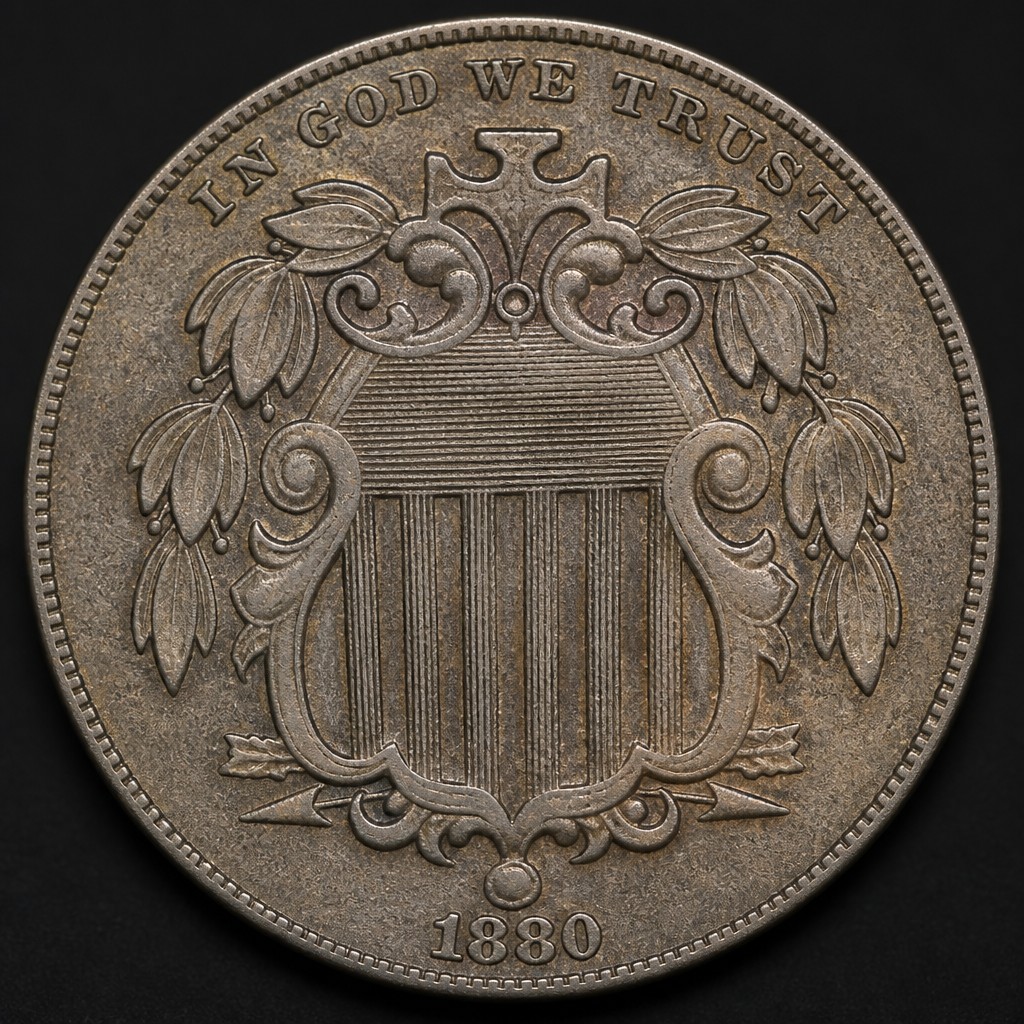
What It Is
The 1880 Shield Nickel had an unusually small number of coins struck for general circulation, making genuine, well-worn business strikes from this date quite scarce relative to most other years in the series. Far more surviving 1880 nickels are proof coins struck for collectors than are business strikes meant for everyday commerce, so context and surface characteristics matter greatly when evaluating a given coin from this date. It is one of several very low-mintage years near the end of the Shield Nickel series, alongside the proof-only 1877 and 1878 dates.
Obverse Design
The obverse shows a heraldic shield with vertical stripes below a horizontal top band, above crossed arrows and an olive branch, with the date at the bottom edge.
Reverse Design
The reverse features a large numeral 5 at the center, surrounded by stars with a plain field between them, consistent with the No Rays style used throughout the later years of the series. UNITED STATES OF AMERICA arcs around the top border.
Size, Weight, Metal, Edge
The coin is 20.5mm in diameter, weighs 5.00 grams, is composed of 75% copper and 25% nickel, and has a plain edge.
Mint Marks
All Shield Nickels, including those dated 1880, were struck only at Philadelphia and carry no mint mark, as this series was never produced at any other mint facility.
Business Strike vs. Proof
Because so few 1880 nickels were made for circulation, most surviving examples are proofs, identifiable by their sharp rims, fully struck details, and mirror-like fields. A coin showing actual wear from circulation, rather than proof characteristics, represents the far scarcer business strike and should be evaluated carefully on its own merits given how rarely genuine circulated examples of this date actually surface.
Grading at a Glance
For a circulated business strike, check the shield's stripes and the olive branch for wear, along with the numeral 5 and star points on the reverse. For a proof, judge the coin by how clean and undisturbed its mirrored fields remain rather than by wear, since proof coins were not struck for use in everyday transactions and should show little to no actual circulation.
Authenticity Red Flags
Given how valuable a genuine circulated 1880 business strike is relative to more common proof survivors, be cautious of coins with altered dates from more common years, or proofs that have been artificially worn or cleaned to be misrepresented as business strikes. Careful examination of the date digits and overall surface consistency under magnification is essential before drawing conclusions about a specific coin's true status and originality, and comparing the piece to well-documented reference examples is always a sensible extra step.
Frequently asked questions
Are most surviving 1880 Shield Nickels proofs or business strikes?
Most surviving examples are proofs; genuine circulated business strikes from this date are especially scarce.
Does the 1880 Shield Nickel have rays on the reverse?
No, by 1880 the series used the No Rays style with a plain field between the stars.
Where would a mint mark appear on this coin?
Nowhere; all Shield Nickels were struck at Philadelphia only, with no mint mark.
How can I tell a proof from a business strike on this date?
Proofs show sharp rims and mirror-like fields, while business strikes show ordinary luster and, if circulated, visible wear.