
How to Identify the 1878 Morgan Dollar (8 Tail Feathers)
The 1878 Morgan Dollar 8 Tail Feathers variety was struck early in the series' debut year before the reverse eagle was revised to have 7 tail feathers.
Read the full 1878 Morgan Dollar (8 Tail Feathers) encyclopedia entry →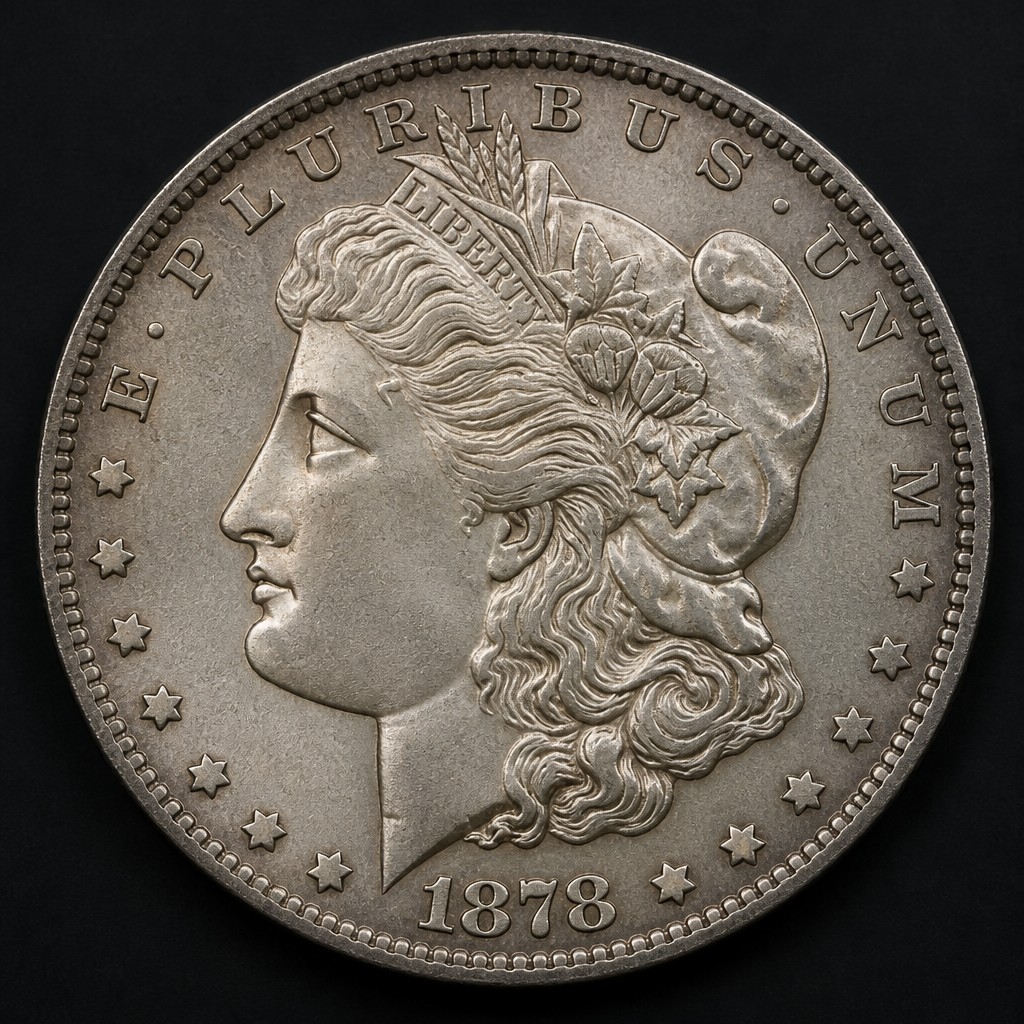
What It Is
The 1878 Morgan Dollar 8 Tail Feathers (8TF) variety represents the earliest production of the brand-new Morgan dollar design, the first standard silver dollar struck since the Seated Liberty dollar ended in 1873. Shortly after production began, the Mint revised the reverse eagle to have 7 tail feathers instead of 8, since eagles naturally have an odd number of tail feathers.
Obverse Design
Liberty faces left wearing a cap, with wheat and cotton forming a wreath behind her head. "E PLURIBUS UNUM" arcs above, stars surround the portrait, and "1878" is below, designed by George T. Morgan.
Reverse Design
An eagle with wings spread holds an olive branch and arrows, encircled by a wreath. On the 8 Tail Feathers variety, count the feathers fanning out beneath the eagle's tail — there are eight rather than the seven found on all later Morgan dollars.
Size, Weight & Metal
Struck in 90% silver, 10% copper, the coin weighs 26.73 grams, measures 38.1 mm across, and has a reeded edge.
Mint Marks
The 8 Tail Feathers variety is generally associated with early 1878 Philadelphia production and carries no mint mark; look on the reverse below the wreath bow for any mint mark, since its absence is expected on this early variety.
Telling It Apart from Similar Coins
Counting the tail feathers is the definitive way to identify this variety: 8 feathers means the first design used briefly in 1878, while 7 feathers (the "7 Tail Feathers" variety, used for the rest of 1878 and every year after) is far more common. A transitional "7 over 8" variety also exists, showing faint traces of an extra feather beneath the visible 7, requiring magnification to confirm.
Grading at a Glance
Wear appears first on Liberty's hair above her ear and on the eagle's breast feathers. Because this is a first-year variety struck in relatively limited quantity compared to later 7TF Morgans, well-struck, lightly worn examples are of particular interest to collectors focused on this specific reverse type.
Authenticity Red Flags
Because identification hinges on a small design detail, check the tail feather count carefully under magnification rather than relying on a quick glance, and be aware that wear or a weak strike can make feather counting difficult on lower-grade coins. Given the added value of the 8TF variety over a common 7TF Morgan, be cautious of coins with an area near the tail feathers that looks re-engraved, tooled, or unnaturally sharp compared to the rest of the design.
Frequently asked questions
How do I count the tail feathers on a Morgan Dollar?
Look at the reverse beneath the eagle's tail, where thin lines fan outward; count each individual feather line under magnification.
Why did the Mint change from 8 to 7 tail feathers?
Real eagles have an odd number of tail feathers, so the design was corrected shortly after 1878 production began.
What is the '7 over 8' variety?
It's a transitional die where faint traces of an 8th feather remain visible beneath the corrected 7-feather design, visible only under magnification.
Does the 8 Tail Feathers variety have a mint mark?
No, it is associated with early 1878 Philadelphia production and carries no mint mark.