
How to Identify the 1878-CC Trade Dollar
A low-mintage Carson City Trade dollar prized by collectors; identified by its seated Liberty obverse, standing eagle reverse, and CC mint mark below the eagle.
Read the full 1878-CC Trade Dollar encyclopedia entry →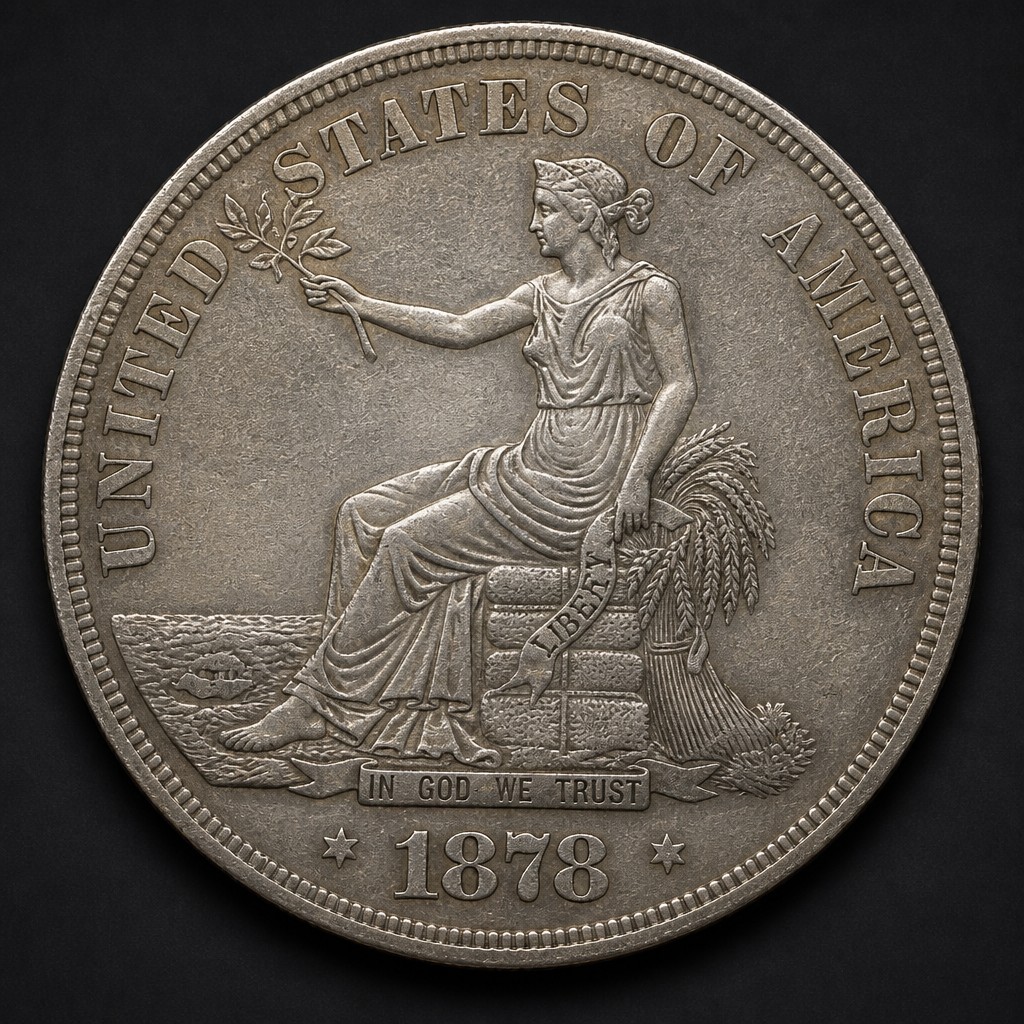
What It Is
The Trade dollar was struck by the U.S. Mint from 1873 to 1885 specifically for commerce with Asia, where merchants demanded silver coins of guaranteed weight and fineness. Business-strike (circulating) Trade dollars were made through 1878, and the Carson City issue of that year had a modest mintage, making it one of the more sought-after dates in the series.
Obverse Design
The obverse shows a seated figure of Liberty facing left on a bale of merchandise, looking out toward the sea. Her right hand extends an olive branch and her left holds a shield with a scroll reading "LIBERTY." Wheat stalks sit behind her, and rolling ocean waves fill the base, a nod to the coin's role in overseas trade. Thirteen stars line the upper rim, and the date sits at the bottom.
Reverse Design & Inscriptions
The reverse features a bald eagle with wings raised, clutching three arrows and an olive branch, standing above a scroll. "IN GOD WE TRUST" arches above the eagle, "UNITED STATES OF AMERICA" wraps the upper rim, and "TRADE DOLLAR" appears below the eagle. Just under the wings, the weight and fineness statement "420 GRAINS, 900 FINE" is spelled out directly on the coin.
Size, Weight, Metal, and Edge
The Trade dollar weighs 420 grains (27.22 grams), is struck in .900 fine silver, measures 38.1 mm across, and has a reeded edge. It is noticeably heavier than a Morgan or Seated Liberty dollar of the same era because it was deliberately made to compete with Mexican and other trade coins circulating in Asia.
Mint Mark Location
Look on the reverse just below the eagle's tail feathers and above the word "DOLLAR" in "TRADE DOLLAR" — the small "CC" mint mark for Carson City sits there. Coins without a mint mark were struck in Philadelphia; an "S" indicates San Francisco.
Telling It Apart From Similar Coins
Do not confuse a Trade dollar with a Morgan or Seated Liberty dollar. The Trade dollar's Liberty sits on a bale with waves beneath her rather than a plain rock, and it is the only U.S. silver dollar with the weight and fineness spelled out on the coin itself. Its slightly larger diameter and heavier weight compared to a Peace or Morgan dollar are also useful clues when the coin is worn.
Judging Condition at a Glance
Check Liberty's head, knee, and breast, plus the eagle's head and wing tips — these are the first spots to flatten with wear. Many surviving Trade dollars carry small punched "chopmarks" from Chinese merchants who tested the silver; these are historical markings rather than damage from circulation in the U.S., but they do affect eye appeal and value.
Authenticity Red Flags
Because genuine 1878-CC examples carry a real premium, watch for added or altered mint marks, particularly a "CC" that looks flat, oddly shaped, or sits in the wrong position relative to genuine examples. Cast counterfeits often show a grainy surface, soft details, or a seam around the edge. Weigh any suspect piece — a coin noticeably off from 27.22 grams is not genuine.
Frequently asked questions
Where is the mint mark on an 1878-CC Trade dollar?
It is on the reverse, below the eagle's tail feathers and just above the word 'DOLLAR' in 'TRADE DOLLAR.'
Why do some Trade dollars have small stamped marks on them?
Those are chopmarks applied by Asian merchants and bankers to verify the silver content; they are a historical feature, not damage, though they affect value.
How can I tell a Trade dollar from a Morgan dollar?
The Trade dollar shows Liberty seated on a bale with ocean waves, is slightly larger and heavier, and spells out '420 GRAINS, 900 FINE' on the reverse, none of which appear on a Morgan dollar.
What weight should a genuine Trade dollar be?
420 grains, which equals 27.22 grams; a coin that differs meaningfully from this weight should be examined closely.