
How to Identify the 1878 7/8 Tail Feathers Morgan Dollar
A first-year Morgan dollar variety where the eagle's tail shows remnants of an extra feather, created when reverse dies were changed mid-production from eight tail feathers to seven.
Read the full 1878 7/8 Tail Feathers Morgan Dollar encyclopedia entry →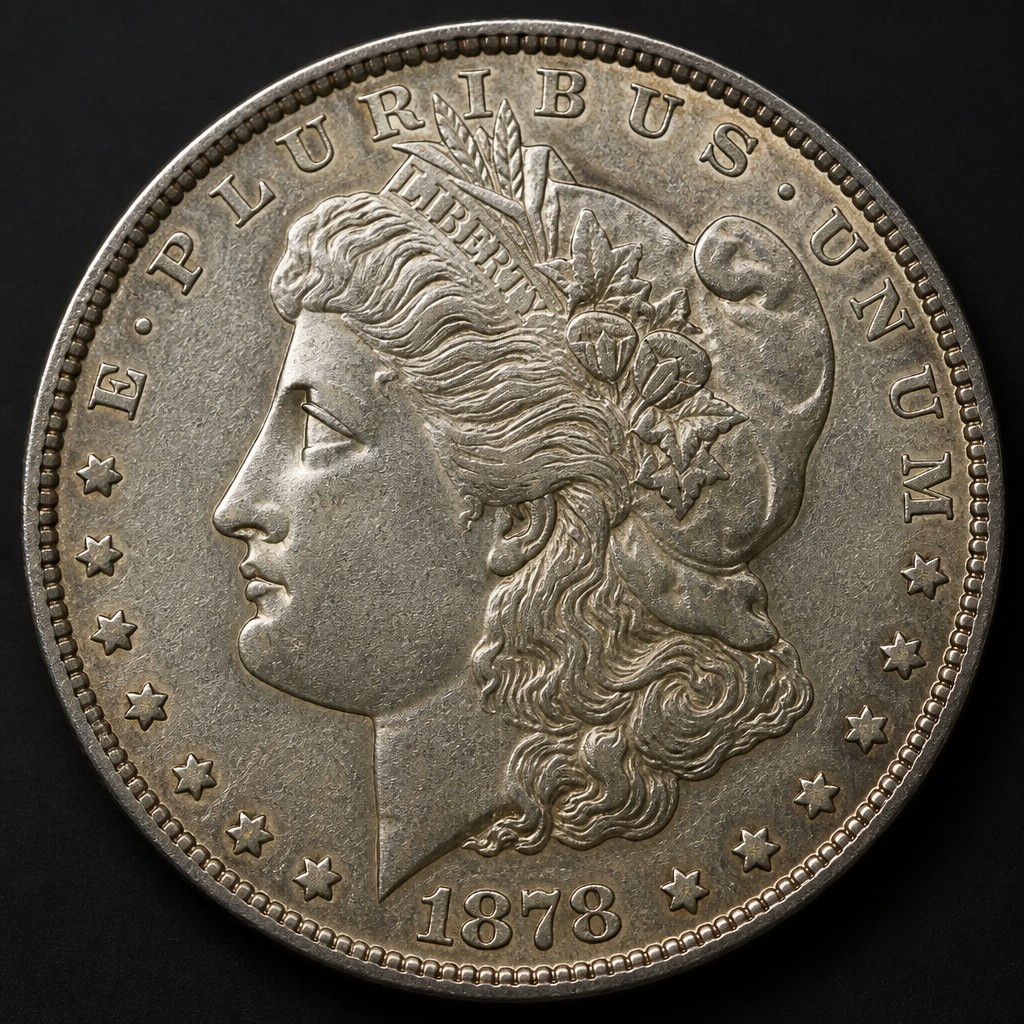
What the Coin Is
When the Morgan dollar debuted in 1878, the Mint initially prepared reverse dies showing the eagle with eight tail feathers. This was quickly revised to seven feathers, and some reverse dies already in use were re-engraved rather than discarded, leaving traces of the original eighth feather visible beneath the new seven-feather design. This is known as the "7 over 8 Tail Feathers" or 7/8 TF variety.
Obverse Design & Inscriptions
The obverse shows Liberty's head facing left in a cap inscribed LIBERTY, surrounded by a wreath of wheat and other crops, with thirteen stars encircling the design and the date 1878 at the bottom.
Reverse Design & Inscriptions
The reverse is where the key variety feature lies: an eagle with wings spread, holding arrows and an olive branch, standing above a wreath. On the 7/8 TF variety, closely examine the tail feathers below the wings; look for a faint extra feather tip or outline overlapping the main seven feathers, strongest on well-preserved examples.
Size, Weight, Metal & Edge
The coin measures 38.1mm in diameter, weighs 26.73 grams, is struck in 90% silver and 10% copper, and has a reeded edge.
Mint Marks
This variety is generally found on coins struck without a mint mark, indicating production at the Philadelphia Mint. Regular 1878 Morgan dollars were also struck at San Francisco (S) and Carson City (CC), with the mint mark located on the reverse below the wreath.
Telling It Apart From Similar Coins
Separate this variety from the plain "8 Tail Feathers" type (which shows a clean eight feathers with no overlap) and the standard "7 Tail Feathers" type (seven feathers with no doubling). The 7/8 TF variety is distinguished by an obvious overlapping or doubled feather tip among the tail feathers, sometimes described as "strong" or "weak" depending on how visible the extra feather remains.
Judging Condition at a Glance
Check Liberty's cheek and hair above the ear, plus the eagle's breast and wing feathers, for smoothing that indicates circulation. Because the tail feather area is a natural focal point for grading, a coin with sharp, undamaged feather tips generally reflects better preservation.
Authenticity Red Flags
This variety is popular enough to attract altered coins, so be wary of tail feather areas that look tooled, scratched, or artificially built up rather than showing the natural raised relief of a die-struck design. Compare the overall strike quality and luster to the rest of the coin; inconsistencies localized only to the tail feather area are a warning sign.
Frequently asked questions
What does '7/8 Tail Feathers' mean?
It refers to a reverse die originally engraved with eight tail feathers on the eagle, later re-cut to seven, leaving a faint trace of the extra feather visible.
Where do I look to identify this variety?
Examine the eagle's tail feathers on the reverse, just below the wings, for an overlapping or doubled feather tip.
Which mints produced 1878 Morgan dollars?
Philadelphia (no mint mark), San Francisco (S), and Carson City (CC) all struck 1878 Morgan dollars.
How is this different from the plain 8 Tail Feathers variety?
The plain 8 Tail Feathers type shows a clean eight feathers with no doubling, while the 7/8 TF variety shows an extra feather tip overlapping the main seven.