
How to Identify the 1877 Indian Head Cent
A visual guide to the 1877 Indian Head Cent, the key date of the series due to its low mintage, covering its headdress portrait, oak wreath and shield reverse, and how to spot common date alterations.
Read the full 1877 Indian Head Cent encyclopedia entry →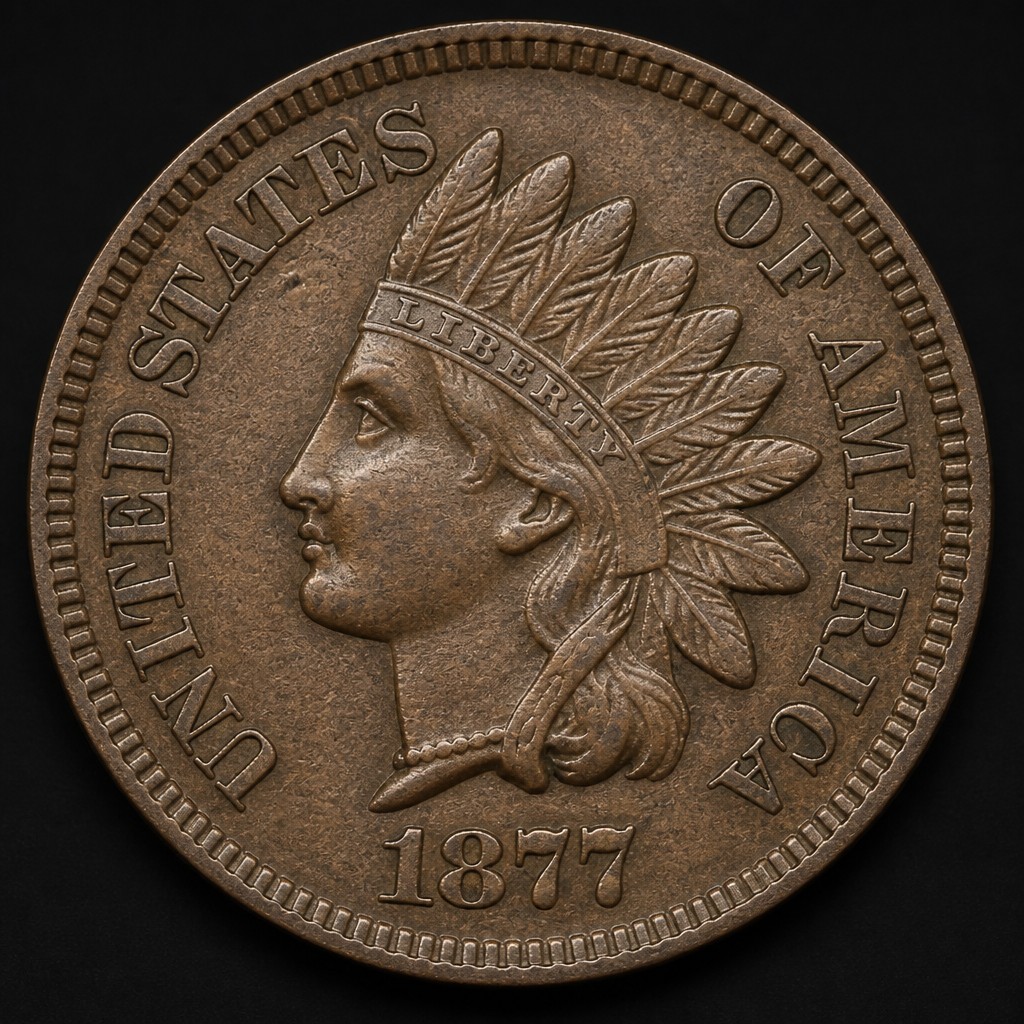
What It Is
The 1877 Indian Head Cent is widely regarded as the key date of the entire Indian Head series, largely because of its notably low original mintage compared to most other years in the run. It is a bronze small cent produced during the design's long tenure from 1859 to 1909.
Obverse Design
Liberty is depicted wearing a Native American-style feathered headdress, facing left, with UNITED STATES OF AMERICA around the border and the date below.
Reverse Design
A wreath of oak leaves, tied with a ribbon and topped by a shield, encircles the words ONE CENT.
Size, Weight, Metal, and Edge
By 1877, the Indian Head Cent was struck in bronze, an alloy of about 95% copper with the remainder tin and zinc. It weighs about 3.11 grams and measures 19mm in diameter, with a plain edge.
Mint Marks
The 1877 Indian Head Cent has no mint mark, as it was struck solely at the Philadelphia Mint; branch mint issues of this design did not begin until years later.
Telling It Apart From Similar Coins
Because 1877 is a comparatively low-mintage, high-demand date, it is a frequent target for date alterations from more common years, particularly by modifying an 1873, 1878, or 1879 cent. Genuine 1877 cents should show a natural, unaltered numeral style consistent with the rest of the date, with no unusual tooling marks, seams, or inconsistent spacing around the last digit.
Judging Condition
Look at the feather tips of the headdress, the ribbon detail on the reverse wreath, and the clarity of "LIBERTY" on the headband, which appears in raised letters on the headdress band on well-preserved coins. Wear typically flattens the feather tips and the ribbon knot first, while the fields around the portrait remain relatively unaffected until the coin is more heavily circulated.
Authenticity Notes
Given its status as the series' key date, the 1877 cent should always be checked carefully for signs of an added or altered digit, such as a slightly different font style, uneven spacing between numerals, or visible file or engraving marks under magnification around the final digit of the date. Comparing the coin's overall wear pattern to the sharpness of the date can also help; a date that looks fresher or different in style than the rest of a well-worn coin is a warning sign.
Frequently asked questions
Why is the 1877 Indian Head Cent considered the key date?
It had a notably low original mintage compared to other years in the series, making genuine examples scarce.
Does the 1877 Indian Head Cent have a mint mark?
No, it was struck only at the Philadelphia Mint, since branch mint Indian Head cents did not begin until later.
How are 1877 cents commonly faked?
By altering a digit on a more common date, such as 1873, 1878, or 1879, to resemble a 7; the added digit's style and spacing should be examined closely.
What metal is the 1877 Indian Head Cent made from?
By 1877 the cent was struck in bronze, about 95% copper with the balance tin and zinc.