
How to Identify the 1875-S Twenty-Cent Piece
An identification guide to the 1875-S twenty-cent piece, the most commonly available date of the short-lived series, covering its design, plain edge, and San Francisco mint mark.
Read the full 1875-S Twenty-Cent Piece encyclopedia entry →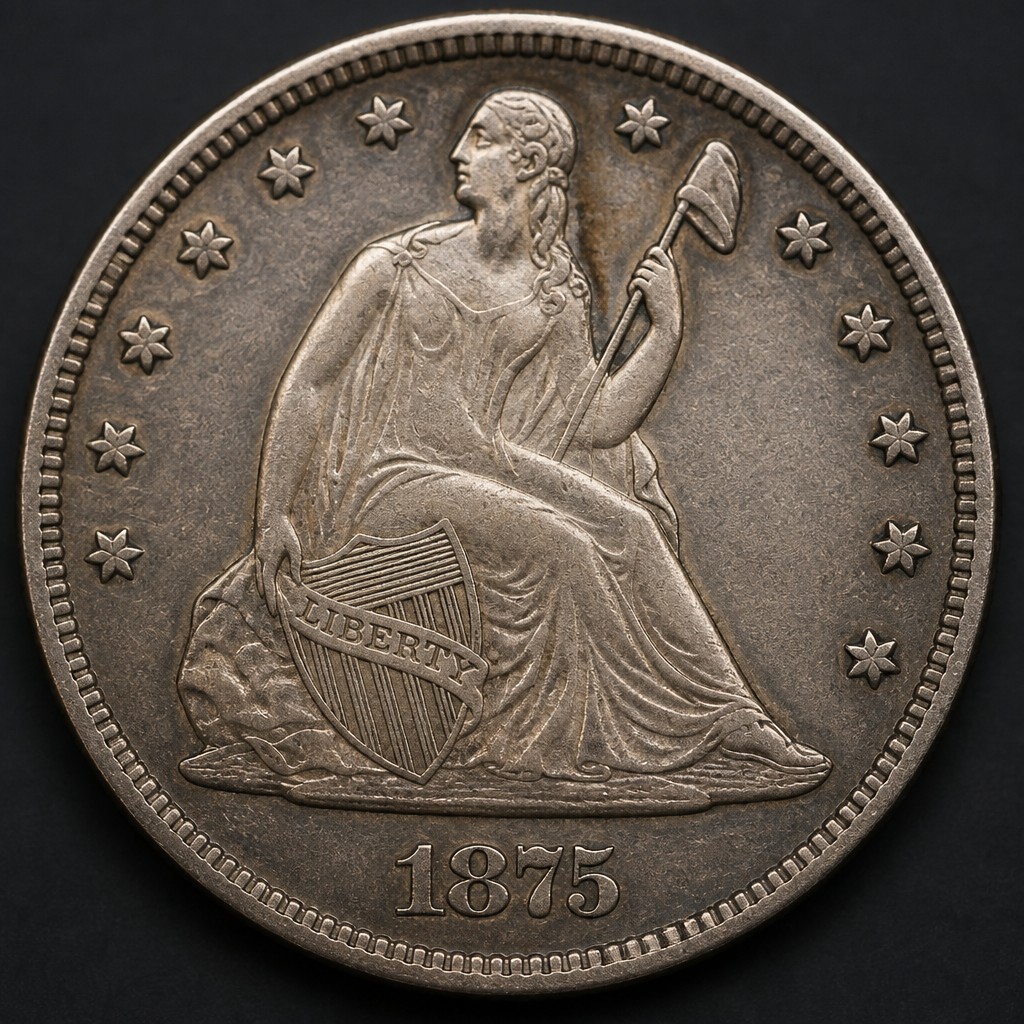
What It Is
Struck during the twenty-cent piece's brief run from 1875 to 1878, the 1875-S was produced at the San Francisco mint in the series' highest volume, making it the most obtainable date for collectors today and a good reference point for studying the denomination as a whole.
Obverse Design
A seated Liberty figure holds a shield inscribed "LIBERTY," with a liberty cap on a pole behind her. Stars ring the border and the date appears at the bottom, following the same general Seated Liberty format used across several silver denominations of the era.
Reverse Design
An eagle with outstretched wings holds arrows and an olive branch, with "UNITED STATES OF AMERICA" around the rim and "TWENTY CENTS" at the bottom. No "E PLURIBUS UNUM" appears on this denomination's reverse, unlike the contemporary quarter dollar.
Size, Weight, Metal & Edge
The coin is 22mm in diameter, weighs 5 grams, is 90% silver, and has a plain, smooth edge rather than the reeded edge found on quarters of similar size.
Mint Mark Location
The "S" mint mark sits on the reverse, below the eagle and directly above the "TWENTY CENTS" lettering.
Telling It Apart from Similar Coins
Its smooth edge is the quickest way to separate it from a same-sized quarter dollar in a mixed group of old coins. Within the twenty-cent series itself, comparing the mint mark distinguishes it from the Philadelphia issue with no mint mark, the Carson City "CC" issues, and the later proof-only dates; the 1875-S is by far the most frequently encountered due to its comparatively large mintage that year.
Judging Condition at a Glance
Look at Liberty's head, breast, and knee for wear on the obverse, and the eagle's breast and wing feathers on the reverse; these are the first points to smooth out with circulation, followed by softening in the finer details of the shield and stars.
Authenticity Red Flags
Since this is the most common date in the series, altering it into a scarcer date or mint mark, such as a fake "CC," is a more relevant concern than the coin itself being counterfeited outright from scratch. Compare the mint mark style and placement to genuine examples, and check for tooling, filing, or an inconsistent surface texture that could indicate an added or altered mint mark meant to misrepresent the coin's origin.
Frequently asked questions
Is the 1875-S a rare twenty-cent piece?
No, it has the highest mintage in the series and is the most commonly found date among twenty-cent pieces.
How do I tell it apart from a quarter dollar?
Check the edge: the twenty-cent piece has a plain, smooth edge, while quarters have a reeded edge.
Where is the mint mark located?
On the reverse, below the eagle and just above the words TWENTY CENTS.
What should I watch for regarding fakes?
Because it is common, the main concern is an altered mint mark meant to pass it off as a scarcer Carson City or Philadelphia issue; compare the mint mark closely to genuine examples.
Does the 1875-S have E Pluribus Unum on the reverse?
No, that motto does not appear on twenty-cent pieces, which distinguishes the reverse from the similar-looking quarter dollar of the period.