
How to Identify the 1873 Two-Cent Piece (Proof Only)
A guide to the final-year 1873 Two-Cent Piece, struck exclusively as proofs for collectors, and its Closed 3 versus Open 3 date varieties.
Read the full 1873 Two-Cent Piece (Proof Only) encyclopedia entry →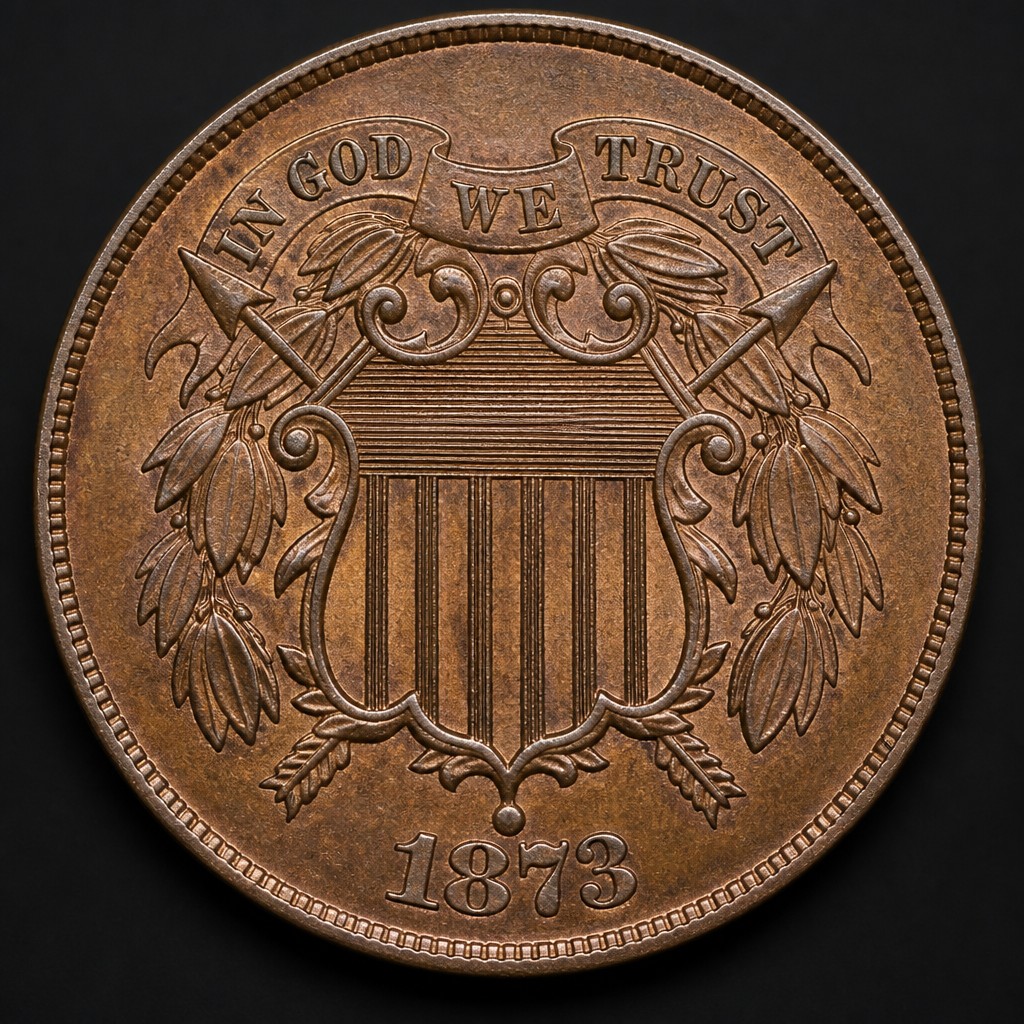
What It Is
By 1873, the Two-Cent Piece had fallen out of favor with the public, and no coins were struck for circulation that year. Instead, the Philadelphia Mint produced a small run of proof coins specifically for collectors, making the 1873 date proof-only — there is no circulation-strike version to compare it against.
Obverse Design
The obverse carries the same design used throughout the series: a shield with crossed arrows behind it, a laurel sprig at its base, a banner above reading "IN GOD WE TRUST," and the date below.
Reverse Design
The reverse shows the numeral "2" inside a wheat wreath, with "CENTS" below and "UNITED STATES OF AMERICA" around the top rim, unchanged from earlier years.
Size, Weight, Metal, and Edge
Like all Two-Cent Pieces, the 1873 issue is bronze, about 6.22 grams, 23mm in diameter, with a plain edge. As proof coins, genuine examples typically show sharp, squared rims and fully struck-up design details from the specially prepared dies used for collector coinage.
Mint Marks
There is no mint mark, since all Two-Cent Pieces, proof or otherwise, were struck at Philadelphia.
Telling It Apart from Similar Coins
The 1873 date is recognized in two die varieties based on the shape of the "3" in the date: Closed 3, where the upper and lower loops of the numeral nearly meet, and Open 3, where the loops are more separated. The Closed 3 is considered the original proof striking, while the Open 3 is associated with a later restrike. Because this date was never struck for circulation, any 1873 Two-Cent Piece showing heavy wear consistent with pocket circulation, rather than the sharp fields expected of a proof, should be examined carefully, since it may be a different date with an altered numeral or another type of coin entirely.
Judging Condition at a Glance
Because these were struck as proofs, grading focuses on the quality of the mirrored fields and the presence of hairlines, spots, or cleaning marks rather than wear from circulation. Look at the shield stripes and wreath leaves for full, crisp detail, and check the fields around the devices for a reflective, unblemished surface.
Authenticity Red Flags
Given its rarity and collector demand, watch for reworked dates on more common Two-Cent Piece years, mismatched surface texture between the date and the rest of the coin, and softness of detail that doesn't match a genuine proof strike. A coin claiming to be this date but showing the wear pattern of a well-circulated piece is a strong warning sign.
Frequently asked questions
Was the 1873 Two-Cent Piece made for everyday use?
No, 1873 was proof-only; the Mint made no circulation strikes that year, only coins for collectors.
What's the difference between Closed 3 and Open 3 varieties?
It refers to the shape of the numeral 3 in the date — Closed 3 has the loops nearly touching, while Open 3 has them more spread apart.
Why would a 1873 Two-Cent Piece show wear if it was proof-only?
It generally shouldn't. Heavy circulation wear on a coin dated 1873 is a red flag that the date may have been altered from a more common year.
What metal and size is the 1873 Two-Cent Piece?
Like all Two-Cent Pieces, it's bronze, about 23mm across and roughly 6.22 grams.