
How to Identify the 1867 Shield Nickel No Rays
How to recognize the revised 1867 Shield Nickel reverse with the rays removed, the design style used for the remainder of the series.
Read the full 1867 Shield Nickel No Rays encyclopedia entry →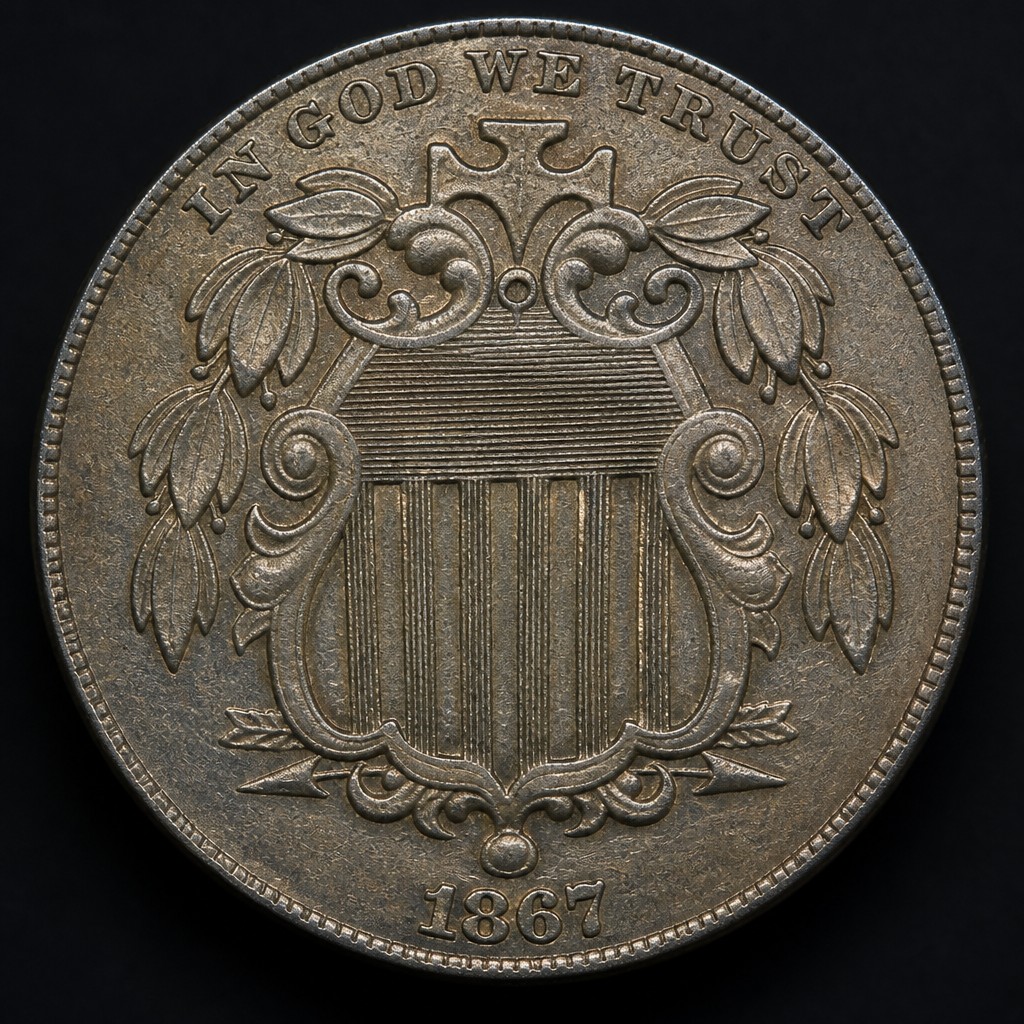
What It Is
The 1867 Shield Nickel No Rays variety reflects a mid-year design change that removed the small rays from between the reverse stars. This simplified reverse became the standard for the rest of the Shield Nickel series through its final year in 1883, making the No Rays style the far more common of the two types found within the run of the series overall. The change was driven largely by practical minting concerns rather than any aesthetic preference.
Obverse Design
The obverse shows a heraldic shield with vertical stripes below a horizontal top band, set above crossed arrows and an olive branch. The date is at the bottom of the coin, just below the shield's point.
Reverse Design
A large numeral 5 sits at the center, surrounded by a ring of stars. Unlike the earlier type, the field between the stars is plain, with no rays present anywhere in the design. UNITED STATES OF AMERICA curves around the top rim.
Size, Weight, Metal, Edge
The coin is 20.5mm in diameter, weighs 5.00 grams, is composed of 75% copper and 25% nickel, and has a plain edge.
Mint Marks
Shield Nickels were struck only at the Philadelphia Mint, so 1867 No Rays examples carry no mint mark anywhere on the coin.
Telling It Apart from Similar Coins
The plain field between the stars, with no small rays present, is what identifies this as the No Rays type. Because 1867 exists in both the With Rays and No Rays styles, checking the reverse field carefully is the only way to tell which type a given 1867 coin represents; the date alone is not enough to determine the variety, since both were struck in the same calendar year.
Grading at a Glance
Look at the shield's stripes and the olive branch leaves for early wear on the obverse. On the reverse, the numeral 5 and the stars themselves show wear on their highest points first; a coin with crisp, well-defined star points and a bold, fully struck 5 generally grades higher than one with soft, rounded details.
Authenticity Red Flags
Because the No Rays type was struck for many years after 1867, watch for date alterations on coins from later, more common years attempting to simulate 1867, given the added collector interest in that specific transitional year of the series. Examine the date closely for tool marks or an unnatural digit shape, and compare wear patterns on the date to the rest of the coin to check for consistency between the two areas. When in doubt, a coin's overall surface quality and toning should look uniform, since selectively altered areas often stand out under close inspection.
Frequently asked questions
How is the No Rays type different from the With Rays type?
The No Rays reverse has a plain field between the stars, while the With Rays version has small raised lines filling that space.
Does 1867 exist with both ray types?
Yes, 1867 was a transitional year, so both With Rays and No Rays examples exist from that date.
Where is the mint mark on this coin?
There isn't one; all Shield Nickels were struck at Philadelphia only.
What should I check if the date looks unusual?
Look closely for tool marks or inconsistent wear around the digits, which can indicate an altered date.