
How to Identify the 1866 Shield Nickel With Rays
How to recognize the first-year Shield Nickel design featuring rays between the reverse stars, later dropped due to production problems.
Read the full 1866 Shield Nickel With Rays encyclopedia entry →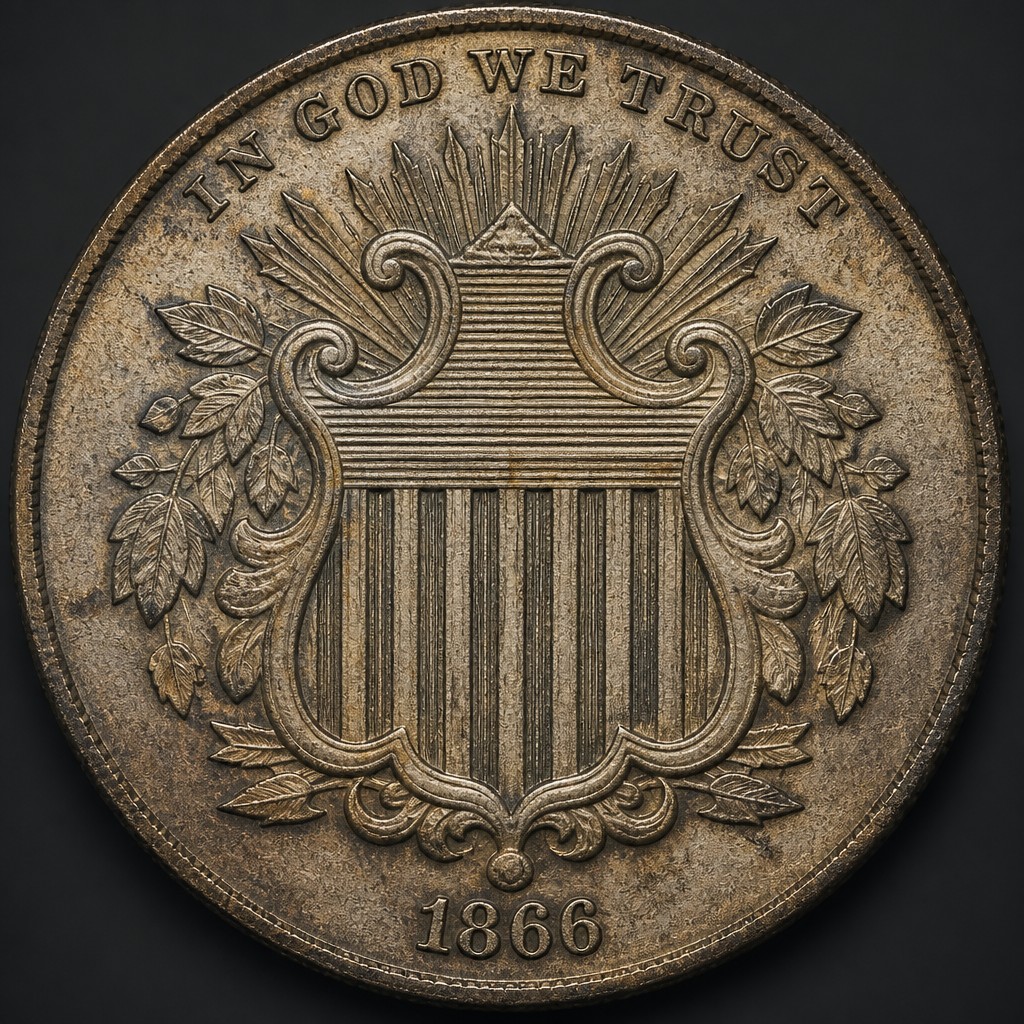
What It Is
The 1866 Shield Nickel is the first year of the Shield design, which introduced a larger, thicker five-cent coin made of a copper-nickel alloy to replace the small silver half dime that had circulated for decades. The 1866 date and part of 1867 used a reverse with small rays between the stars, a design element dropped later in 1867 after it proved troublesome in production.
Obverse Design
The obverse shows a heraldic shield with vertical stripes on the lower portion and a horizontal band across the top, resting above a pair of crossed arrows and an olive branch, a design meant to evoke both strength and peace. The date is placed below the shield at the bottom of the coin.
Reverse Design
The reverse centers on a large numeral 5, surrounded by a circle of stars representing the states. Between each pair of stars, short raised rays fill the field, giving this early type its "With Rays" name. UNITED STATES OF AMERICA arcs around the top border.
Size, Weight, Metal, Edge
The Shield Nickel is 20.5mm in diameter, weighs 5.00 grams, and is composed of 75% copper and 25% nickel, the same alloy that gave the five-cent denomination its common name. The edge is plain, with no reeding.
Mint Marks
All Shield Nickels, including every 1866 example, were struck exclusively at the Philadelphia Mint. No mint marks exist for this series at any point in its production.
Telling It Apart from Similar Coins
The rays between the stars are the defining feature of this early type. Later Shield Nickels, starting partway through 1867, removed the rays, leaving plain fields between the stars; a coin without rays is the "No Rays" type rather than the 1866 style, even if the date reads 1867 rather than 1866, since both varieties exist for that particular year.
Grading at a Glance
Check the shield's vertical stripes and the horizontal top band for wear, along with the leaves of the olive branch, which flatten quickly with circulation. On the reverse, the rays themselves are delicate and wear down fast, so their presence and sharpness is a good indicator of a coin's overall condition and how much handling it has seen.
Authenticity Red Flags
Because die clashing was common with this design, look for unusual raised outlines or ghostly incuse shapes on either side that don't match the intended design, which can indicate significant die clash damage rather than damage to the coin itself. Also be cautious of coins with rays that look added or artificially deepened, and always confirm the date is unaltered and consistent with normal, gradual wear patterns rather than sharp, isolated tool marks.
Frequently asked questions
What makes the 1866 Shield Nickel different from later dates?
It has small rays between the stars on the reverse, a feature used only in 1866 and part of 1867 before being discontinued.
Does the 1866 Shield Nickel have a mint mark?
No, all Shield Nickels were struck only at Philadelphia, so none carry a mint mark.
Why were the rays removed from the design?
The rays contributed to die clashing and breakage problems, prompting the Mint to simplify the reverse later in 1867.
What metal is the Shield Nickel made of?
75% copper and 25% nickel, the alloy that gave the five-cent denomination its common name.