
How to Identify the 1861 Confederate Half Dollar
The 1861 Confederate half dollar pairs a regular Seated Liberty obverse with a special Confederate States reverse; genuine originals are extraordinarily rare, and most surviving pieces are later restrikes or replicas.
Read the full 1861 Confederate Half Dollar encyclopedia entry →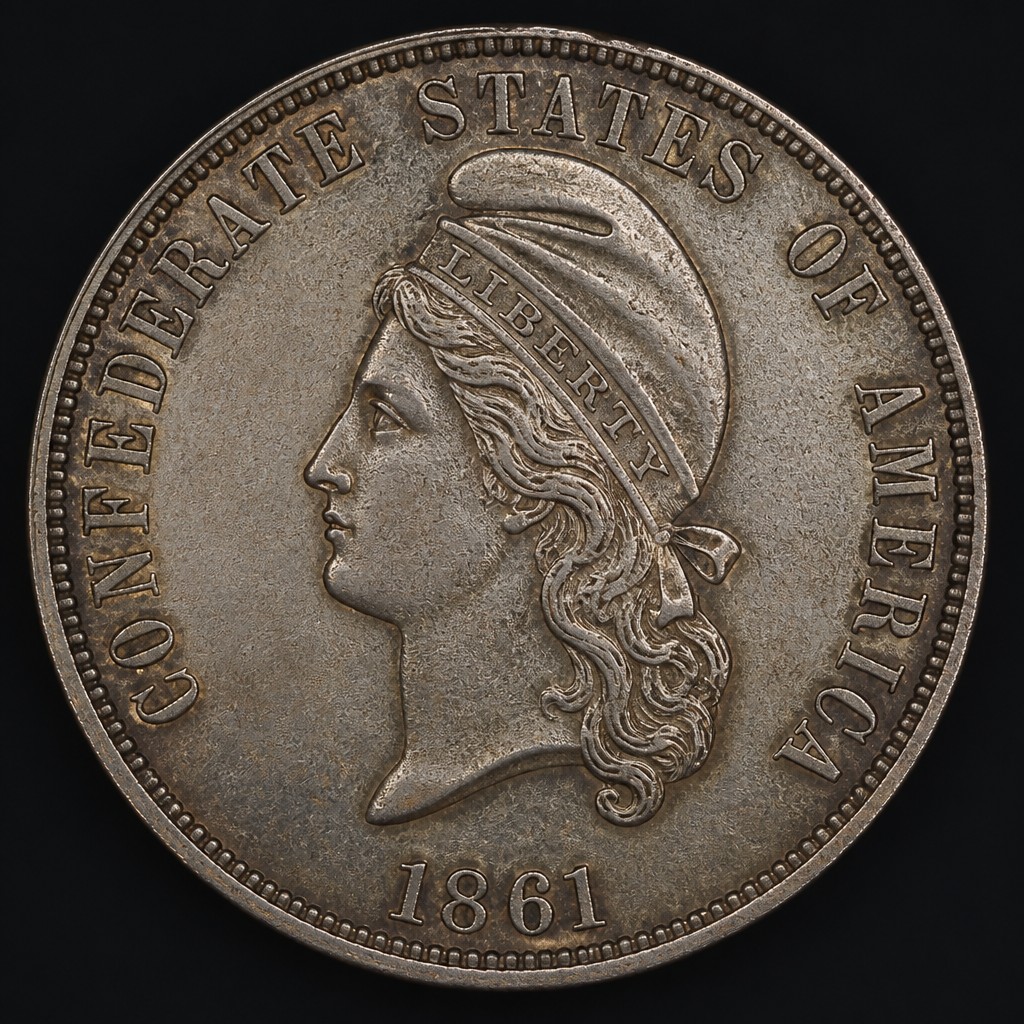
What It Is
The 1861 Confederate half dollar refers to a small number of coins struck at the New Orleans Mint after it came under Confederate control early in the Civil War, using a special reverse die depicting Confederate symbols paired with the regular Seated Liberty obverse already in use. Only a handful of originals were struck before the die was set aside.
Obverse Design
The obverse is the standard 1861-O Seated Liberty half dollar design: Liberty seated on a rock, holding a liberty pole and shield, with "UNITED STATES OF AMERICA" around the border and the date below.
Reverse Design
The special reverse shows a shield with seven stars, flanked by a stack of cannonballs, and a bundle of arrows and a liberty cap on a pole, encircled by "CONFEDERATE STATES OF AMERICA" with "HALF DOL." near the bottom, a design distinct from any regular US Mint issue.
Size, Weight, and Edge
Genuine original strikes match the standard Seated Liberty half dollar specifications: about 12.5 grams, 90% silver, 30.6mm diameter, with a reeded edge, since the same planchets and obverse dies used for regular coinage were involved.
Mint Marks
Because originals were struck at New Orleans, the standard "O" mint mark for that mint would appear in its usual location on the obverse near the reverse-facing side of the wreath on Seated Liberty half dollars of the period, consistent with other 1861-O halves.
Telling It Apart From Similar Coins
Because only a tiny number of coins were struck with the genuine Confederate reverse die, the overwhelming majority of pieces in circulation today are 19th-century restrikes or modern replicas. A well-known 1879 restrike combined an original 1861-O half dollar's obverse with an electrotype copy of the Confederate reverse, and further modern copies and tokens have circulated since. Comparing thickness, weight, and the sharpness and style of the Confederate reverse against documented genuine and restrike examples is essential.
Judging Condition at a Glance
On any candidate coin, examine the obverse for normal Seated Liberty wear patterns consistent with genuine 1861-O halves, and study the reverse for whether it shows the texture of a struck coin or the slightly different surface quality often associated with electrotype or cast reproductions.
Authenticity Red Flags
A mismatched weight or thickness between the obverse and reverse sides, a reverse that looks cast or has a seam, or a reverse texture that differs noticeably from the obverse are all signs of a restrike or replica rather than a Civil War-era original. Given the extreme rarity of genuine originals, any example should be compared carefully against well-documented reference pieces before drawing conclusions.
Frequently asked questions
Is every 1861 Confederate half dollar a genuine Civil War original?
No, only a very small number of genuine originals were struck; most existing pieces are later 19th-century restrikes or modern replicas made using copies of the Confederate reverse die.
What does the Confederate reverse design show?
A shield with seven stars, a stack of cannonballs, and a bundle of arrows with a liberty cap on a pole, surrounded by CONFEDERATE STATES OF AMERICA and HALF DOL.
How is a well-known restrike identified?
One documented 19th-century restrike combined a genuine 1861-O half dollar's obverse with an electrotype copy of the Confederate reverse, which can show different surface texture from a true struck coin.
What obverse does the coin use?
The standard 1861-O Seated Liberty half dollar obverse already in production at the New Orleans Mint at the time.