
How to Identify the 1856-S Seated Liberty Quarter
A visual guide to the 1856-S Seated Liberty quarter, an early San Francisco Mint issue, covering its Liberty seated design, eagle reverse, and mint mark placement.
Read the full 1856-S Seated Liberty Quarter encyclopedia entry →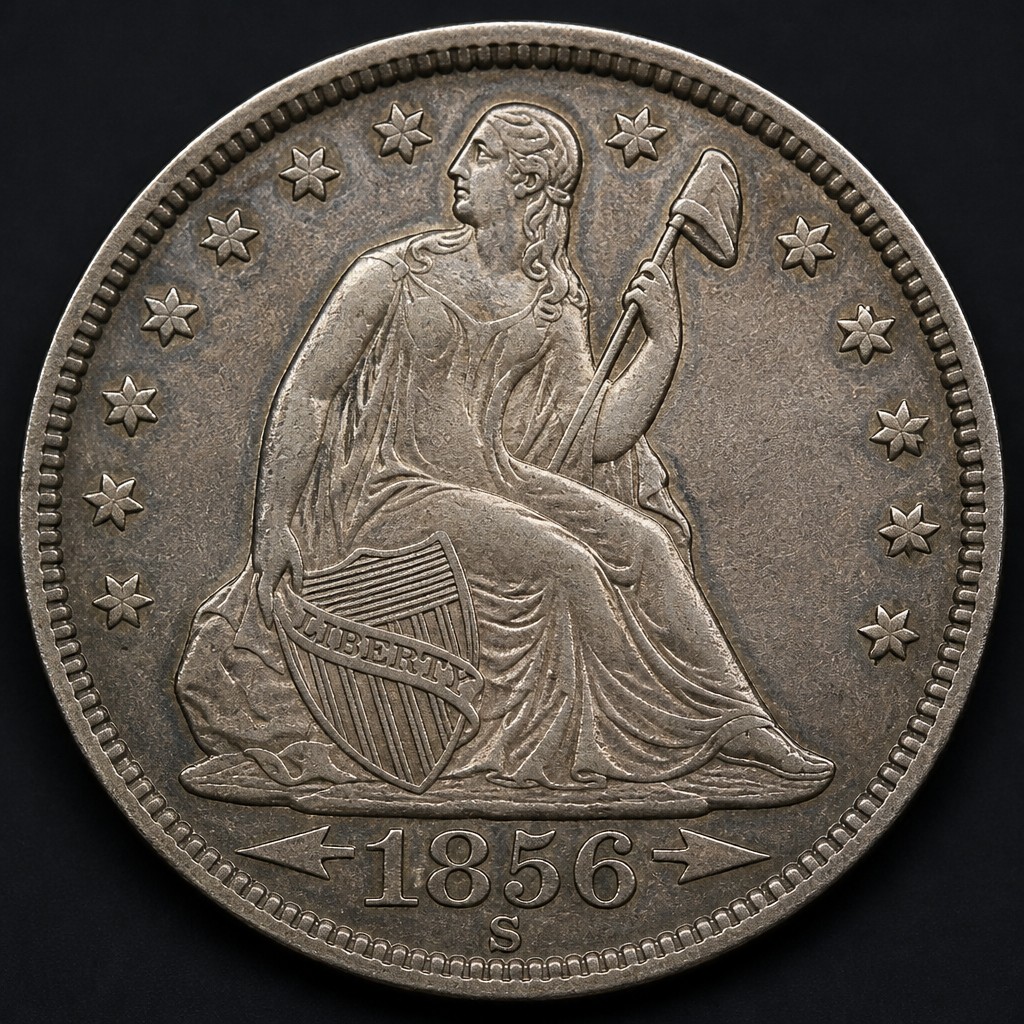
What It Is
The 1856-S quarter belongs to the Seated Liberty series, struck by the U.S. Mint from 1838 to 1891. It was produced at the San Francisco Mint, which had opened just two years earlier in 1854, making early San Francisco quarters like this one relatively scarce compared to Philadelphia issues of the same year.
Obverse (Front)
The obverse shows Liberty seated on a rock, facing left, holding a pole topped with a liberty cap in one hand and steadying a shield inscribed "LIBERTY" with the other. Thirteen stars encircle the design near the rim, representing the original colonies, and the date "1856" appears at the bottom.
Reverse (Back)
The reverse features an eagle with wings spread, holding arrows and an olive branch, with "UNITED STATES OF AMERICA" arcing above and "QUARTER DOL." below. Coins from this era do not carry the motto "IN GOD WE TRUST," which was not added to the design until 1866.
Size, Weight, Metal, and Edge
The coin measures approximately 24.3 mm in diameter and weighs about 6.22 grams, struck in 90% silver and 10% copper. The edge is reeded.
Mint Marks
The mint mark "S" is located on the reverse, below the eagle, between the tips of the olive branch and arrows just above the "QUARTER DOL." inscription. A coin without any letter in this spot would be a Philadelphia strike from the same year.
Telling It Apart From Similar Coins
Within the Seated Liberty series, quarters can be told apart primarily by date, mint mark, and the presence or absence of arrows beside the date (used in certain years to denote a weight change) or rays around the eagle on the reverse (used briefly in 1853). The 1856-S has no arrows or rays, a plain date, and the seated Liberty design without motto, distinguishing it from both earlier variant years and later issues after 1866 that added "IN GOD WE TRUST" above the eagle.
Grading at a Glance
Key wear points are Liberty's knee and breast on the obverse and the eagle's head, neck, and wing tops on the reverse. On well-worn coins, the shield lines and Liberty's head details fade first, while the rim and lettering typically remain legible even on lower grades due to the coin's raised border design.
Authenticity Red Flags
Because this is a scarcer early San Francisco issue, watch for added or altered mint marks, where an "S" has been soldered, tooled, or engraved onto a common Philadelphia-strike quarter of the same date. Genuine mint marks are integral to the design with consistent depth, shape, and metal flow matching the surrounding devices; an added mint mark often shows different texture, tooling marks under magnification, or slightly irregular placement. Given the coin's silver content and age, verifying weight, diameter, and overall design consistency against known genuine examples—or having it authenticated by a professional grading service—is the most reliable approach.
Frequently asked questions
Where is the mint mark on an 1856-S quarter?
On the reverse, below the eagle and just above the "QUARTER DOL." inscription, where a small "S" indicates a San Francisco Mint strike.
Does the 1856-S quarter have "IN GOD WE TRUST" on it?
No. That motto wasn't added to Seated Liberty quarters until 1866, so any coin claiming to be from 1856 with the motto present would be either a different date or a misidentified/altered coin.
What metal is the coin made of?
It is 90% silver and 10% copper, weighing approximately 6.22 grams.
Why is the 1856-S considered scarcer than some other dates?
The San Francisco Mint had only opened in 1854, and its early mintages, including 1856, were comparatively low next to Philadelphia's output, making surviving examples less common, especially in higher grades.