
How to Identify the 1856 Flying Eagle Cent
A visual guide to the famous 1856 Flying Eagle Cent, a low-mintage pattern issue that introduced the small-cent format, covering its eagle obverse, wreath reverse, and the date-style details used to confirm it.
Read the full 1856 Flying Eagle Cent encyclopedia entry →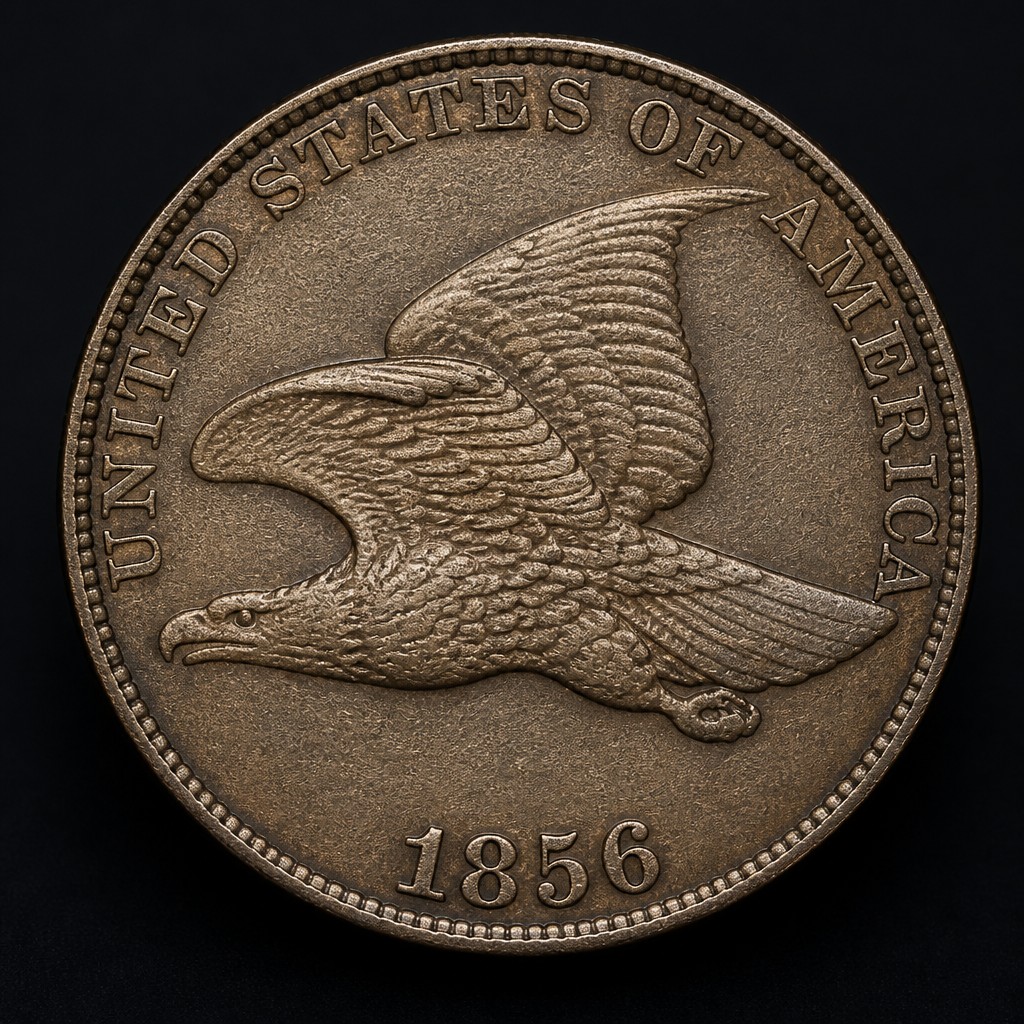
What It Is
The 1856 Flying Eagle Cent is one of the most celebrated dates in American coinage. It was produced in very limited numbers as a pattern to demonstrate the new small-size cent format ahead of its official 1857 debut, and while not originally intended for wide circulation, examples were distributed to Congress and other officials, and the date quickly became famous among collectors.
Obverse Design
An eagle is shown in flight, wings spread, facing left, with UNITED STATES OF AMERICA arching above and the date below. This design, adapted from an earlier pattern motif, replaced the large cent's Liberty portraits with a dramatic, naturalistic bird.
Reverse Design
The reverse displays a wreath composed of agricultural elements, including corn, wheat, cotton, and tobacco, encircling the words ONE CENT.
Size, Weight, Metal, and Edge
This was a landmark change in cent production: the coin is small, about 19mm in diameter, and struck in a copper-nickel alloy of about 88% copper and 12% nickel, weighing approximately 4.67 grams. The edge is plain. This composition and size are dramatically different from the large copper cents produced through 1857.
Mint Marks
No mint mark appears on the 1856 Flying Eagle Cent; it was struck at the Philadelphia Mint.
Telling It Apart From Similar Coins
Because 1856 dies were also used, along with restrikes, in later years, and because the design continued into 1857 and 1858 as an officially circulating coin, confirming a genuine 1856 date is essential; some 1858 cents have style variations in their numerals but should not be confused with an 1856 date. The 1856 date numerals have a specific style that collectors compare closely against known genuine dies, since the low original mintage makes this date valuable and a frequent target for alteration from other dates.
Judging Condition
Examine the eagle's feather detail, the wreath's leaf and kernel definition, and the clarity of the date and legends. Because so few 1856-dated pieces were struck, most surviving examples were preserved carefully, so heavily worn coins are less commonly seen than well-preserved ones, though both exist.
Authenticity Notes
Given its fame and value, the 1856 Flying Eagle Cent is one of the most commonly counterfeited or altered small cents, frequently created by altering the last digit of a genuine 1858 cent to resemble a 6. Careful examination of the date's numeral shapes, spacing, and any signs of tooling or re-engraving around the final digit is an important step, along with checking that the coin's overall design details match the known 1856 dies rather than assuming the date alone confirms the coin.
Frequently asked questions
Why is the 1856 Flying Eagle Cent so significant?
It was a limited pattern issue that introduced the small-cent format and composition later adopted officially in 1857.
What metal is the 1856 Flying Eagle Cent made from?
It is struck in a copper-nickel alloy of about 88% copper and 12% nickel, unlike the pure copper large cents that came before it.
How can an 1856 date be faked?
A common alteration involves modifying the last digit of a genuine 1858 cent to resemble a 6, so the date's numeral shape and any tooling marks should be checked closely.
Does the 1856 Flying Eagle Cent have a mint mark?
No, it was struck at the Philadelphia Mint and has no mint mark.