
How to Identify the 1853 Seated Liberty Quarter (Arrows and Rays)
A one-year design featuring arrows added beside the date and rays radiating from behind the eagle, marking a reduction in the coin's silver weight.
Read the full 1853 Seated Liberty Quarter (Arrows and Rays) encyclopedia entry →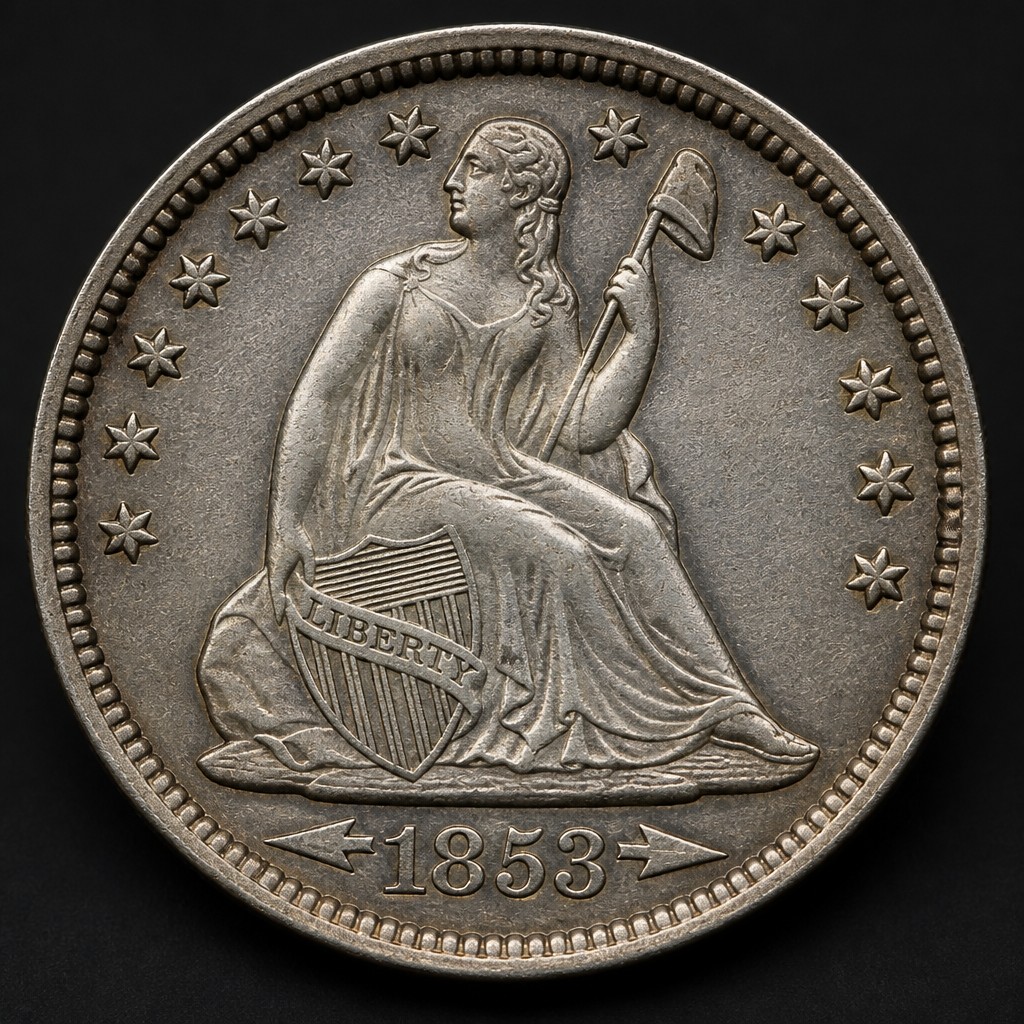
What the Coin Is
The 1853 Arrows and Rays quarter was struck for a single year to mark a reduction in the silver weight of the quarter dollar, a change made across U.S. silver coinage to address bullion price pressures. Arrows were added flanking the date, and rays bursting from behind the eagle were added to the reverse, both temporary design changes unique to 1853 that make this issue instantly recognizable within the broader Seated Liberty series.
Obverse Design & Inscriptions
Liberty sits on a rock holding a liberty pole with cap and a shield inscribed "LIBERTY," with the drapery fold at her elbow present. Small arrowheads flank the date "1853" on either side, a feature not found on quarters from surrounding years and one of the clearest visual signals of this particular design phase.
Reverse Design & Inscriptions
The reverse shows the standard eagle with shield, olive branch, and arrows, but for this year only, additional engraved rays radiate outward from behind the eagle toward the border, giving the design a distinctive burst pattern. "UNITED STATES OF AMERICA" and "QUARTER DOL." surround the design as usual, unchanged from the standard Seated Liberty layout.
Size, Weight, Metal, Edge
The coin is struck in 90% silver and 10% copper at the reduced weight standard adopted in 1853, roughly 6.22 grams, with a diameter of 24.3 mm and a reeded edge, a weight standard that would remain in place for the rest of the Seated Liberty quarter series.
Mint Marks
Quarters of this type were struck at both Philadelphia (no mintmark) and New Orleans (an "O" mintmark below the eagle on the reverse); check that location carefully to identify the mint of origin before making any further comparisons.
Telling It Apart From Similar Coins
The rays on the reverse are the quickest identifying feature — no other Seated Liberty quarter date shows this burst pattern, since it was dropped after 1853. Compare against the 1854-1855 Arrows-only quarters, which retain the arrows beside the date but lack the rays on the reverse, making the two easy to separate once you know what to look for.
Judging Condition at a Glance
Because the rays add fine detail that wears down quickly, their presence and clarity can help gauge condition; heavily worn coins often show only partial or faint ray lines. Also check Liberty's knee, breast, and the eagle's wing feathers as usual high-wear points, since these areas tend to soften noticeably before the rays disappear entirely.
Authenticity Red Flags
Given the coin's popularity as a one-year type, be alert to added rays scratched onto a plain 1853 quarter reverse to simulate this variety — genuine rays are part of the coin's original strike and appear as clean, sunken lines rather than scratches sitting atop the surface. Also confirm arrows beside the date show natural, struck detail rather than tool-added marks, since both features together are needed to correctly identify this type.
Frequently asked questions
What makes the 1853 Arrows and Rays quarter unique?
It was struck for one year only with arrows beside the date and rays radiating from the reverse eagle, marking a reduction in the coin's silver weight.
How do I tell it apart from the 1854-1855 Arrows quarters?
Those later issues kept the arrows beside the date but dropped the rays from the reverse, so the presence of rays points specifically to 1853.
Which mints struck this variety?
Philadelphia struck examples without a mintmark, while New Orleans coins carry an 'O' mintmark below the eagle.
How can I spot a faked ray design?
Genuine rays appear as clean, recessed lines from striking, while added rays on a plain reverse typically look like surface scratches sitting on top of the metal.