
How to Identify the 1839 Gobrecht Dollar
The 1839 Gobrecht dollar was a transitional issue introducing the Seated Liberty design to the silver dollar, struck in very limited numbers for circulation.
Read the full 1839 Gobrecht Dollar encyclopedia entry →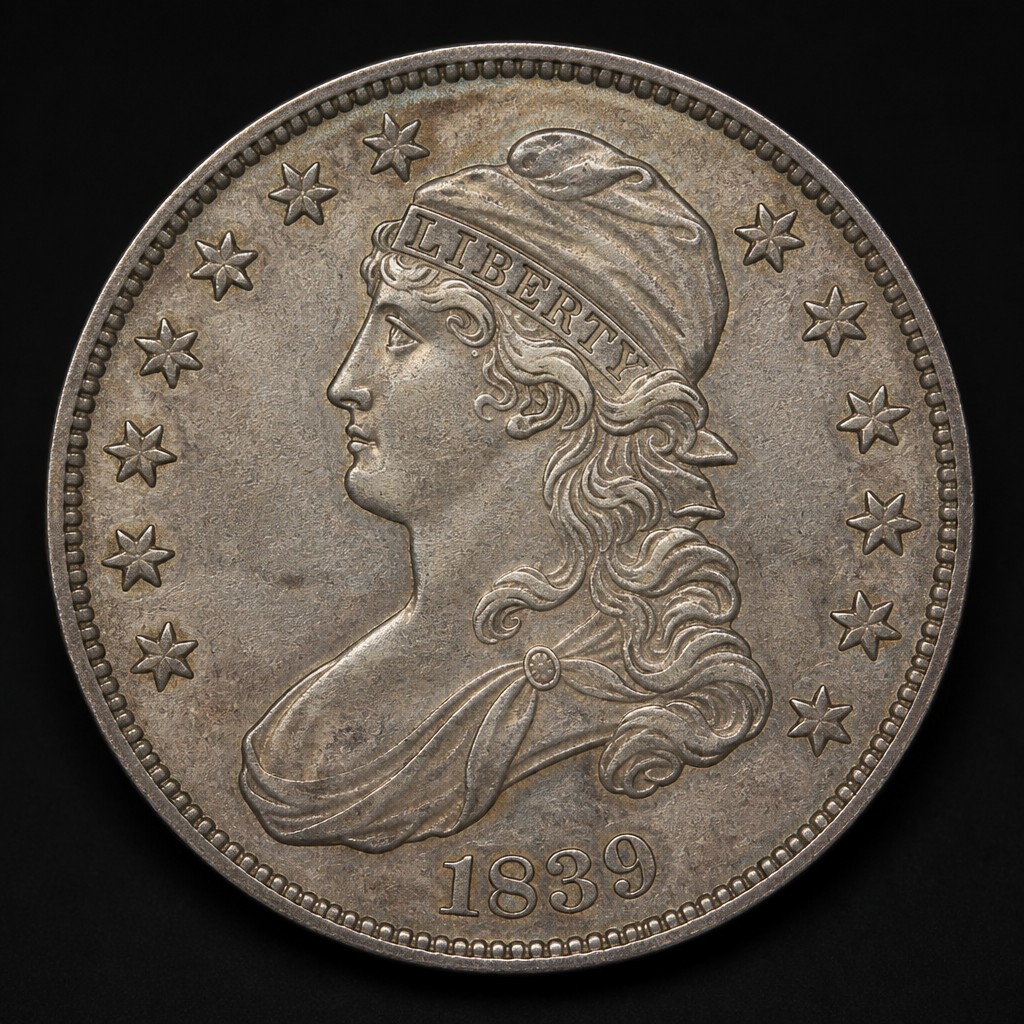
What It Is
The 1839 Gobrecht dollar, designed by Christian Gobrecht, represents the final circulation-related striking of this pattern-like dollar before the regular Seated Liberty dollar series began in 1840. Only a small number were produced at the Philadelphia Mint.
Obverse Design
Liberty sits on a rock, facing left, holding a liberty pole topped with a cap in one hand and a shield inscribed "LIBERTY" in the other. Stars surround the design near the rim, and the date is below.
Reverse Design
An eagle flies alone across a plain field, without the ring of stars seen on the earlier 1836 originals. "UNITED STATES OF AMERICA" arches around the border and "ONE DOLLAR" appears below the eagle.
Size, Weight, and Edge
The 1839 issue follows the reduced silver dollar weight standard adopted in 1837, weighing about 26.73 grams at .900 fine silver, with a reeded edge, a change from the plain edge used on some earlier Gobrecht dollar strikings.
Mint Marks
No mint mark appears, since the coin was struck only at the Philadelphia Mint.
Telling It Apart From Similar Coins
The 1839 issue is distinguished from the original 1836 Gobrecht dollars by its plain reverse field lacking stars around the eagle, its reeded edge, and the absence of "C. GOBRECHT F." on the base of Liberty, which had appeared on some earlier strikings. Because Gobrecht dollars were later restruck in various forms, die alignment (whether the reverse eagle flies level or angled relative to the obverse) is a detail specialists use to help sort originals from later restrikes.
Judging Condition at a Glance
Examine Liberty's knee and breast, along with the eagle's breast and wing tips, for the first signs of wear. Because these coins were often saved as curiosities rather than circulated heavily, many surviving examples show light wear or proof-like surfaces rather than the heavy wear typical of ordinary circulating coinage.
Authenticity Red Flags
Given the coin's rarity and the existence of period and later restrikes, confirm the reverse field truly lacks stars, the edge is properly reeded, and the weight and diameter match expected specifications. Because sorting originals from restrikes involves technical details like die rotation, treat any example without clear, well-documented provenance with careful scrutiny.
Frequently asked questions
How is the 1839 Gobrecht dollar different from the 1836 version?
The 1839 reverse eagle flies in a plain field without surrounding stars, uses a reeded edge, and typically omits the designer's name from Liberty's base, unlike some 1836 strikings.
Does the 1839 Gobrecht dollar have a mint mark?
No, it was struck only at the Philadelphia Mint, which did not use mint marks at the time.
Why do some Gobrecht dollars look barely worn?
Many were saved as curiosities or patterns rather than used in everyday commerce, so surviving examples often show light wear or proof-like surfaces.
What is die alignment and why does it matter here?
It refers to how the obverse and reverse designs line up relative to each other when the coin is rotated, a detail specialists use to help distinguish original strikes from later restrikes.