
How to Identify the 1838 Seated Liberty Quarter (No Drapery)
The first-year Seated Liberty quarter design, showing Liberty seated on a rock without the drapery fold at her elbow that was added in later years.
Read the full 1838 Seated Liberty Quarter (No Drapery) encyclopedia entry →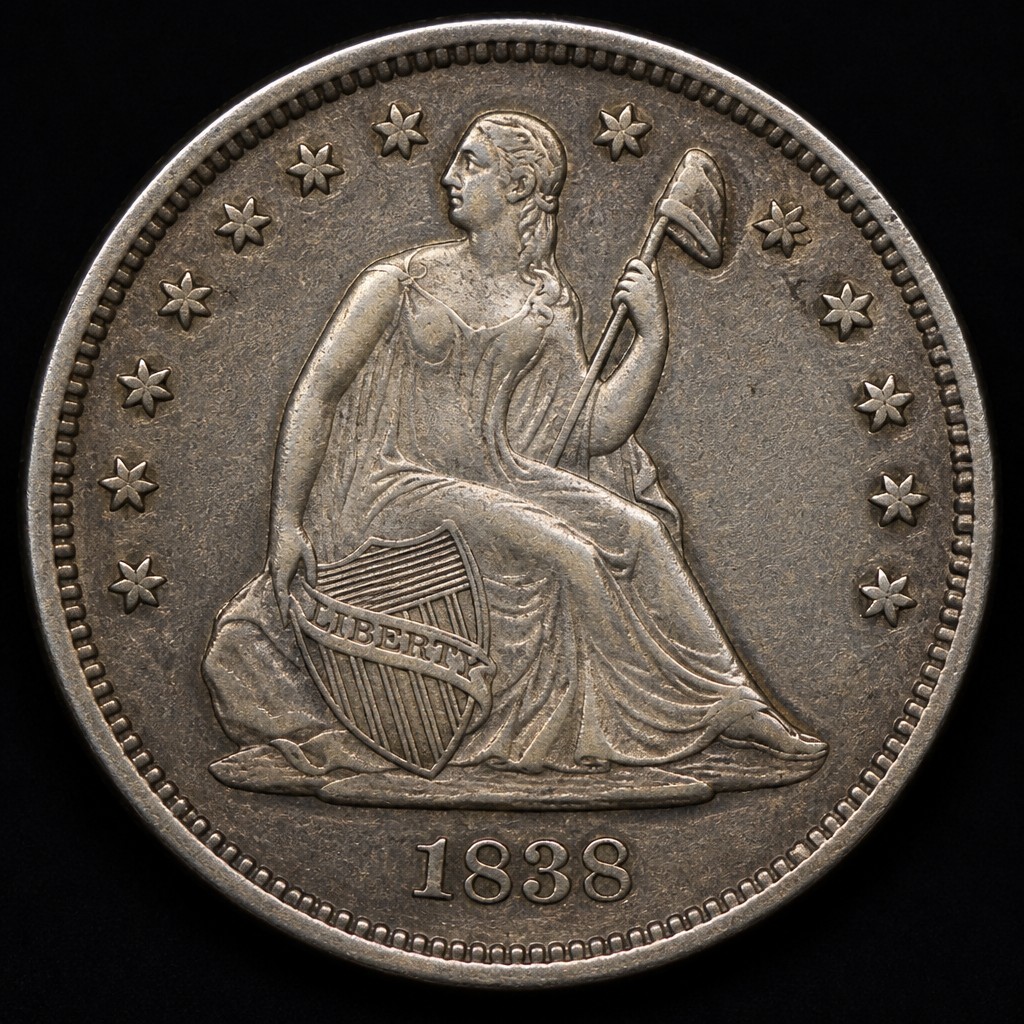
What the Coin Is
The 1838 quarter marks the debut of Christian Gobrecht's Seated Liberty design for the denomination, replacing the Capped Bust type. This first version lacks the drapery fold at Liberty's elbow that would be added starting in 1840, giving rise to the "No Drapery" designation collectors use to describe it, and it represents a dramatic visual shift from the bust-only portraits used on all earlier quarters.
Obverse Design & Inscriptions
Liberty sits on a rock, holding a liberty pole topped with a cap in one hand and a shield inscribed "LIBERTY" in the other. Her left arm rests bare at the elbow, without the drapery fold seen in later dates. Thirteen stars surround the design, and the date "1838" appears below, framed by the rock she is seated upon, a pose that would remain largely unchanged for the following five decades.
Reverse Design & Inscriptions
The reverse shows an eagle with wings spread, a shield on its breast, an olive branch and arrows in its talons, encircled by "UNITED STATES OF AMERICA" above and "QUARTER DOL." below. There is no motto on the reverse of this early type, since "IN GOD WE TRUST" would not be added until nearly three decades later.
Size, Weight, Metal, Edge
The coin is struck in 90% silver and 10% copper, weighs 6.68 grams, measures 24.3 mm in diameter, and has a reeded edge, a size and weight standard that would carry forward largely unchanged for the rest of the Seated Liberty series aside from the brief 1853 weight reduction.
Mint Marks
No mintmark appears on this issue; it was struck exclusively at the Philadelphia Mint, so there is no mint location to verify for this particular date.
Telling It Apart From Similar Coins
The most reliable way to distinguish the 1838 No Drapery quarter from later Seated Liberty quarters is the bare, undraped elbow area of Liberty's left arm — starting in 1840, a fold of drapery was added there. Also compare it against the earlier Capped Bust quarters, which show an entirely different bust-style portrait rather than a full seated figure, making the two types easy to tell apart even at a glance.
Judging Condition at a Glance
Check the high points on Liberty's knee, breast, and head, along with the eagle's wing tips and shield lines, since these areas wear first. A well-defined shield outline and legible "LIBERTY" on Liberty's shield are good indicators of a coin retaining moderate detail, while more heavily worn coins may show these features only faintly.
Authenticity Red Flags
Because this is an early type coin, inspect the date for even spacing and a natural font matching genuine references, as altered dates from more common years can occasionally surface. Surface graininess, weak or mushy design elements, and an irregular edge are signs of a cast counterfeit rather than an authentic Mint strike, and comparing the coin's weight against the expected standard is a simple additional check.
Frequently asked questions
What does 'No Drapery' mean on this quarter?
It refers to the bare, undraped area at Liberty's elbow, a feature unique to the earliest Seated Liberty quarters before a drapery fold was added starting in 1840.
Does the 1838 quarter have a mintmark?
No, it was struck only at the Philadelphia Mint, which did not place mintmarks on this issue.
How is this different from a Capped Bust quarter?
The Seated Liberty design shows a full seated figure of Liberty rather than a bust-only portrait used on earlier Capped Bust quarters.
What areas show wear first?
Liberty's knee, breast, and head, along with the eagle's wing tips and shield lines, tend to wear first on this design.