
How to Identify the 1836 Gobrecht Dollar
The 1836 Gobrecht dollar was the first US silver dollar to feature the Seated Liberty design, struck in small numbers as a design trial ahead of regular coinage.
Read the full 1836 Gobrecht Dollar encyclopedia entry →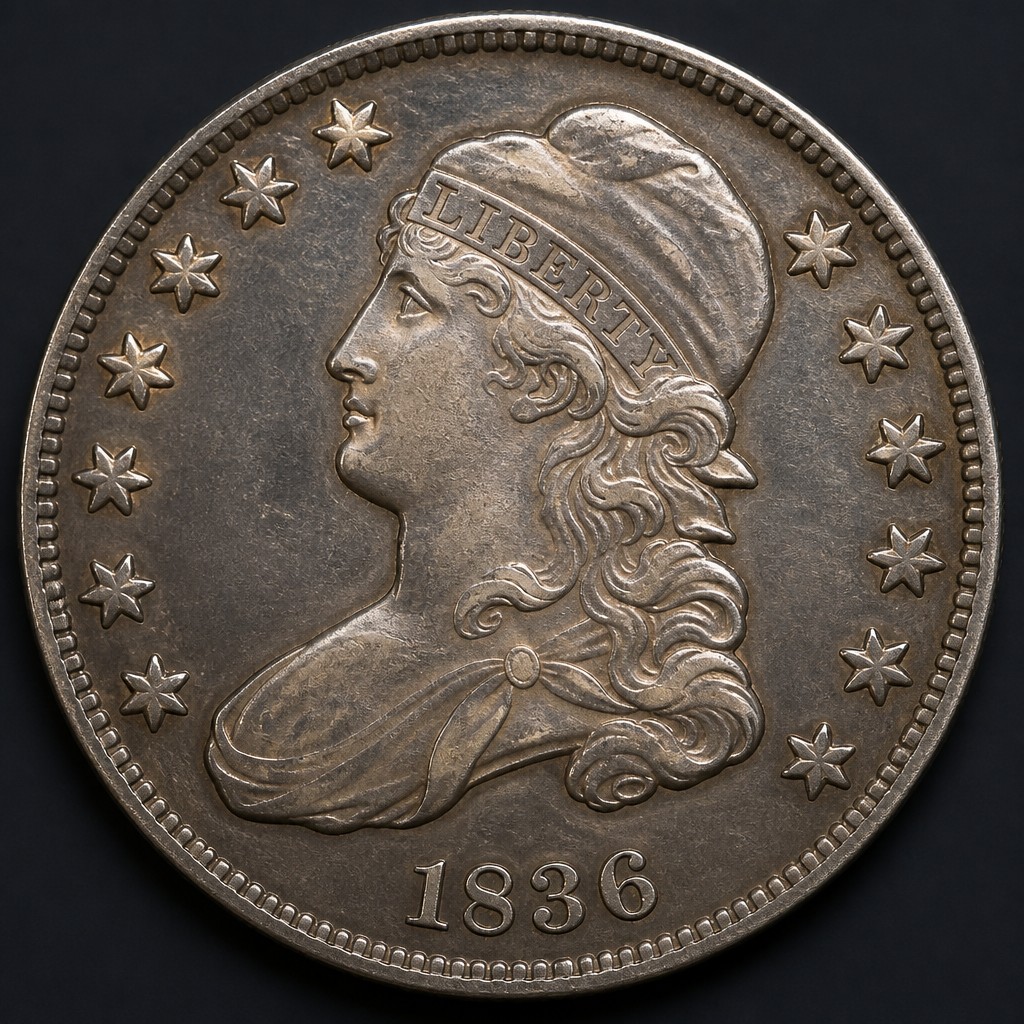
What It Is
The 1836 Gobrecht dollar, created by engraver Christian Gobrecht, introduced the Seated Liberty motif that would appear on US silver coinage for decades afterward. It was produced at the Philadelphia Mint in limited quantities, functioning partly as a pattern and partly as a circulating trial issue.
Obverse Design
Liberty sits on a rock facing left, holding a liberty pole and cap in one hand and a shield inscribed "LIBERTY" in the other, with stars around the border and the date below.
Reverse Design
An eagle flies amid a field of stars, typically 26 in number representing the states at the time, with "UNITED STATES OF AMERICA" arching around and "ONE DOLLAR" below. On some original 1836 strikes, the designer's name "C. GOBRECHT F." appears on the rock beneath Liberty, a detail later removed after public criticism that it resembled a campaign slogan.
Size, Weight, and Edge
Original 1836 strikes were made under the earlier silver dollar weight standard of about 26.96 grams at .8924 fine, though some later restrikes used the reduced standard of 26.73 grams at .900 fine. Plain edges are typical of the earliest strikes, while some later restrikes show a reeded edge.
Mint Marks
No mint mark appears, as the coin was produced only at the Philadelphia Mint.
Telling It Apart From Similar Coins
The presence of "C. GOBRECHT F." on the base and the star-filled reverse field help identify an 1836-dated piece from the later, plainer 1839 issue. Because genuine period originals, later Mint restrikes, and even fantasy restrikes all exist bearing this date, details like edge type, weight standard, and die rotation are used by specialists to sort these into distinct categories.
Judging Condition at a Glance
Check Liberty's raised knee and the eagle's breast and wingtips for wear, though many surviving examples were preserved as curiosities and show only light circulation or proof-like fields rather than typical heavy wear.
Authenticity Red Flags
Because so many different strikings exist under the 1836 date, verify the weight standard, edge type, and presence or absence of the engraver's name against known categories before drawing conclusions. Coins with mismatched combinations of these features, or with a crude, poorly formed shield or star pattern, deserve closer comparison against documented genuine examples.
Frequently asked questions
What does 'C. GOBRECHT F.' mean on this coin?
It is the designer's name and the Latin abbreviation for 'made it,' engraved on the rock beneath Liberty on some original 1836 strikes before it was later removed.
How many stars appear on the reverse?
Original 1836 strikes typically show 26 stars around the flying eagle, representing the number of states at the time.
Does the 1836 Gobrecht dollar have a reeded edge?
The earliest original strikes generally have a plain edge, while some later restrikes were given a reeded edge, so edge type is one clue used to sort different strikings.
Why are there so many versions of the 1836 Gobrecht dollar?
The Mint struck originals as trial pieces and later produced restrikes using different dies, weight standards, and edges, resulting in several recognized varieties sharing the same date.