
How to Identify the 1815 Capped Bust Quarter
The first year of the large-diameter Capped Bust quarter design by John Reich, featuring Liberty in a cloth cap and a large eagle reverse with a motto banner.
Read the full 1815 Capped Bust Quarter encyclopedia entry →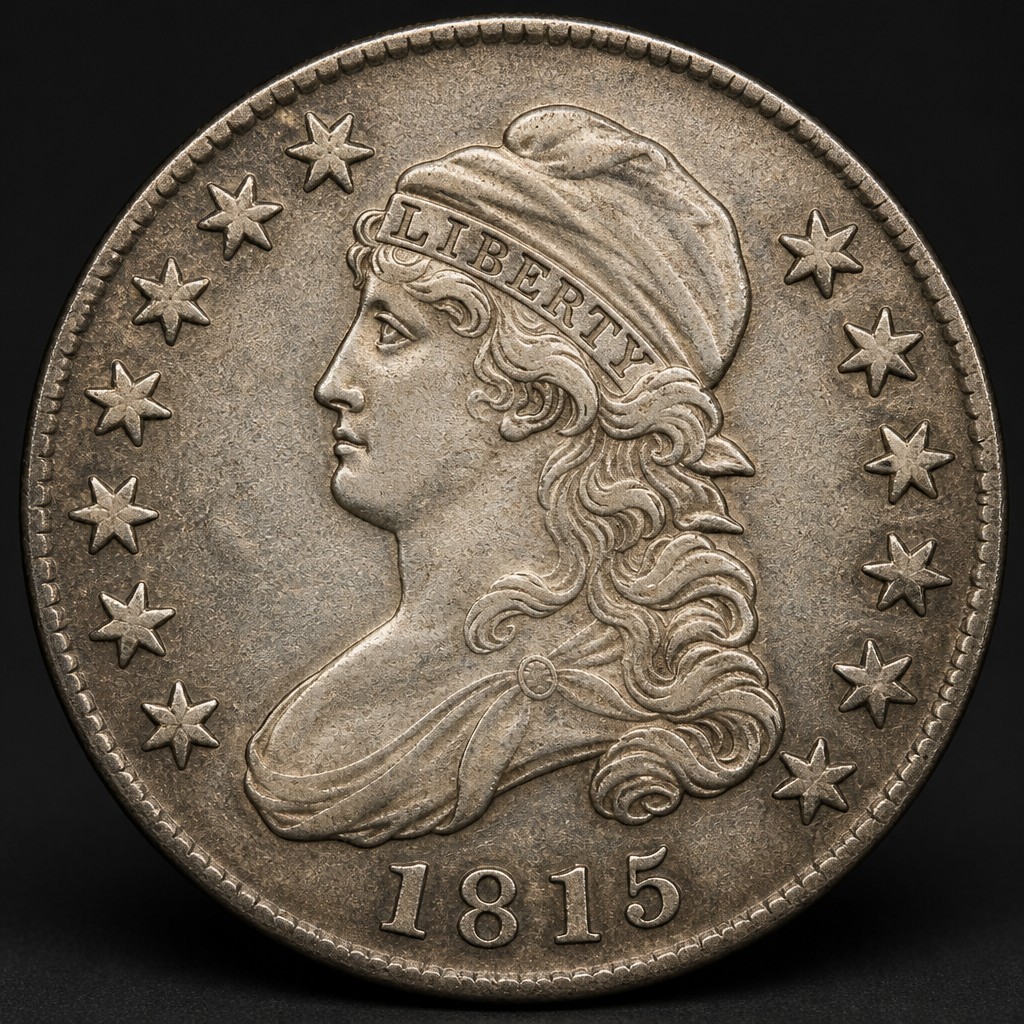
What the Coin Is
The 1815 quarter introduced the Capped Bust design by John Reich, a significant change from the earlier Draped Bust type. Quarters had not been struck for several years before 1815, so this date marks a fresh start for the denomination with a bolder, larger portrait style, reflecting the broader artistic shift happening across U.S. silver coinage in this period.
Obverse Design & Inscriptions
Liberty faces left wearing a soft cap inscribed "LIBERTY" across the band, with curled hair flowing beneath it. Stars surround the bust — seven to the left, six to the right — and the date "1815" sits below, with drapery falling naturally across her shoulder in Reich's more rounded, fuller style compared to the earlier Draped Bust portrait.
Reverse Design & Inscriptions
The reverse features a large eagle with outstretched wings, a shield on its breast, arrows and an olive branch in its talons, and a scroll above its head reading "E PLURIBUS UNUM." The legend "UNITED STATES OF AMERICA" arcs around the top and sides, with "25 C." appearing as the denomination near the bottom — the first quarter design to state its value directly on the coin, making this an easy visual anchor when sorting early quarter types.
Size, Weight, Metal, Edge
The coin is struck in silver, weighs about 6.74 grams, and measures roughly 27 mm in diameter, with a reeded edge applied during striking. Handled examples typically show a warm, even silver-gray tone that deepens with age when left untouched.
Mint Marks
There is no mintmark on this coin. All Capped Bust quarters of this era were produced at the Philadelphia Mint only, so verifying a mint of origin is unnecessary for this date.
Telling It Apart From Similar Coins
The 1815 is easy to distinguish from Draped Bust quarters by its larger portrait, capped headdress, and the addition of "25 C." on the reverse — a feature absent from earlier quarter types. Within the Capped Bust series itself, compare the date and star count against later years, since minor die varieties exist for several dates in this run, including small differences in star placement and curl detail.
Judging Condition at a Glance
Look at Liberty's cap and hair curls, the drapery at her bust, and the eagle's wing feathers and shield lines as the primary high points. Because Capped Bust quarters were struck with less precise presses than later coinage, look for natural die-adjustment weakness at the centers rather than mistaking it for excessive wear, particularly on the eagle's central shield details.
Authenticity Red Flags
As with all scarce early silver, check the date digits for signs of alteration — an uneven baseline, filed area around a numeral, or a font mismatch compared to genuine 1815 examples are all warning signs. Surface graininess, a dull or grayish sheen, and a visible casting seam around the edge point to a cast counterfeit rather than an authentic struck coin, and an unusually light or heavy weight reading is another useful red flag to check.
Frequently asked questions
What makes the 1815 quarter different from earlier quarter types?
It introduced John Reich's Capped Bust portrait and was the first quarter to display its value, '25 C.', directly on the reverse.
Does the 1815 quarter have a mintmark?
No, it was struck only at the Philadelphia Mint, which did not use mintmarks at the time.
How many stars surround Liberty's portrait?
Typically thirteen stars appear, split seven on the left and six on the right of the bust.
What wear points should I check first?
Focus on Liberty's cap and hair curls on the obverse and the eagle's wing feathers on the reverse.