
How to Identify the 1804 Draped Bust Eagle
The final year of the original $10 gold eagle series, known for two varieties: genuine 1804 business strikes and rare 1834-era proof restrikes made for diplomatic gifts.
Read the full 1804 Draped Bust Eagle encyclopedia entry →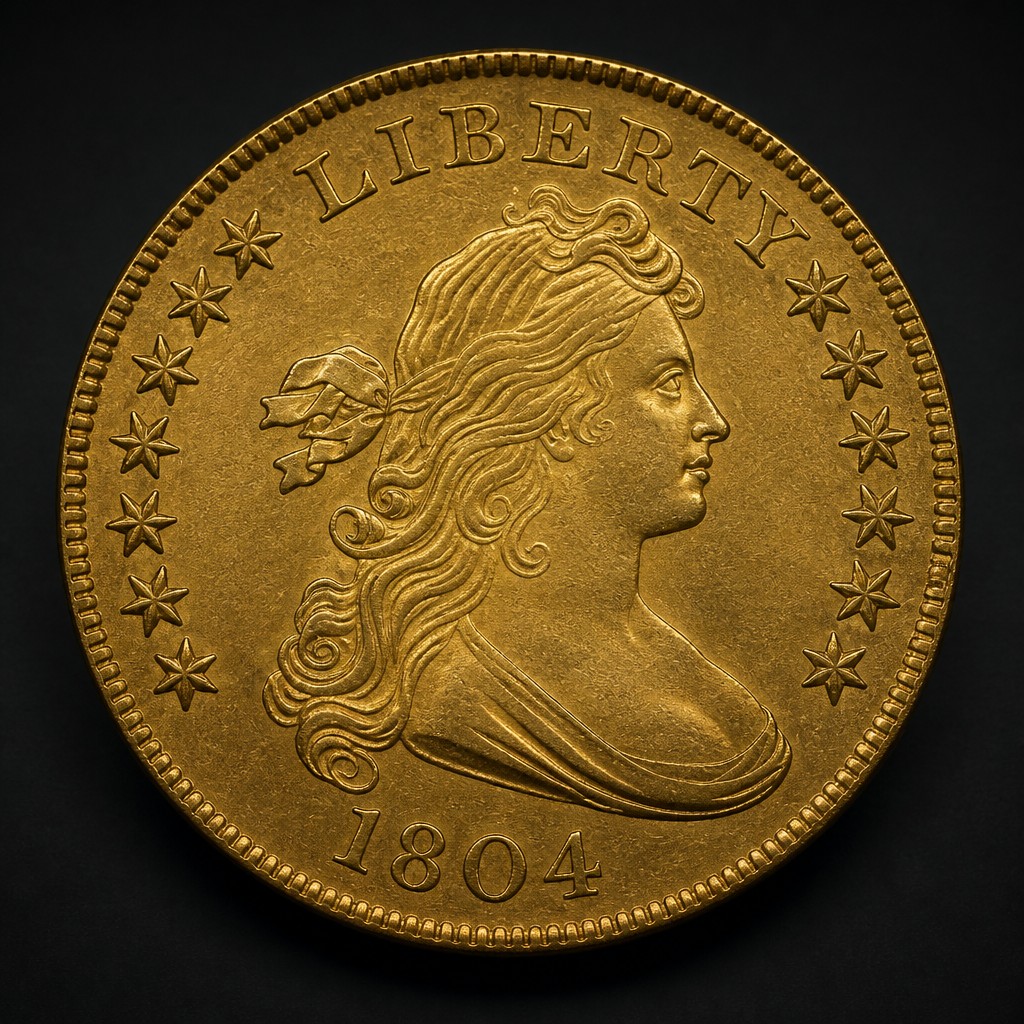
What It Is
The 1804 Draped Bust Eagle marks the last year of the original $10 gold eagle series before the U.S. Mint suspended eagle production for over three decades; no more eagles were struck for circulation until 1838. This date carries an especially storied history due to a famous later restrike.
Obverse Design
Liberty faces right beneath a soft turban-style cap with flowing hair, LIBERTY inscribed above, stars around the portrait, and the 1804 date below — the same Draped Bust/Turban Head style used since 1795.
Reverse Design
The Heraldic Eagle design is used exclusively on this date, the earlier Small Eagle reverse having been discontinued by 1804. The eagle carries a shield on its breast, arrows and an olive branch in its talons, clouds and stars above its head, and a ribbon reading E PLURIBUS UNUM in its beak, with UNITED STATES OF AMERICA around the border.
Size, Weight, Metal & Edge
33mm diameter, 17.5 grams, .9167 fine gold, reeded edge. No numeral denomination appears on the coin.
Key Varieties and Mint Marks
Two important varieties exist for this date. "Plain 4" coins are genuine business strikes actually produced for circulation in 1804. "Crosslet 4" coins are proof restrikes produced around 1834 at the Philadelphia Mint, made as diplomatic gift pieces alongside restruck 1804 silver dollars presented in special proof sets to foreign rulers; the crossbar-style "4" was not in normal use by 1804, which is a telltale sign these were struck later from newly made dies. No branch mints existed in 1804, so every genuine example originates from Philadelphia.
Telling It Apart From Similar Coins
Examine the style of the "4" in the date. A plain, flat-top 4 indicates an original 1804 business strike, while a 4 with a small crossbar or serif indicates the much rarer circa-1834 restrike. Restrikes were produced as proofs and should show mirror-like fields and complete, sharp detail rather than the softer look typical of ordinary circulated gold coinage.
Judging Condition at a Glance
On business-strike examples, check the hair curls, cap ribbon, and the eagle's shield and wing tops for wear, as with other Draped Bust/Turban Head eagles. Because so few genuine 1804 eagles of either variety survive, any example should be evaluated by an experienced grader.
Authenticity Red Flags
This is among the most desirable and heavily counterfeited early American gold dates. Altered dates from more common years, such as 1801 or 1803, are a persistent risk, so examine the date digits carefully for tooling marks. A genuine business-strike example is already extremely rare, and a genuine Crosslet 4 restrike is essentially a museum-grade rarity — any purported 1804 eagle should be independently authenticated.
Frequently asked questions
What's the difference between the Plain 4 and Crosslet 4 varieties?
The Plain 4 is a genuine 1804 business strike with a flat-top numeral 4. The Crosslet 4 is a rare proof restrike made around 1834, identifiable by a small crossbar on the 4, a style not used in 1804.
Why were the Crosslet 4 restrikes made three decades later?
They were struck around 1834 as diplomatic gift pieces, alongside restruck 1804 silver dollars, for inclusion in special proof sets presented to foreign rulers.
Why did eagle production stop after 1804?
The U.S. Mint suspended production of the $10 gold eagle for circulation after 1804; no more eagles were struck until the series resumed in 1838.
How can I tell if my 1804 eagle might be altered from another date?
Examine the date digits closely under magnification for tooling marks, inconsistent spacing, or an unnatural surface texture, and seek expert authentication given how frequently this date is targeted.