
How to Identify the 1804 Draped Bust Dollar
The 1804 Draped Bust Dollar, nicknamed the 'King of American Coins,' is an extreme rarity actually struck decades after 1804 for diplomatic presentation sets.
Read the full 1804 Draped Bust Dollar encyclopedia entry →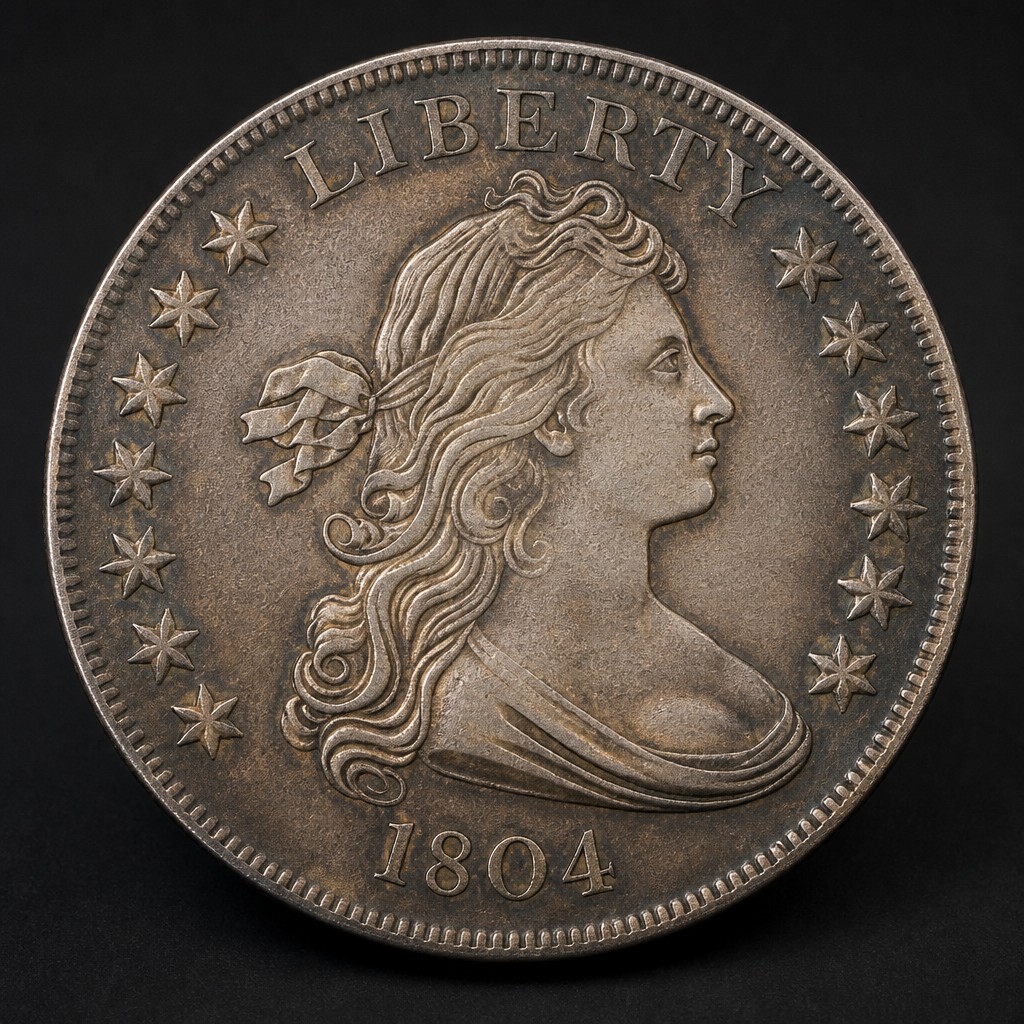
What It Is
The 1804 Draped Bust Dollar is one of the most famous coins in American numismatics, often called the "King of American Coins." Despite bearing the date 1804, none were struck in that year; Mint records show no dollars were coined in 1804. The known specimens were produced later, primarily in the mid-1830s for diplomatic presentation proof sets, with additional restrikes made later in the 19th century. Only 15 genuine examples are known to exist across all varieties.
Obverse Design
The obverse follows the standard Draped Bust dollar style: Liberty's bust faces right, draped fabric over her shoulder, hair tied back, with thirteen stars around the portrait and "1804" below.
Reverse Design
The reverse shows a heraldic eagle with a shield on its breast, arrows and an olive branch in its talons, and "UNITED STATES OF AMERICA" around the rim, matching the heraldic eagle reverse used on Draped Bust dollars from 1798 onward.
Size, Weight & Metal
Like other early silver dollars, it is struck in approximately 89.2% silver, weighs about 26.96 grams, and measures roughly 39-40 mm across. Most genuine examples have a lettered edge, though some later restrikes have a plain edge.
Mint Marks
There are no mint marks; all examples, whether originals or restrikes, were produced at the Philadelphia Mint.
Telling It Apart from Similar Coins
Because only 15 genuine specimens exist and they reside almost entirely in museums, major collections, or have sold at high-profile auctions, any "1804 dollar" encountered in ordinary circumstances is overwhelmingly likely to be a modern replica, souvenir piece, or altered coin rather than genuine. Compare against a genuine Draped Bust dollar of another date (1795-1803) for the correct design elements, then treat any 1804-dated example with extreme caution.
Grading at a Glance
Given the coin's rarity and value, grading of the few genuine specimens is handled by professional third-party grading services, not casual visual inspection. General wear patterns would follow other Draped Bust dollars: Liberty's hair and bust, and the eagle's head and wing tips, show wear first.
Authenticity Red Flags
Common items misrepresented as "1804 dollars" include replica or reproduction coins (often marked "COPY" if legitimately sold), foreign coins with re-engraved dates, and novelty pieces. Genuine specimens have well-documented ownership histories (provenance) traceable through major auction houses and collections; a coin without such a paper trail, or one offered informally at a price far below its documented value, is not a genuine 1804 dollar.
Frequently asked questions
Were any 1804 dollars actually struck in 1804?
No. Mint records confirm no silver dollars were coined in 1804; the dated coins were made later, mostly in the 1830s, for special presentation sets.
How many genuine 1804 dollars exist?
Only 15 are known across all recognized varieties, making it one of the rarest and most valuable U.S. coins.
If I find a coin dated 1804, is it likely genuine?
Almost certainly not. Genuine examples are accounted for in museums and major collections, so an unverified find is far more likely a replica or altered coin.
What does the coin look like?
It follows the standard Draped Bust dollar design: Liberty's draped bust on the obverse and a heraldic eagle with shield on the reverse.