
How to Identify the 1799/8 Draped Bust Silver Dollar Overdate
An early United States silver dollar overdate variety where a leftover 1798-dated die was repunched with 1799, leaving a visible 8 beneath the 9.
Read the full 1799/8 Draped Bust Silver Dollar Overdate encyclopedia entry →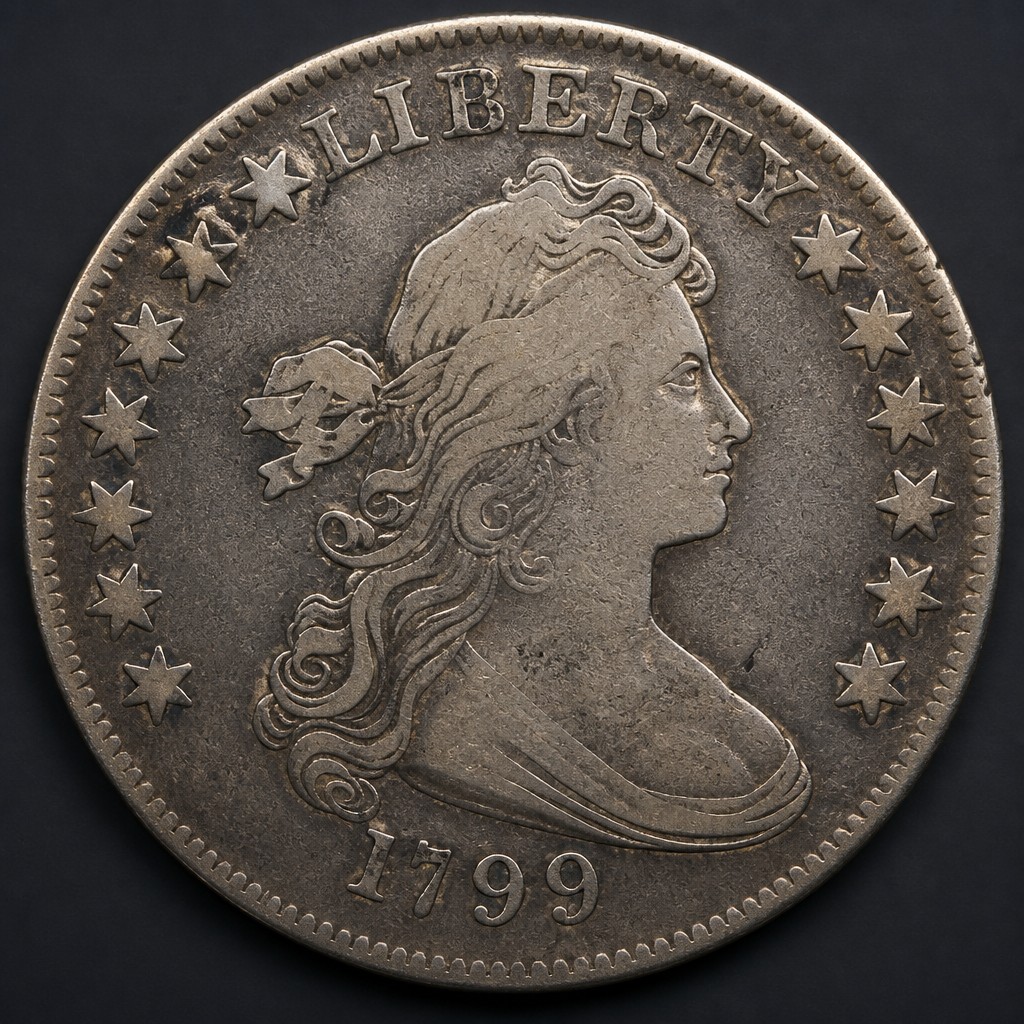
What the Coin Is
Early United States Mint dies were valuable and often reused across years. The 1799/8 overdate occurred when a die originally dated 1798 was repunched with 1799, leaving a partial impression of the earlier "8" visible beneath the final "9." Several die pairings of this overdate exist, cataloged by early numismatic researchers.
Obverse Design & Inscriptions
This coin uses the Draped Bust design with the Heraldic Eagle reverse. The obverse shows Liberty's bust facing right, hair flowing and draped fabric at her shoulder, with LIBERTY above her head, stars arranged around the border (the star count varies by die), and the date at the bottom, where the overdate evidence appears.
Reverse Design & Inscriptions
The reverse features a heraldic eagle with wings spread, holding an olive branch and arrows in its talons, a shield on its breast, with clouds and a ring of stars above, and UNITED STATES OF AMERICA around the border. No denomination appears on the coin; its value was understood from its size and weight.
Size, Weight, Metal & Edge
The coin measures roughly 39-40mm in diameter and weighs about 26.96 grams, struck in silver of approximately 89.2% fineness under the early Mint standard. Rather than a reeded edge, these early dollars have lettered edges reading HUNDRED CENTS ONE DOLLAR OR UNIT with decorative devices between words.
Mint Marks
No mint mark appears on this coin, since the Philadelphia Mint was the only mint operating at the time and did not use mint marks on silver dollars of this era.
Telling It Apart From Similar Coins
To confirm the overdate, examine the final digit of the date closely under magnification for a curved remnant that doesn't belong to a normal "9," most often visible near the lower loop. Compare against a standard 1799 dollar without the overdate, since not all 1799-dated dollars show this feature.
Judging Condition at a Glance
Look at Liberty's hair curls, the drapery lines at her bust, and the eagle's breast feathers and wing tips for smoothing from circulation. Because these coins are over two centuries old, moderate wear is common and expected even on collectible examples; sharp central details and a legible date are the main things to look for.
Authenticity Red Flags
Early dollars are frequently targeted by counterfeiters due to their age and value, so look for correct edge lettering, appropriate weight, and a die style consistent with the period. Cast reproductions often show a grainy surface, seam lines on the edge, or soft, mushy details compared to the sharp, engraved look of a genuine struck coin. Be cautious of any coin with a suspiciously fresh appearance or a date area that looks tooled rather than naturally double-punched.
Frequently asked questions
What does the 1799/8 overdate look like?
Under magnification, the final 9 in the date shows a faint curved remnant of an earlier 8, usually near the lower part of the digit.
Does this coin have a mint mark?
No, it was struck only at the Philadelphia Mint, which did not use mint marks on silver dollars at this time.
What is the edge like on this coin?
It has a lettered edge reading HUNDRED CENTS ONE DOLLAR OR UNIT with decorative devices, rather than the reeded edge seen on later dollars.
Why were dies reused across years like this?
Dies were expensive and labor-intensive to produce by hand, so the Mint often repunched leftover dies with a new date rather than engraving an entirely new one.