
How to Identify the 1796 Draped Bust Quarter
A guide to identifying the 1796 Draped Bust quarter, the first quarter dollar struck by the US Mint and a rare one-year type, covering its design, size, and signs of casting or alteration.
Read the full 1796 Draped Bust Quarter encyclopedia entry →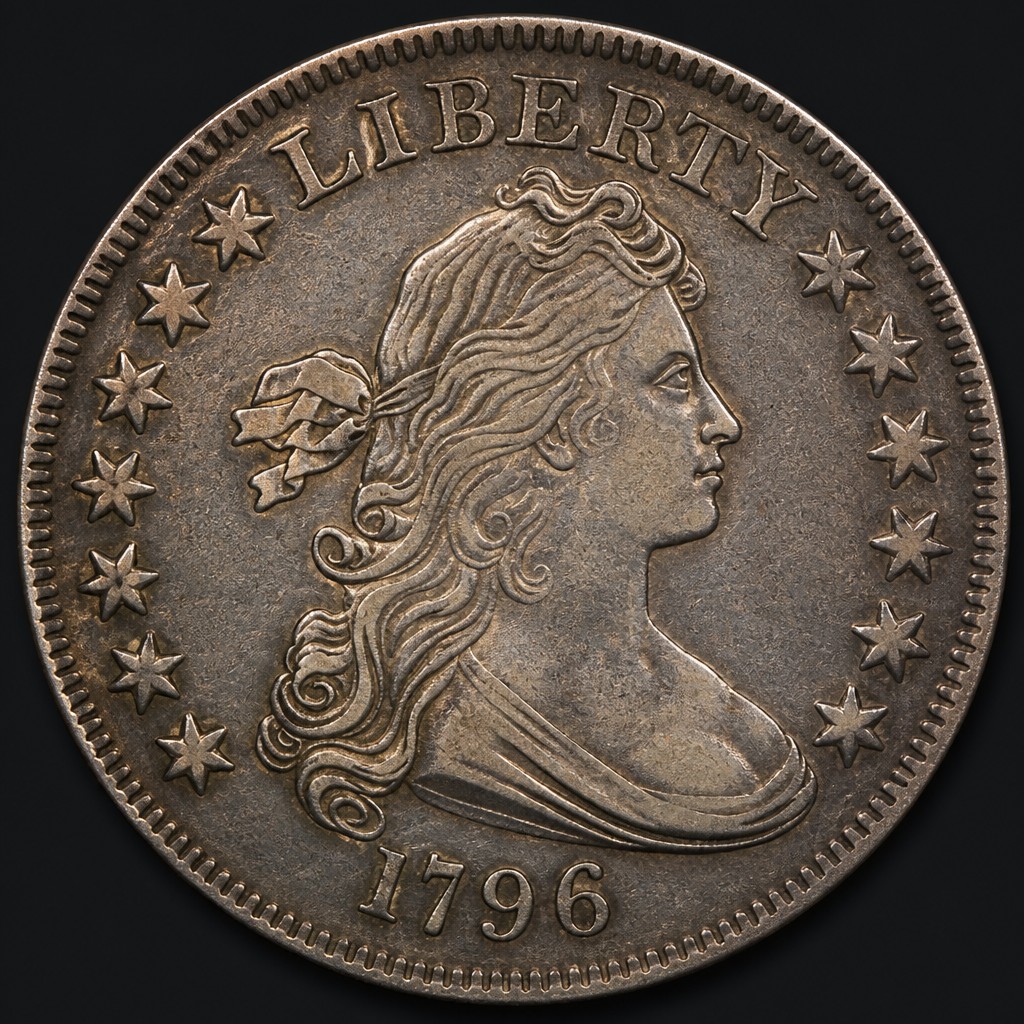
What It Is
Struck only in 1796, this coin was the very first quarter dollar issued by the United States Mint, designed by Robert Scot. No quarters were struck again until 1804, and even that later issue used a different reverse design, making the 1796 a true one-year type with a very small original mintage produced during the Mint's earliest years of operation.
Obverse Design
Liberty's draped bust faces right, her hair tied with a ribbon flowing behind her neck, with drapery visible across her shoulder. "LIBERTY" arcs above, the date is below, and stars flank the portrait, typically arranged with several on the left and the remainder on the right, reflecting the number of states in the union at the time the dies were made.
Reverse Design
This is the so-called "small eagle" reverse: a delicate, thin-bodied eagle perched on a cloud or branch, encircled by a wreath, with "UNITED STATES OF AMERICA" around the border. Notably, no denomination appears anywhere on the coin, since early United States quarters did not state their value in words or numerals.
Size, Weight, Metal & Edge
The coin is larger than a modern quarter, roughly 27.5mm in diameter, weighing about 6.74 grams, struck in an early Mint silver alloy of about 89.24% silver and 10.76% copper, with a reeded edge.
Mint Marks
There is no mint mark anywhere on the coin, since the Philadelphia Mint was the only mint in operation in 1796 and mint marks were not yet used on United States coinage.
Telling It Apart from Similar Coins
Compare the size and design carefully against other Draped Bust denominations, such as the half dollar or silver dollar, which are larger overall and carry somewhat different reverse details. Within quarters specifically, the "small eagle" reverse is unique to 1796, since when the denomination resumed in 1804 it used a different "heraldic eagle" reverse design that had by then been adopted across other silver denominations.
Judging Condition at a Glance
Because of the coin's age, wear assessment focuses on the definition remaining in Liberty's hair curls and drapery folds on the obverse, and on the eagle's feather and wing detail on the reverse. Even well-worn examples remain historically significant collector items simply due to the rarity of the type and its status as the first year of the denomination.
Authenticity Red Flags
This is one of the most replicated early American coin types given its value and historical importance as a first-year issue. Warning signs include an incorrect diameter or weight, cast-coin indicators such as pitting, seams, or a slightly grainy surface texture, overly soft or mushy design details consistent with a mold-made copy rather than a struck coin, and an incorrect star count or arrangement compared to documented genuine dies. Given the significance of any authentic example, third-party grading service verification is standard practice before any conclusions are drawn.
Frequently asked questions
What makes the 1796 quarter a one-year type?
No quarters were struck again until 1804, and that later issue used a different reverse design, making 1796 unique to its own year and design.
Does the 1796 quarter show its denomination anywhere?
No, early US quarters did not state a value on the coin; the denomination has to be inferred from size and design.
How big is the 1796 quarter compared to a modern quarter?
It is somewhat larger, at roughly 27.5mm in diameter versus 24.3mm for a modern quarter.
What are common signs of a fake or cast 1796 quarter?
Pitted or grainy surfaces, seam lines, soft or mushy design details, and incorrect diameter or weight compared to genuine struck examples.
What does the small eagle reverse look like?
A slender, thin-bodied eagle perched on a cloud or branch and surrounded by a wreath, distinct from the later, more robust heraldic eagle design.