
How to Identify the 1796 Draped Bust Dime
A guide to the first-year 1796 dime, its Draped Bust obverse and small eagle reverse, and the details collectors use to confirm genuine early examples.
Read the full 1796 Draped Bust Dime encyclopedia entry →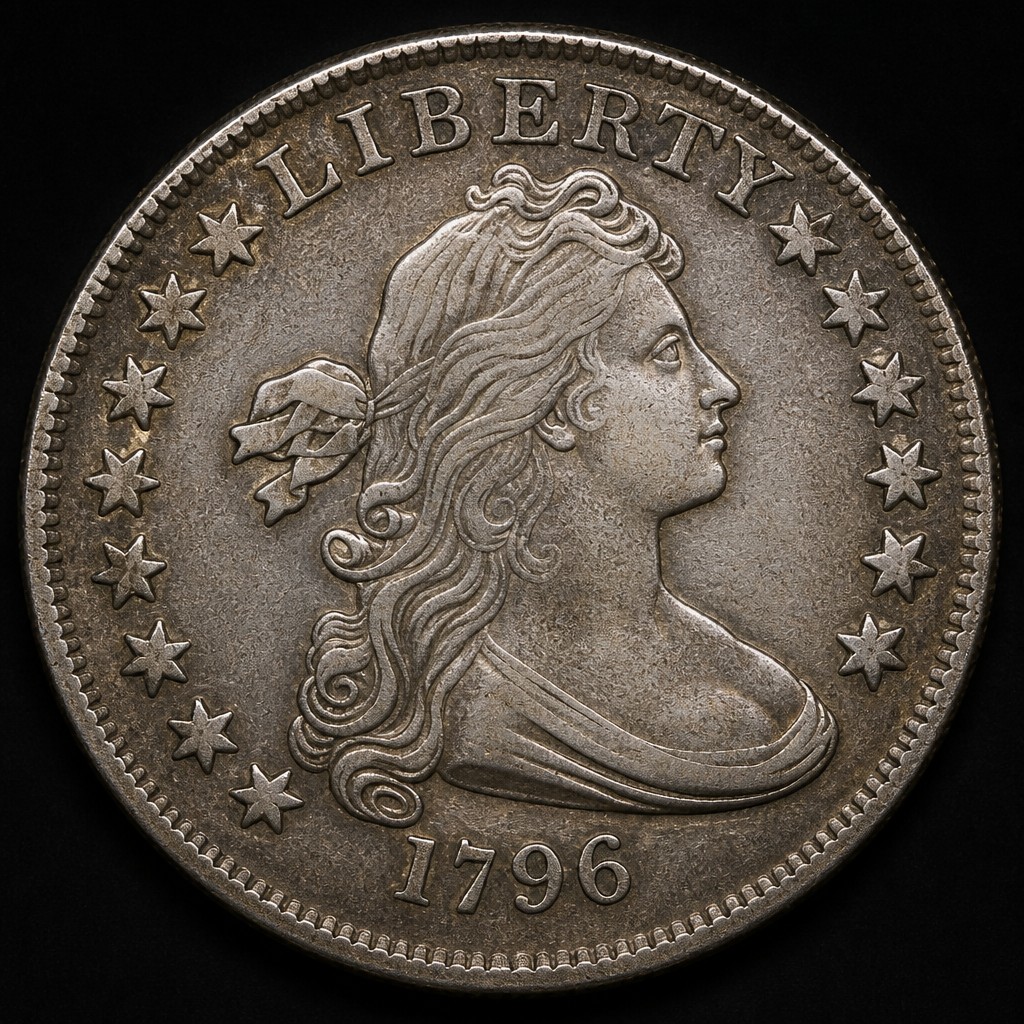
What It Is
The 1796 dime is the very first year of the dime denomination, authorized under the Coinage Act of 1792 and first struck four years later. It carries the Draped Bust obverse and the Small Eagle reverse, a design pairing used only in 1796 and 1797 before the eagle design changed, and it holds lasting significance to collectors as the debut issue of a denomination still produced today.
Obverse Design
Liberty faces right with hair tied back and drapery at the bust. LIBERTY arches above, the date sits below, and the border is ringed with 15 stars, matching the number of states in the Union at the time.
Reverse Design
The reverse shows a small, thin eagle with spread wings perched on a cloud, surrounded by a wreath, with UNITED STATES OF AMERICA around the border. As with other coinage of the period, no numeral value is printed on the coin, since size and design alone conveyed denomination.
Size, Weight, Metal, and Edge
The 1796 dime measures roughly 18.8mm across and weighs about 2.7 grams, in an alloy of approximately 89% silver, with a reeded edge and no edge lettering.
Mint Marks
There is no mint mark. The Philadelphia Mint was the sole producer of United States coinage at this time, and it remained the only mint striking dimes for several decades afterward.
Telling It Apart From Similar Coins
The Small Eagle reverse is the key identifying feature separating 1796-1797 dimes from the Heraldic Eagle reverse used from 1798 onward. Several die marriages are documented for 1796, distinguished by small differences in star spacing and letter placement, which specialists use to pinpoint exact varieties. Comparing the coin's diameter to a modern dime is also useful, since early dimes are slightly larger than today's coin despite sharing the same denomination.
Judging Condition at a Glance
Look for wear starting on Liberty's hair near the temple and on the drapery folds at the bust, along with the eagle's breast and wingtips on the reverse. As a first-year issue with a limited surviving population, most known examples show significant circulation wear, and coins with clear devices and a legible date are considered attractive for the grade, while sharply struck, well-centered pieces command particular attention from specialists.
Authenticity Red Flags
As a historically important first-year issue, the 1796 dime is a target for counterfeiters, particularly through casting. Genuine pieces should weigh close to 2.7 grams and measure about 18.8mm; check the edge for sharp, evenly spaced reeding rather than a seam or grainy texture that suggests a cast copy. Soft, indistinct lettering or a surface that looks artificially aged can also indicate a reproduction. Because of its significance and value, verification by a professional grading service is recommended before relying on any example as genuine, since a properly made cast copy can otherwise be difficult to distinguish from a genuine, well-worn coin.
Frequently asked questions
Why is the 1796 dime historically significant?
It is the first year the dime denomination was struck, following its authorization in the Coinage Act of 1792.
What reverse design does the 1796 dime use?
The Small Eagle reverse, showing a thin eagle perched on a cloud within a wreath; this design was used only in 1796 and 1797.
How many stars are on the 1796 dime's obverse?
Fifteen stars, representing the number of states in the Union at the time.
Does the 1796 dime have a mint mark?
No, it was struck only at the Philadelphia Mint, which used no mint mark.