
How to Identify the 1795 Liberty Cap Large Cent
A guide to identifying the 1795 large cent, covering its Liberty Cap design, the lettered-edge and plain-edge weight varieties, and signs of altered or reproduced examples.
Read the full 1795 Liberty Cap Large Cent encyclopedia entry →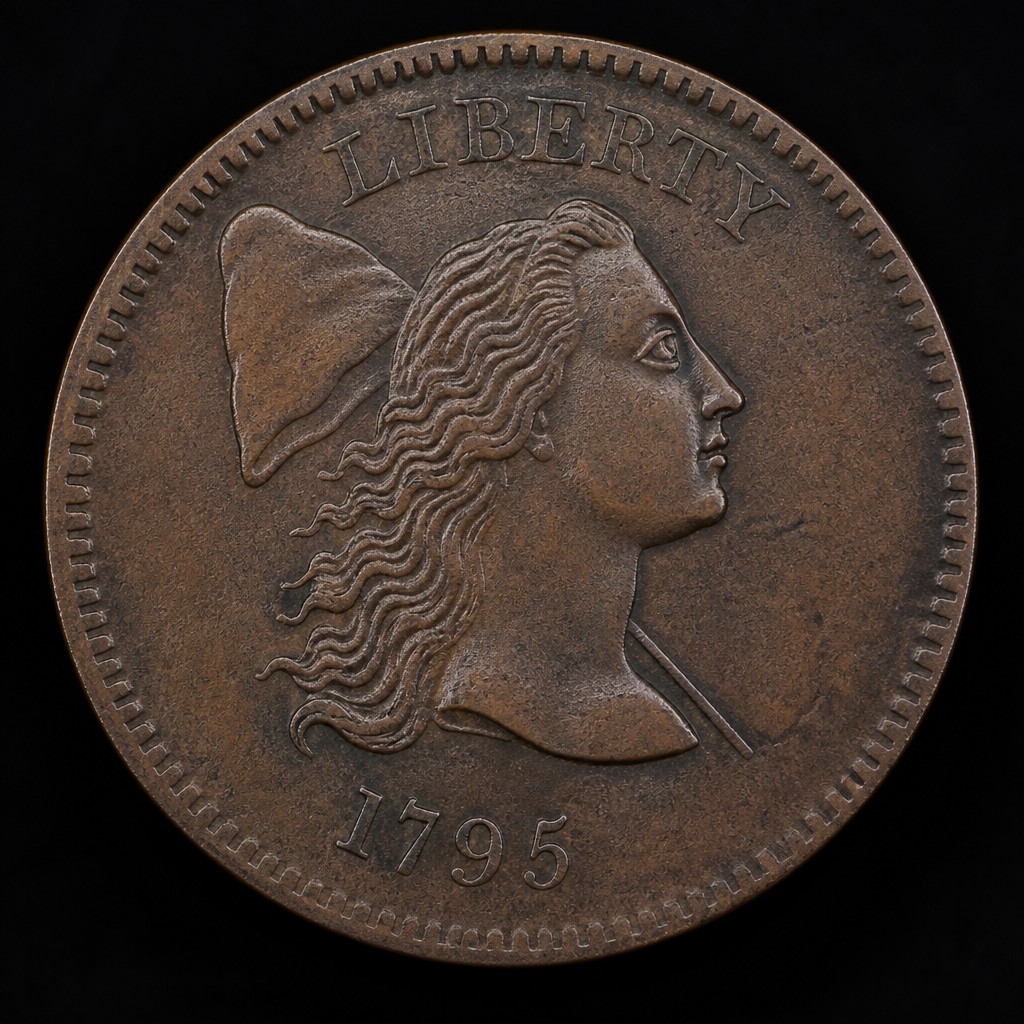
What It Is
The 1795 cent belongs to the Liberty Cap type of large cent, used from mid-1793 through 1796, an early U.S. copper coin roughly the size of a modern half dollar and among the first coins struck in quantity by the fledgling United States Mint in Philadelphia.
Obverse Design
Liberty faces right, wearing a soft cap mounted on a pole positioned behind her head and shoulder, a classical symbol of freedom borrowed from ancient Roman imagery. "LIBERTY" arches above her portrait, with the date placed below her bust near the rim.
Reverse Design
A wreath, generally described as laurel, encircles the denomination "ONE CENT" and the fraction "1/100," with "UNITED STATES OF AMERICA" running around the outer border of the coin.
Size, Weight, and Metal
Struck in pure copper. 1795 cents exist in two distinct weight and edge varieties, reflecting a change in the legal weight standard that Congress ordered partway through the year: earlier, heavier pieces weigh about 13.5 grams and often carry a lettered edge reading "ONE HUNDRED FOR A DOLLAR," while later, lighter pieces weigh about 10.9 grams and typically have a plain edge instead. Diameter is roughly 29 mm across for both varieties.
Mint Marks
None; all early U.S. coins of this era were struck exclusively at the single Philadelphia Mint, since no branch mints yet existed.
Telling It Apart From Similar Coins
Distinguish 1795 from other Liberty Cap years (1793-1796) primarily by the date itself, but also note the die-variety differences in lettering size, letter spacing, and minor design details that specialists use to attribute specific die pairs within the year. The edge type, lettered versus plain, combined with the coin's weight, helps identify which specific 1795 variety a given example represents.
Judging Condition
Large cents of this era are graded largely by the sharpness of Liberty's hair curls and cap, the legibility of the lettering around both sides, and the definition of the leaves in the reverse wreath. Because these coins circulated heavily for decades and are now well over two centuries old, most survivors show significant wear, corrosion, or old cleaning, and sharp, original surfaces are relatively scarce and valued highly by specialists.
Authenticity Red Flags
Early large cents sometimes show re-engraved or "sharpened" worn dates, or artificial surface treatments meant to disguise corrosion pitting or porosity in the copper. Look for unnatural sharpness confined only to the date numerals while the rest of the coin shows heavy wear, tool marks around the digits, or a surface texture that looks smoothed, waxy, or otherwise inconsistent with the natural, uneven wear expected on a genuinely circulated 18th-century copper coin.
Frequently asked questions
Why do some 1795 cents have lettered edges and others don't?
The legal weight standard changed mid-year; heavier early coins often have a lettered edge, lighter later coins a plain edge.
How heavy is a genuine 1795 cent?
About 13.5 grams for the heavier lettered-edge variety, or about 10.9 grams for the lighter plain-edge variety.
Did the 1795 cent have a mint mark?
No, all early U.S. coins were struck only at the Philadelphia Mint, which used no mint marks.
What are signs of a reproduction?
A grainy or pitted surface, seam lines, or soft, mushy design details instead of sharp struck lines.